







Question: Suppose M is a 10 3 matrix (i.e., M R03). Let A be the matrix consisting of the first and second columns of M
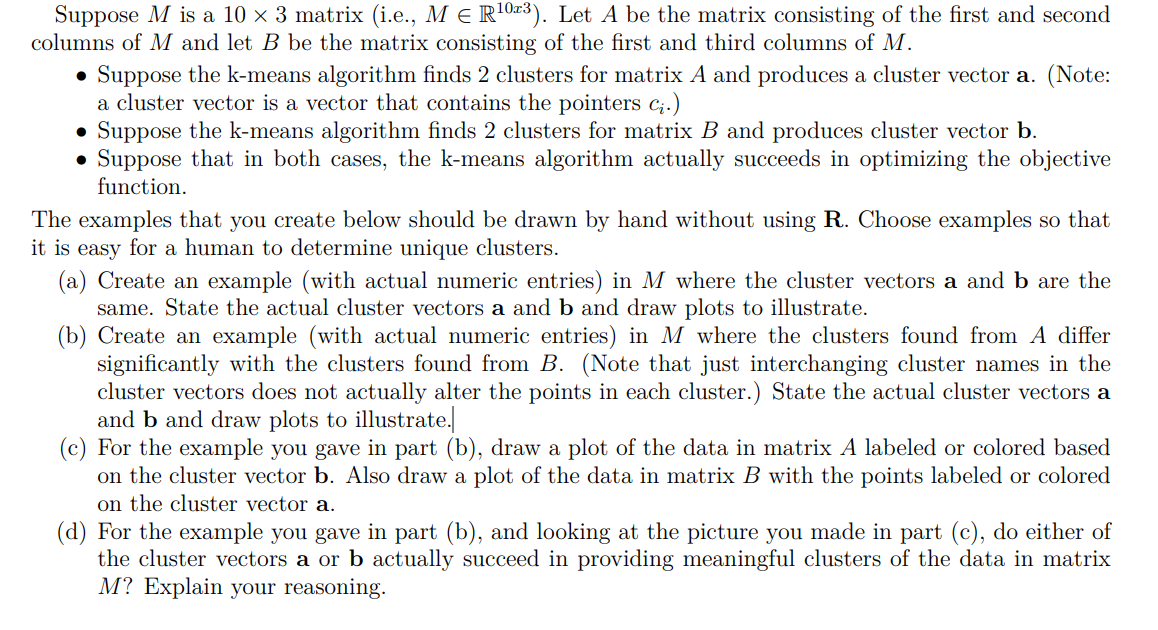
Suppose M is a 10 3 matrix (i.e., M R03). Let A be the matrix consisting of the first and second columns of M and let B be the matrix consisting of the first and third columns of M. Suppose the k-means algorithm finds 2 clusters for matrix A and produces a cluster vector a. (Note: a cluster vector is a vector that contains the pointers c.) Suppose the k-means algorithm finds 2 clusters for matrix B and produces cluster vector b. Suppose that in both cases, the k-means algorithm actually succeeds in optimizing the objective function. The examples that you create below should be drawn by hand without using R. Choose examples so that it is easy for a human to determine unique clusters. (a) Create an example (with actual numeric entries) in M where the cluster vectors a and b are the same. State the actual cluster vectors a and b and draw plots to illustrate. (b) Create an example (with actual numeric entries) in M where the clusters found from A differ significantly with the clusters found from B. (Note that just interchanging cluster names in the cluster vectors does not actually alter the points in each cluster.) State the actual cluster vectors a and b and draw plots to illustrate. (c) For the example you gave in part (b), draw a plot of the data in matrix A labeled or colored based on the cluster vector b. Also draw a plot of the data in matrix B with the points labeled or colored on the cluster vector a. (d) For the example you gave in part (b), and looking at the picture you made in part (c), do either of the cluster vectors a or b actually succeed in providing meaningful clusters of the data in matrix M? Explain your reasoning.
Step by Step Solution
There are 3 Steps involved in it

Get step-by-step solutions from verified subject matter experts
 Study Help