







Question: Suppose stock returns can be explained by the following three-factor model: R; = Rp + B1F1 + B2F2 - B3F3 Assume there is no firm-specific
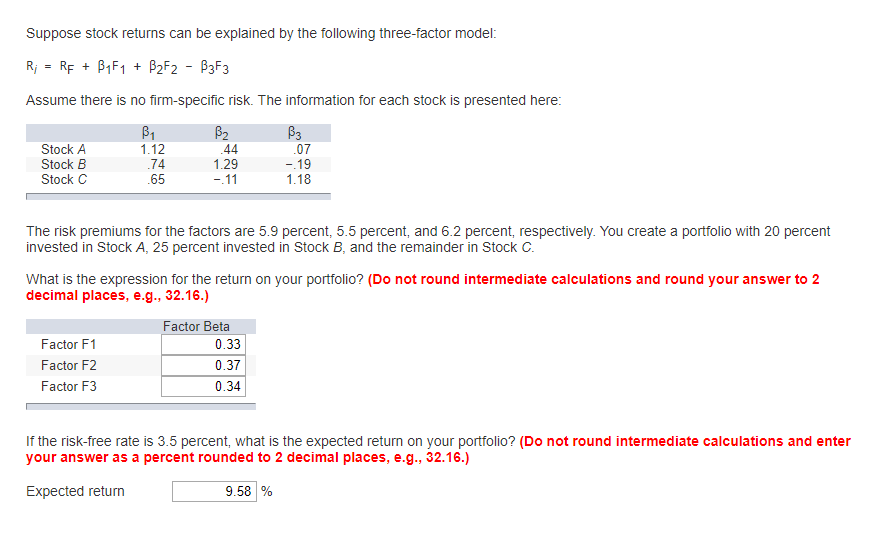
Suppose stock returns can be explained by the following three-factor model: R; = Rp + B1F1 + B2F2 - B3F3 Assume there is no firm-specific risk. The information for each stock is presented here: B1 1.12 B2 44 Stock A Stock B Stock C .74 1.29 B3 07 -19 1.18 .65 -11 The risk premiums for the factors are 5.9 percent, 5.5 percent, and 6.2 percent, respectively. You create a portfolio with 20 percent invested in Stock A, 25 percent invested in Stock B, and the remainder in Stock C. What is the expression for the return on your portfolio? (Do not round intermediate calculations and round your answer to 2 decimal places, e.g., 32.16.) Factor F1 Factor F2 Factor F3 Factor Beta 0.33 0.37 0.34 If the risk-free rate is 3.5 percent, what is the expected return on your portfolio? (Do not round intermediate calculations and enter your answer as a percent rounded to 2 decimal places, e.g., 32.16.) Expected return 9.58 %
Step by Step Solution
There are 3 Steps involved in it

Get step-by-step solutions from verified subject matter experts
 Study Help