







Question: Suppose that a truth table with n variables is specified. A compound proposition can be constructed from this truth table by taking the disjunction of
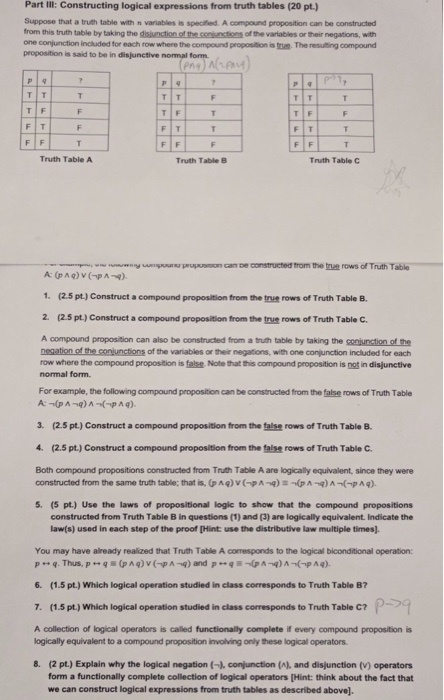
Suppose that a truth table with n variables is specified. A compound proposition can be constructed from this truth table by taking the disjunction of the conjunctions of the variables or their negations, with one conjunction included for each row where the compound proposition is true. The resulting compound proposition is said to be in disjunctive normal form. Construct a compound proposition from the true rows of Truth Table B. Construct a compound proposition from the true rows of Truth Table C. A compound proposition can also be constructed from a truth table by taking the conjunction of the negation of the conjunctions of the variables or their negations, with one conjunction included for each row where the compound proposition is false. Note that this compound proposition is not in disjunctive normal form. For example, the following compound proposition can be constructed from the false rows of Truth Table A: (p logicaland q) logicaland (p logicaland q). Construct a compound proposition from the false rows of Truth Table B. Construct a compound proposition from the false rows of Truth Table C. Both compound propositions constructed from Truth Table A are logically equivalent, since they were constructed from the same truth table: that is, (p logicaland q) logicalor (p logicaland q) identical (p logicaland q) logicaland (p logicaland q). Use the laws of propositional logic to show that the compound propositions constructed from Truth Table B in questions (1) and (3) are logically equivalent. Indicate the law(s) used in each step of the proof You may have already realized that Truth Table A corresponds to the logical biconditional operation: p doubleheadarrow q. Thus, p doubleheadarrow q identical (p logicaland q) logicalor (p logicaland q) and p doubleheadarrow q identical (p logicaland q) logicaland (p logicaland q). Which logical operation studied in class corresponds to Truth Table B? Which logical operation studied in class corresponds to Truth Table C? A collection of logical operators is called functionally complete if every compound proposition is logically equivalent to a compound proposition involving only these logical operators. Explain why the logical negation (), conjunction (logicaland), and disjunction (logicalor) operators form a functionally complete collection of logical operators
Step by Step Solution
There are 3 Steps involved in it

Get step-by-step solutions from verified subject matter experts
 Study Help