



Question: Suppose that machine Ml in Problem 12 costs $10,000 and M2 costs $15,000. If you ran program 1 on machines M1 and M2, clearly M2
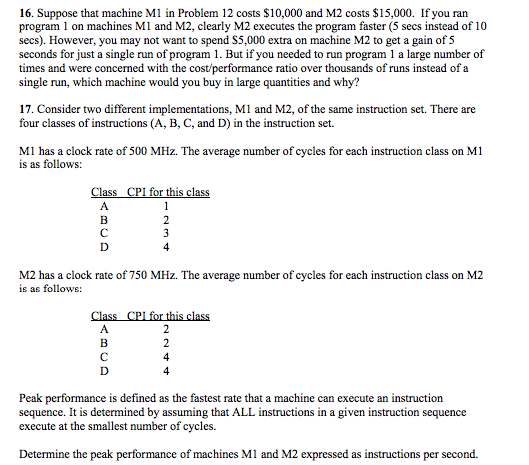
Suppose that machine Ml in Problem 12 costs $10,000 and M2 costs $15,000. If you ran program 1 on machines M1 and M2, clearly M2 executes the program faster (5 secs instead of 10 secs). However, you may not want to spend $5.000 extra on machine M2 to get a gain of 5 seconds for just a single run of program 1. But if you needed to run program 1 a large number of times and were concerned with the cost/performance ratio over thousands of runs instead of a single run, which machine would you buy in large quantities and why? Consider two different implementations, Ml and M2, of the same instruction set. There are four classes of instructions (A, B, C, and D) in the instruction set. Ml has a clock rate of 500 MHz. The average number of cycles for each instruction class on Ml is as follows: M2 has a clock rate of 750 MHz. The average number of cycles for each instruction class on M2 ie ae follows: Peak performance is defined as the fastest rate that a machine can execute an instruction sequence. It is determined by assuming that ALL instructions in a given instruction sequence execute at the smallest number of cycles. Determine the peak performance of machines Ml and M2 expressed as instructions per second
Step by Step Solution
There are 3 Steps involved in it

Get step-by-step solutions from verified subject matter experts