



Question: Suppose that the driver has to pay a flat fine equal to F dollars. If she is caught speeding, then her income in that state
Suppose that the driver has to pay a flat fine equal to F dollars. If she is caught speeding, then her income in that state is given by: IC = I ?F and, consequently, the lottery she faces is given by: LF = [I,I ?F; 1 ??,?] .
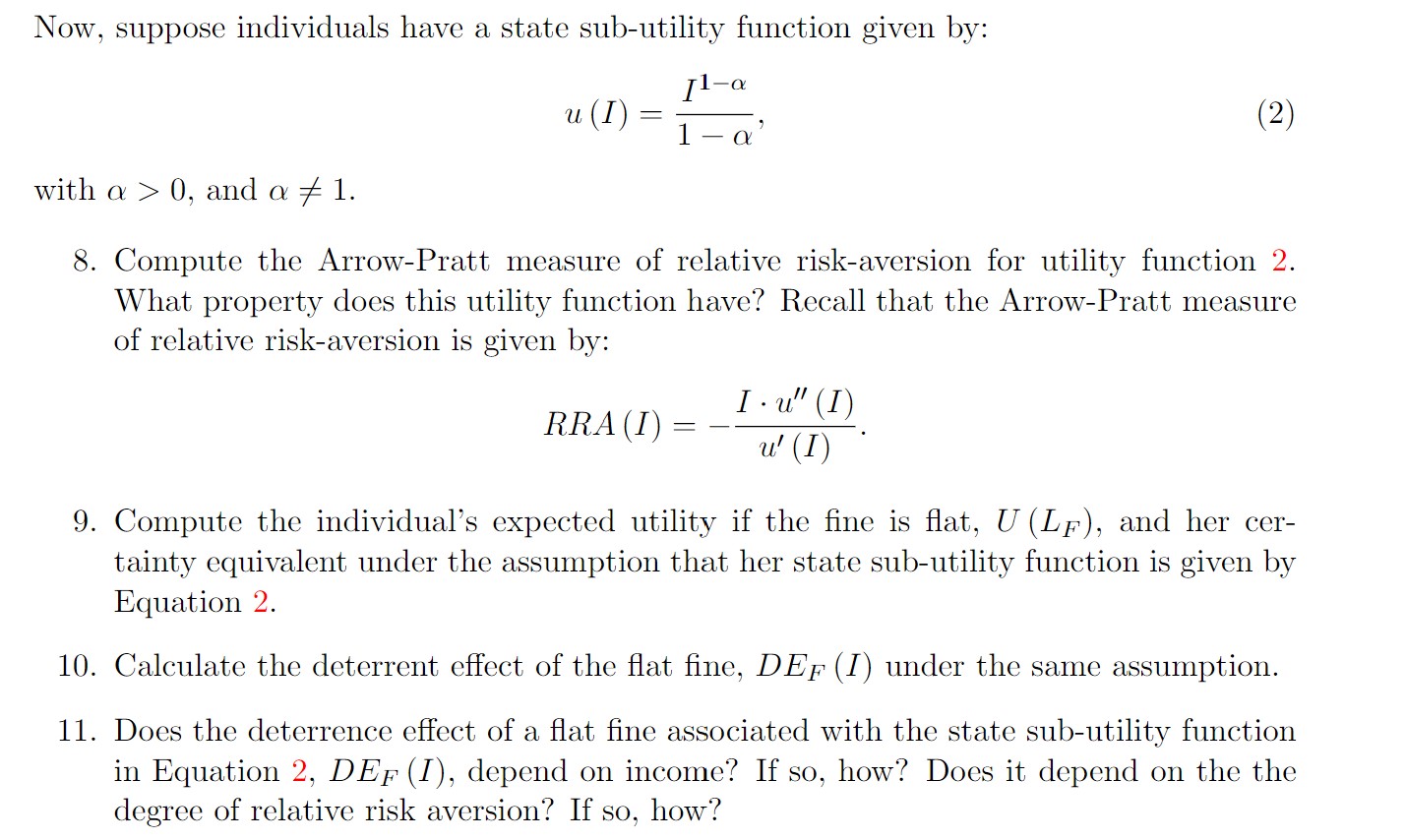
Now, suppose individuals have a state sub-utility function given by: Ila MI) = , (2) 1oe witha>0, andagl. 8. 10. 11. Compute the ArrowPratt measure of relative riskaversion for utility function 2. What property does this utility function have? Recall that the ArrowPratt measure of relative riskaversion is given by: I-u\"(I) RRAU) = _ u'U) . Compute the individual's expected utility if the ne is flat, U (LF), and her cer tainty equivalent under the assumption that her state subutility function is given by Equation 2. Calculate the deterrent effect of the flat fine, DEF (I ) under the same assumption. Does the deterrence effect of a flat ne associated with the state subutility function in Equation 2, DEF (I), depend on income? If so, how? Does it depend on the the degree of relative risk aversion? If so, how
Step by Step Solution
There are 3 Steps involved in it

Get step-by-step solutions from verified subject matter experts