



Question: Suppose that the true regression model that generates an outcome Y is given by Y = X1 +X2+ E, but instead I regress Y against
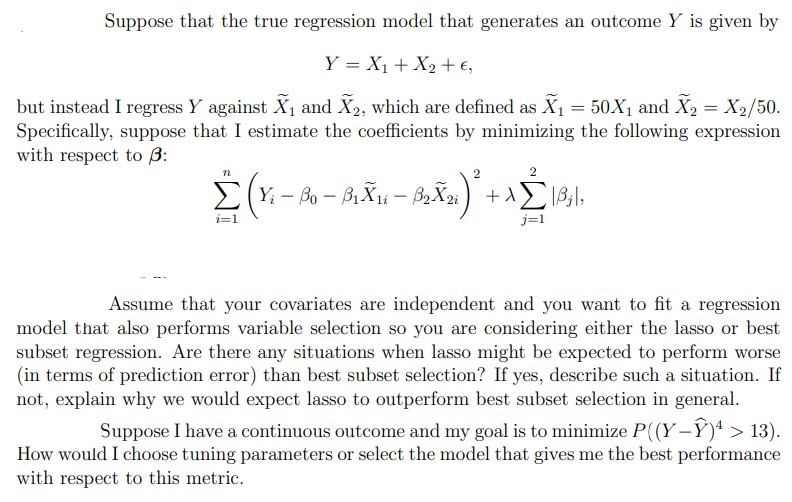
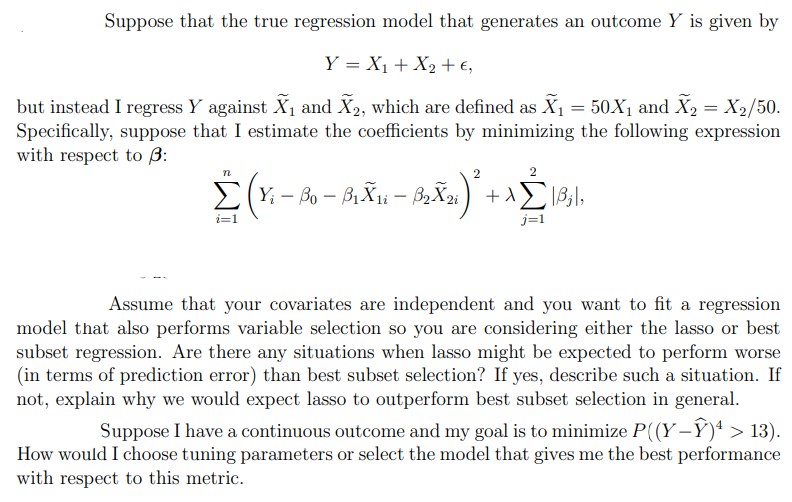
Suppose that the true regression model that generates an outcome Y is given by Y = X1 +X2+ E, but instead I regress Y against X, and X2, which are defined as X1 = 50X, and X2 = X2/50. Specifically, suppose that I estimate the coefficients by minimizing the following expression with respect to 3: n 2 2 E ( Vi - Bo - BIXli - B2X2i) + > CIB;1, i=1 j=1 Assume that your covariates are independent and you want to fit a regression model that also performs variable selection so you are considering either the lasso or best subset regression. Are there any situations when lasso might be expected to perform worse (in terms of prediction error) than best subset selection? If yes, describe such a situation. If not, explain why we would expect lasso to outperform best subset selection in general. Suppose I have a continuous outcome and my goal is to minimize P( (Y -Y)4 > 13). How would I choose tuning parameters or select the model that gives me the best performance with respect to this metric
Step by Step Solution
There are 3 Steps involved in it

Get step-by-step solutions from verified subject matter experts