



Question: The Governor of the state of New York is considering raising TANF benefits for single mothers with two or more children. The public shows
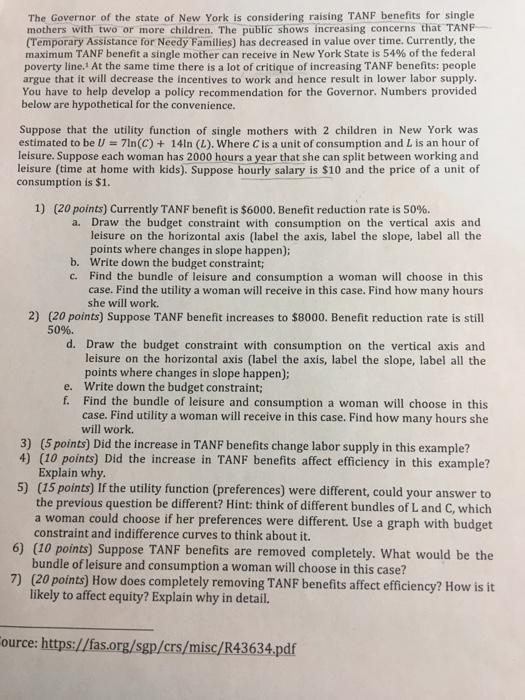
The Governor of the state of New York is considering raising TANF benefits for single mothers with two or more children. The public shows increasing concerns that TANF (Temporary Assistance for Needy Families) has decreased in value over time. Currently, the maximum TANF benefit a single mother can receive in New York State is 54% of the federal poverty line. At the same time there is a lot of critique of increasing TANF benefits: people. argue that it will decrease the incentives to work and hence result in lower labor supply. You have to help develop a policy recommendation for the Governor. Numbers provided below are hypothetical for the convenience. Suppose that the utility function of single mothers with 2 children in New York was estimated to be U = 7in(C) + 14in (L). Where C is a unit of consumption and L is an hour of leisure. Suppose each woman has 2000 hours a year that she can split between working and leisure (time at home with kids). Suppose hourly salary is $10 and the price of a unit of consumption is $1. 1) (20 points) Currently TANF benefit is $6000. Benefit reduction rate is 50%. a. Draw the budget constraint with consumption on the vertical axis and leisure on the horizontal axis (label the axis, label the slope, label all the points where changes in slope happen); b. Write down the budget constraint; c. Find the bundle of leisure and consumption a woman will choose in this case. Find the utility a woman will receive in this case. Find how many hours she will work. 2) (20 points) Suppose TANF benefit increases to $8000. Benefit reduction rate is still 50%. d. Draw the budget constraint with consumption on the vertical axis and leisure on the horizontal axis (label the axis, label the slope, label all the points where changes in slope happen); Write down the budget constraint; Find the bundle of leisure and consumption a woman will choose in this case. Find utility a woman will receive in this case. Find how many hours she will work. e. f. 3) (5 points) Did the increase in TANF benefits change labor supply in this example? 4) (10 points) Did the increase in TANF benefits affect efficiency in this example? Explain why. 5) (15 points) If the utility function (preferences) were different, could your answer to the previous question be different? Hint: think of different bundles of L and C, which a woman could choose if her preferences were different. Use a graph with budget constraint and indifference curves to think about it. 6) (10 points) Suppose TANF benefits are removed completely. What would be the bundle of leisure and consumption a woman will choose in this case? 7) (20 points) How does completely removing TANF benefits affect efficiency? How is it likely to affect equity? Explain why in detail. Fource: https://fas.org/sgp/crs/misc/R43634.pdf
Step by Step Solution
3.36 Rating (162 Votes )
There are 3 Steps involved in it
1 20 points Currently TANF benefit is 6000 Benefit reduction rate is 50 a Draw the budget constraint with consumption on the vertical axis and leisure on the horizontal axis label the axis label the s... View full answer

Get step-by-step solutions from verified subject matter experts