





Question: Suppose that we don't include an intercept term in our model. That is. our model is now simply if = we. where T is the
Suppose that we don't include an intercept term
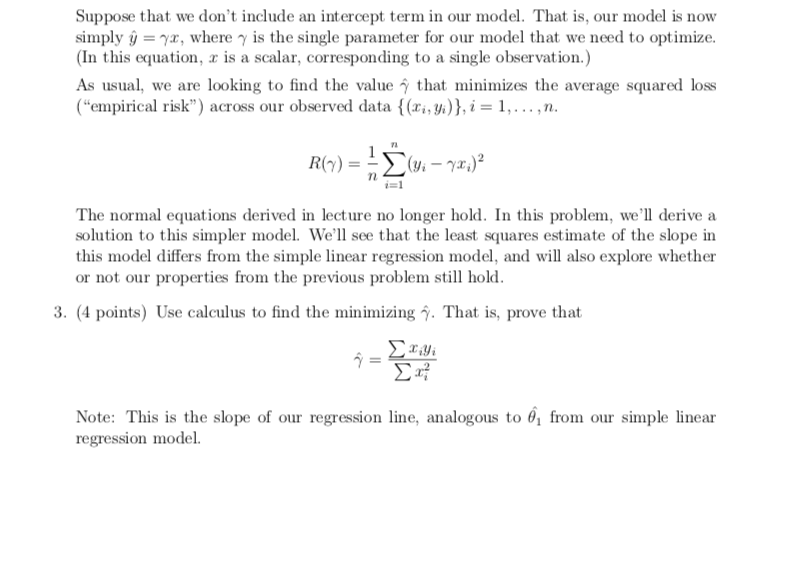
Suppose that we don't include an intercept term in our model. That is. our model is now simply if = we. where \"T is the single parameter for our model that we need to optimize. (In this equation. a: is a scalar. corresponding to a single observation.) As usual. we are looking to nd the value c} that minimizes the average squared loss (\"empirical risk\") across our observed data {[er..y.-)}.i = 1.. . . .n. Riv} = xin- van-i2 i=1 The normal equations derived in lecture no longer hold. In this problem. we'll derive a solution to this simpler model. We'll see that the least squares estimate of the slope in this model differs from the simple linear regression model. and will also explore whether or not our properties from the previous problem still hold. . (4 points) Use calculus to nd the minimizing c}. That is. prove that =z;miyi Es? Note: This is the slope of our regression line. analogous to 51 from our simple linear regression model

Step by Step Solution

There are 3 Steps involved in it

1 Expert Approved Answer
Step: 1 Unlock blur-text-image

Question Has Been Solved by an Expert!

Get step-by-step solutions from verified subject matter experts

Step: 2 Unlock
Step: 3 Unlock

Students Have Also Explored These Related Mathematics Questions!