







Question: Suppose that we have a system using multi-level queuing. Specifically, there are two queues and each queue has its own scheduling algorithms: Queue A
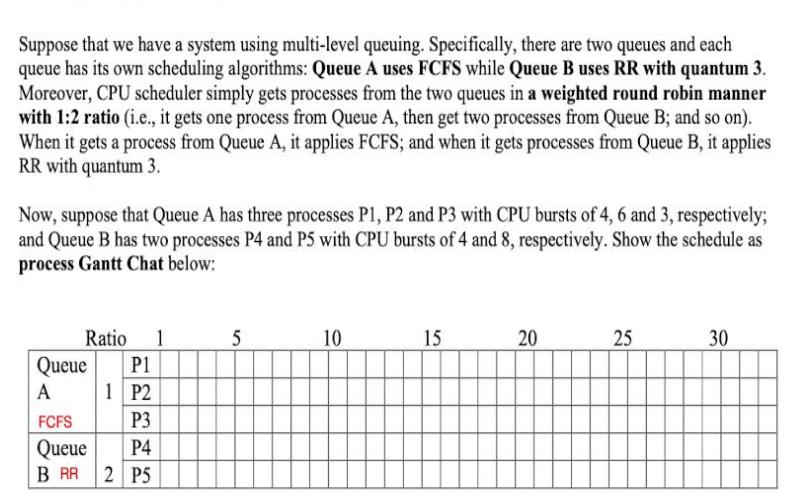
Suppose that we have a system using multi-level queuing. Specifically, there are two queues and each queue has its own scheduling algorithms: Queue A uses FCFS while Queue B uses RR with quantum 3. Moreover, CPU scheduler simply gets processes from the two queues in a weighted round robin manner with 1:2 ratio (i.e., it gets one process from Queue A, then get two processes from Queue B; and so on). When it gets a process from Queue A, it applies FCFS; and when it gets processes from Queue B, it applies RR with quantum 3. Now, suppose that Queue A has three processes P1, P2 and P3 with CPU bursts of 4, 6 and 3, respectively; and Queue B has two processes P4 and P5 with CPU bursts of 4 and 8, respectively. Show the schedule as process Gantt Chat below: Ratio 1 | P1 1 P2 P3 P4 Queue A FCFS Queue BRR 2 P5 5 10 15 20 25 30
Step by Step Solution
There are 3 Steps involved in it
A multilevel queueing system is a way of organizing processes into different queues based on some cr... View full answer

Get step-by-step solutions from verified subject matter experts
 Study Help