







Question: Suppose that we need to send four packets (A, B, C, D) from a sender to a receiver. Consider two cases. 1) packet B is
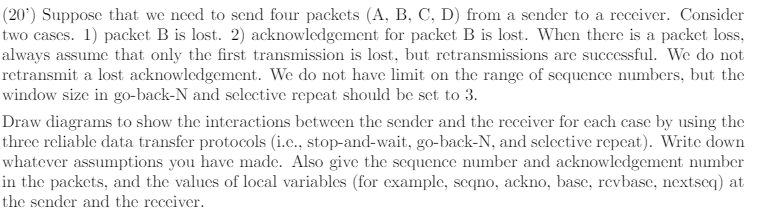
Suppose that we need to send four packets (A, B, C, D) from a sender to a receiver. Consider two cases. 1) packet B is lost. 2 acknowledgement for packet B is lost. When there is a packet loss, always assume that only the first transmission is lost, but retransmissions are successful. We do not retransmit a lost acknowledgement. We do not have limit on the range of sequence numbers, but the window size in go-back-N and selective repeat should be set to 3. Draw diagrams to show the interactions between the sender and the receiver for each case by using the three reliable data transfer protocols (i.c., stop-and-wait, go-back-N, and selective repeat). Write down whatever assumptions you have made. Also give the sequence number and acknowledgement number in the packets, and the values of local variables (for example, seqno, ackno, base, rcvbase, nextseq) at the sender and the receiver
Step by Step Solution
There are 3 Steps involved in it

Get step-by-step solutions from verified subject matter experts
 Study Help