







Question: Suppose that x is a binomial random variable with n = 5, p = 0.33, and q = .67. (b) For each value of x,
Suppose thatxis a binomial random variable withn= 5,p= 0.33, andq= .67.
(b)For each value of x, calculate p(x).(Round final answers to 4 decimal places.)
p(0) =,p(1) =,p(2) =,p(3) =
p(4) =,p(5) =
(c)FindP(x= 3).(Round final answer to 4 decimal places.)
P(x=3)=
(d)FindP(x? 3).(Do not round intermediate calculations. Round final answer to 4 decimal places.)
P(x? 3)=
(e)FindP(x(Do not round intermediate calculations.Round final answer to 4 decimal places.)
P(xP(x? 2)=
(f)FindP(x? 4).(Do not round intermediate calculations.Round final answer to 4 decimal places.)
P(x? 4)=
(g)FindP(x> 2).(Do not round intermediate calculations. Round final answer to 4 decimal places.)
P(x> 2)=
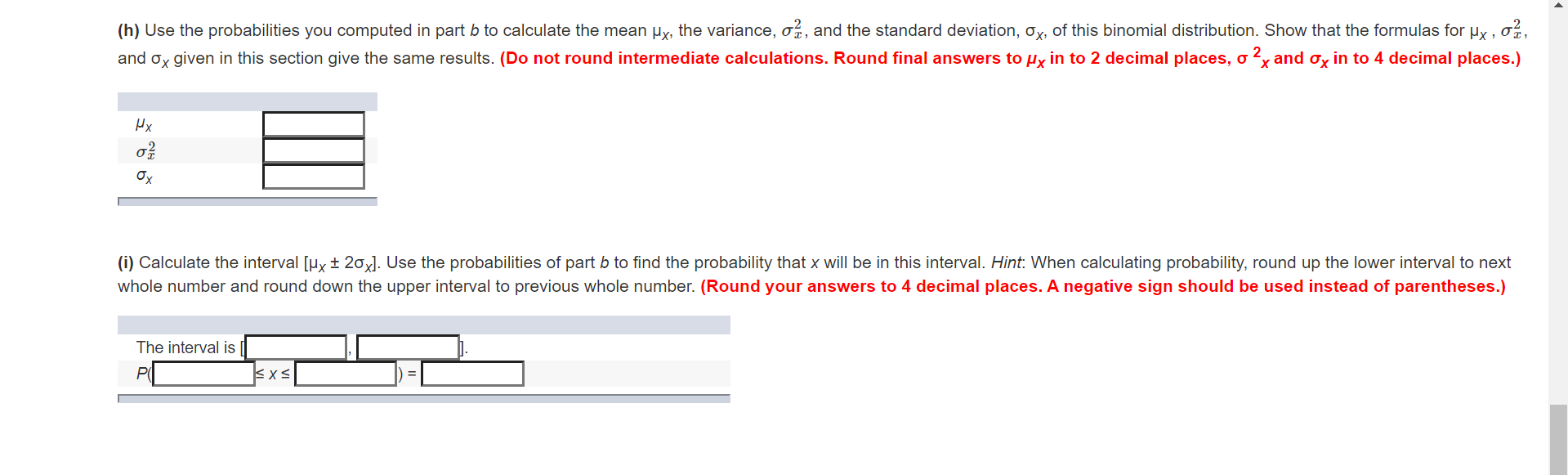
(h) Use the probabilities you computed in part b to calculate the mean [1,, the variance, 0%, and the standard deviation, o'x, of this binomial distribution. Show that the formulas for \"X , 0%, and ox given in this section give the same results. (Do not round intermediate calculations. Round final answers to p, in to 2 decimal places, 0 2x and 0', in to 4 decimal places.) (i) Calculate the interval [px t 20x]. Use the probabilities of part b to nd the probability that xwill be in this interval. Hint: When calculating probability, round up the lower interval to next whole number and round down the upper interval to previous whole number. (Round your answers to 4 decimal places. A negative sign should be used instead of parentheses.) The interval is , . P( x5 )= '
Step by Step Solution
There are 3 Steps involved in it

Get step-by-step solutions from verified subject matter experts
 Study Help