



Question: Suppose the following normal form game. X y X a, 0,0 Player 1 Y 0,0 6,6 The value of a is either 10 or

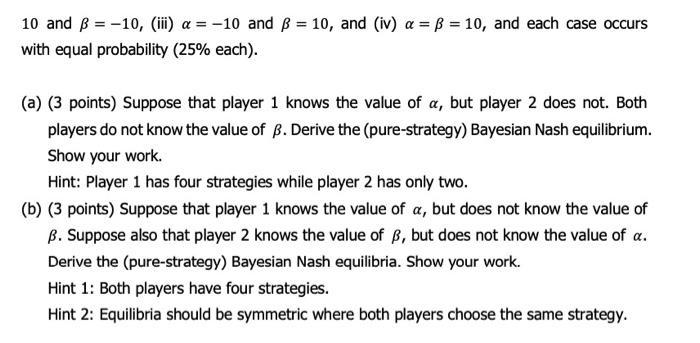
Suppose the following normal form game. X y X a, 0,0 Player 1 Y 0,0 6,6 The value of a is either 10 or -10 with equal probability (50% each), and the value of is also either 10 or -10 with equal probability. The values of these two parameters are independently decided. Therefore, there are four possible cases, (i) a = B = 10, (ii) a = Player 2 10 and B = -10, (iii) a = -10 and B = 10, and (iv) a = = 10, and each case occurs with equal probability (25% each). (a) (3 points) Suppose that player 1 knows the value of a, but player 2 does not. Both players do not know the value of . Derive the (pure-strategy) Bayesian Nash equilibrium. Show your work. Hint: Player 1 has four strategies while player 2 has only two. (b) (3 points) Suppose that player 1 knows the value of a, but does not know the value of B. Suppose also that player 2 knows the value of , but does not know the value of a. Derive the (pure-strategy) Bayesian Nash equilibria. Show your work. Hint 1: Both players have four strategies. Hint 2: Equilibria should be symmetric where both players choose the same strategy.
Step by Step Solution
3.51 Rating (164 Votes )
There are 3 Steps involved in it
a If player 1 knows the value of a then they will always choose x10 an... View full answer

Get step-by-step solutions from verified subject matter experts