







Question: Suppose there is a polynomial p(x) = (x p) (x - e)(x ) where is the golden ratio, e is the natural exponential base,
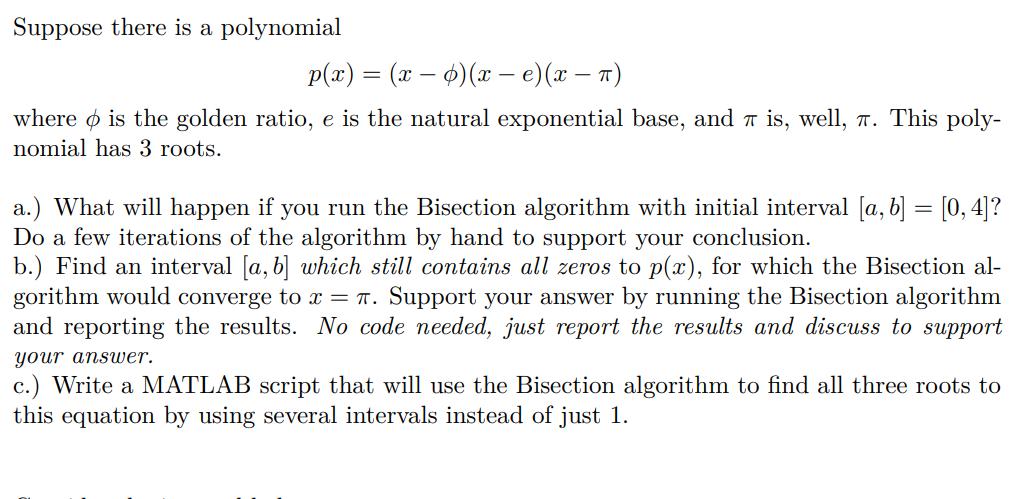
Suppose there is a polynomial p(x) = (x p) (x - e)(x ) where is the golden ratio, e is the natural exponential base, and is, well, . This poly- nomial has 3 roots. a.) What will happen if you run the Bisection algorithm with initial interval [a, b] = [0, 4]? Do a few iterations of the algorithm by hand to support your conclusion. b.) Find an interval [a, b] which still contains all zeros to p(x), for which the Bisection al- gorithm would converge to x = T. Support your answer by running the Bisection algorithm and reporting the results. No code needed, just report the results and discuss to support your answer. c.) Write a MATLAB script that will use the Bisection algorithm to find all three roots to this equation by using several intervals instead of just 1.
Step by Step Solution
3.45 Rating (158 Votes )
There are 3 Steps involved in it
a If we run the Bisection algorithm with initial interval a b 04 it will not converge to any of the three roots of the polynomial We can see this by o... View full answer

Get step-by-step solutions from verified subject matter experts
 Study Help