







Question: Suppose users A and B exchange message P in a public-key system (like RSA) using the following protocol: A signs P using A's private key,
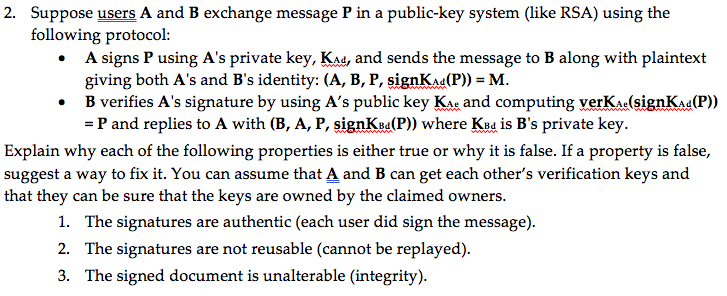
Suppose users A and B exchange message P in a public-key system (like RSA) using the following protocol: A signs P using A's private key, K_ad, and sends the message to B along with plaintext giving both A's and B's identity: (A, B, P, sign K_Ad(P)) = M. B verifies A's signature by using A's public key K_ac and computing verK_Ac(signK_Ad(P)) = P and replies to A with (B, A, P, signK_Bj(P)) where K_bj is B's private key. Explain why each of the following properties is either true or why it is false. If a property is false, suggest a way to fix it. You can assume that A and B can get each other's verification keys and that they can be sure that the keys are owned by the claimed owners. The signatures are authentic (each user did sign the message). The signatures are not reusable (cannot be replayed). The signed document is unalterable (integrity)
Step by Step Solution
There are 3 Steps involved in it

Get step-by-step solutions from verified subject matter experts
 Study Help