







Question: Suppose we are given an array A that contains n distinct integers. Our goal is to find a nice pivot A[m] that has the following
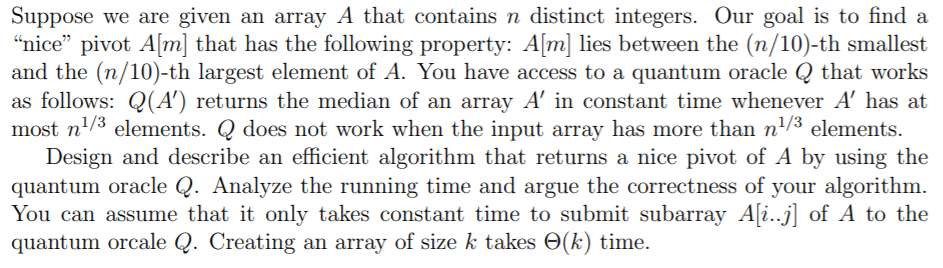
Suppose we are given an array A that contains n distinct integers. Our goal is to find a nice pivot A[m] that has the following property: A[m] lies between the (n/10)-th smallest and the (n/10)-th largest element of A. You have access to a quantum oracle Q that works as follows: Q(A) returns the median of an array A' in constant time whenever A' has at most n1/3 elements. Q does not work when the input array has more than n1/3 elements. Design and describe an efficient algorithm that returns a nice pivot of A by using the quantum oracle Q. Analyze the running time and argue the correctness of your algorithm. You can assume that it only takes constant time to submit subarray A[i..j] of A to the quantum orcale Q. Creating an array of size k takes O(k) time. Suppose we are given an array A that contains n distinct integers. Our goal is to find a nice pivot A[m] that has the following property: A[m] lies between the (n/10)-th smallest and the (n/10)-th largest element of A. You have access to a quantum oracle Q that works as follows: Q(A) returns the median of an array A' in constant time whenever A' has at most n1/3 elements. Q does not work when the input array has more than n1/3 elements. Design and describe an efficient algorithm that returns a nice pivot of A by using the quantum oracle Q. Analyze the running time and argue the correctness of your algorithm. You can assume that it only takes constant time to submit subarray A[i..j] of A to the quantum orcale Q. Creating an array of size k takes O(k) time
Step by Step Solution
There are 3 Steps involved in it

Get step-by-step solutions from verified subject matter experts
 Study Help