



Question: Suppose we develop a certain test to detect the presence of a disease D, and one which outputs a test result to be positive
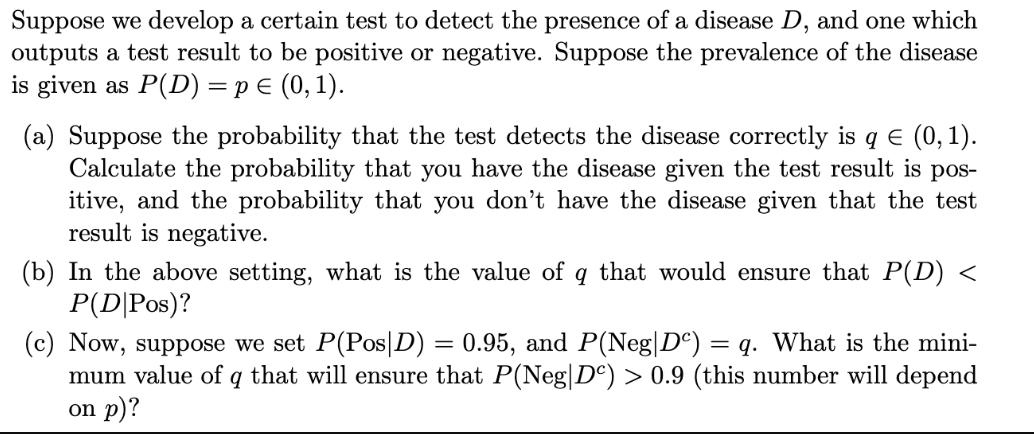
Suppose we develop a certain test to detect the presence of a disease D, and one which outputs a test result to be positive or negative. Suppose the prevalence of the disease is given as P(D) = p = (0, 1). (a) Suppose the probability that the test detects the disease correctly is q (0, 1). Calculate the probability that you have the disease given the test result is pos- itive, and the probability that you don't have the disease given that the test result is negative. (b) In the above setting, what is the value of q that would ensure that P(D) < P(D|Pos)? (c) Now, suppose we set P(Pos|D) 0.95, and P(Neg|D) = q. What is the mini- mum value of q that will ensure that P(Neg|Dc) > 0.9 (this number will depend on p)?
Step by Step Solution
There are 3 Steps involved in it

Get step-by-step solutions from verified subject matter experts