







Question: Suppose we have a function f defined by the power series f(x) = ) ak(x - a)k on its interval of convergence I. It turns
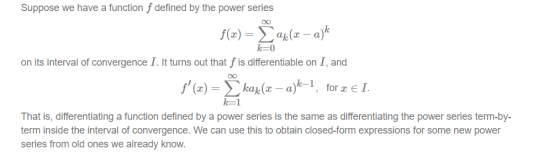
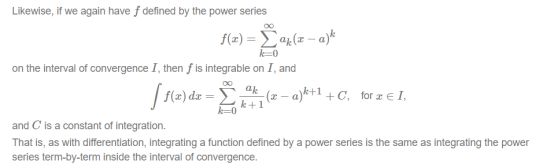
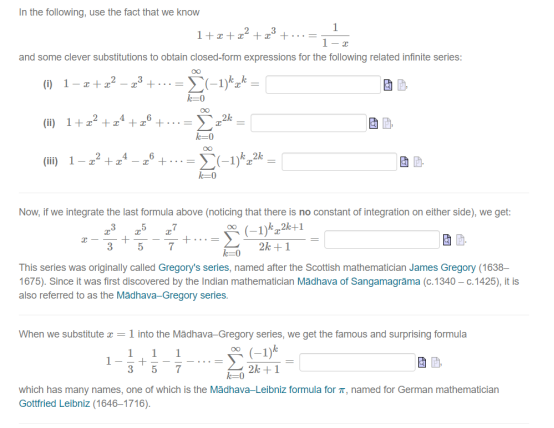
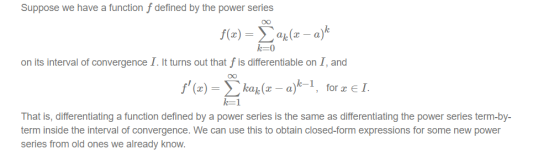
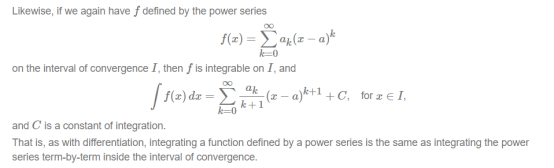
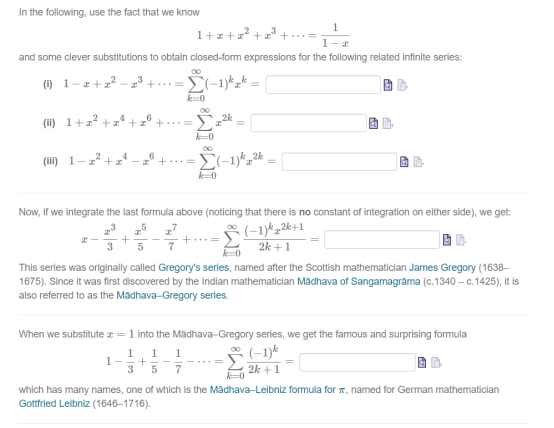
Suppose we have a function f defined by the power series f(x) = ) ak(x - a)k on its interval of convergence I. It turns out that f is differentiable on I, and f'(z) = >kak(x - a) , for z EI. That is, differentiating a function defined by a power series is the same as differentiating the power series term-by- term inside the interval of convergence. We can use this to obtain closed-form expressions for some new power series from old ones we already know.Likewise, if we again have f defined by the power series f(z) = Ek(x - a)k on the interval of convergence I, then f is integrable on ], and f(z) da = > k+1 (x - a)*+1 + C, for zel, and C is a constant of integration. That Is, as with differentiation, Integrating a function defined by a power series is the same as Integrating the power series term-by-term inside the interval of convergence.In the following, use the fact that we know and some clever substitutions to obtain closed-form expressions for the following related infinite series: 00 ()) 1-2+-8+=)(1= Now, if we integrate the last formula above (noticing that there is no constant of integration on either side), we get: 3 5 (-1)* 124+1 2k + 1 = This series was originally called Gregory's series, named after the Scottish mathematician James Gregory (1638- 1675). Since It was first discovered by the Indian mathematician Madhava of Sangamagrama (c.1340 - c.1425), It is also referred to as the Madhava-Gregory series. When we substitute x = 1 into the Madhava-Gregory series, we get the famous and surprising formula (-1)k 2k + 1 which has many names, one of which is the Madhava-Leibniz formula for x, named for German mathematician Gottfried Leibniz (1646-1716)
Step by Step Solution
There are 3 Steps involved in it

Get step-by-step solutions from verified subject matter experts
 Study Help