







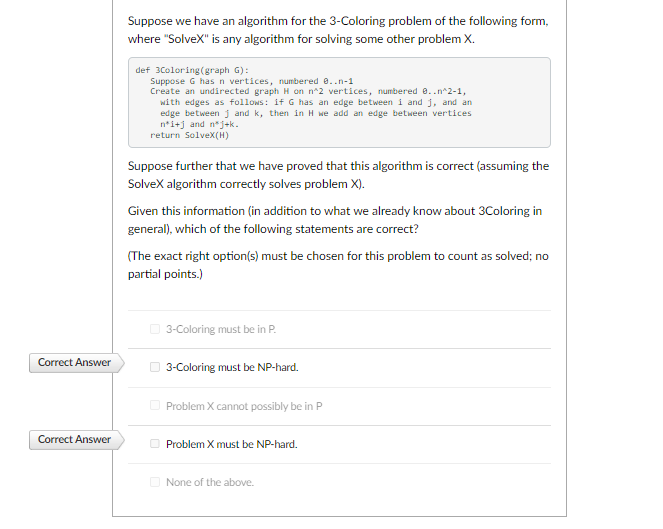
Question: Suppose we have an algorithm for the 3 - Coloring problem of the following form, where SolveX is any algorithm for solving some other problem
Suppose we have an algorithm for the Coloring problem of the following form,
where "SolveX" is any algorithm for solving some other problem X
Suppose further that we have proved that this algorithm is correct assuming the
SolveX algorithm correctly solves problem
Given this information in addition to what we already know about Coloring in
general which of the following statements are correct?
The exact right options must be chosen for this problem to count as solved; no
partial points.
Coloring must be in
Coloring must be NPhard.
Problem cannot possibly be in
Problem X must be NPhard.
None of the above.
Can you explain why we chose these alternative, and what I need to think of when I encounter like this problem in order to solve it
Step by Step Solution
There are 3 Steps involved in it
1 Expert Approved Answer
Step: 1 Unlock

Question Has Been Solved by an Expert!
Get step-by-step solutions from verified subject matter experts
Step: 2 Unlock
Step: 3 Unlock
 Study Help