







Question: Suppose you have a function defined by T(n) = log2 (1) + log2(2) + + log2(n). Your job on this Exercise is to find a
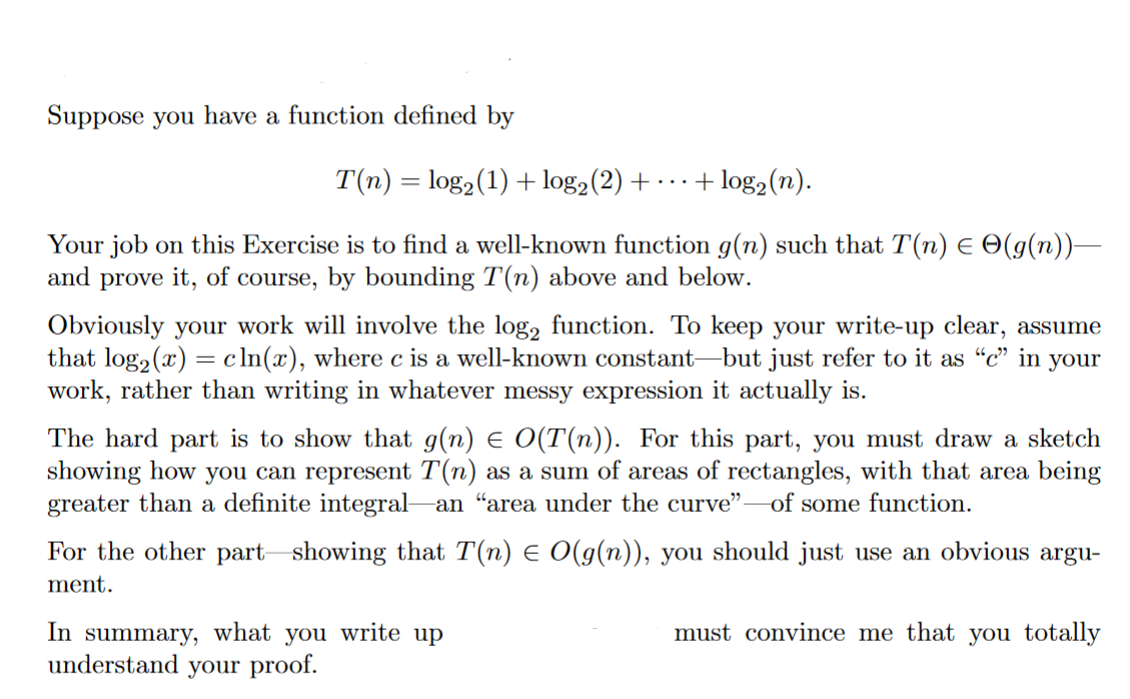
Suppose you have a function defined by T(n) = log2 (1) + log2(2) + + log2(n). Your job on this Exercise is to find a well-known function g(n) such that T(n) E O(g(n)) and prove it, of course, by bounding T(n) above and below. Obviously your work will involve the log, function. To keep your write-up clear, assume that log2(x) = c ln(x), where c is a well-known constantbut just refer to it as c in your work, rather than writing in whatever messy expression it actually is. The hard part is to show that g(n) E O(T(n)). For this part, you must draw a sketch showing how you can represent T(n) as a sum of areas of rectangles, with that area being greater than a definite integralan area under the curve of some function. For the other part showing that T(n) O(g(n)), you should just use an obvious argu- ment. must convince me that you totally In summary, what you write up understand your proof
Step by Step Solution
There are 3 Steps involved in it

Get step-by-step solutions from verified subject matter experts
 Study Help