



Question: Supreme Court Case: Gideon v. Wainwright Please do not use AI Chat GPT!!! Please follow this exact form below. Thank you in advance!!! Autosave D
Supreme Court Case: Gideon v. Wainwright
Please do not use AI Chat GPT!!!
Please follow this exact form below. Thank you in advance!!!
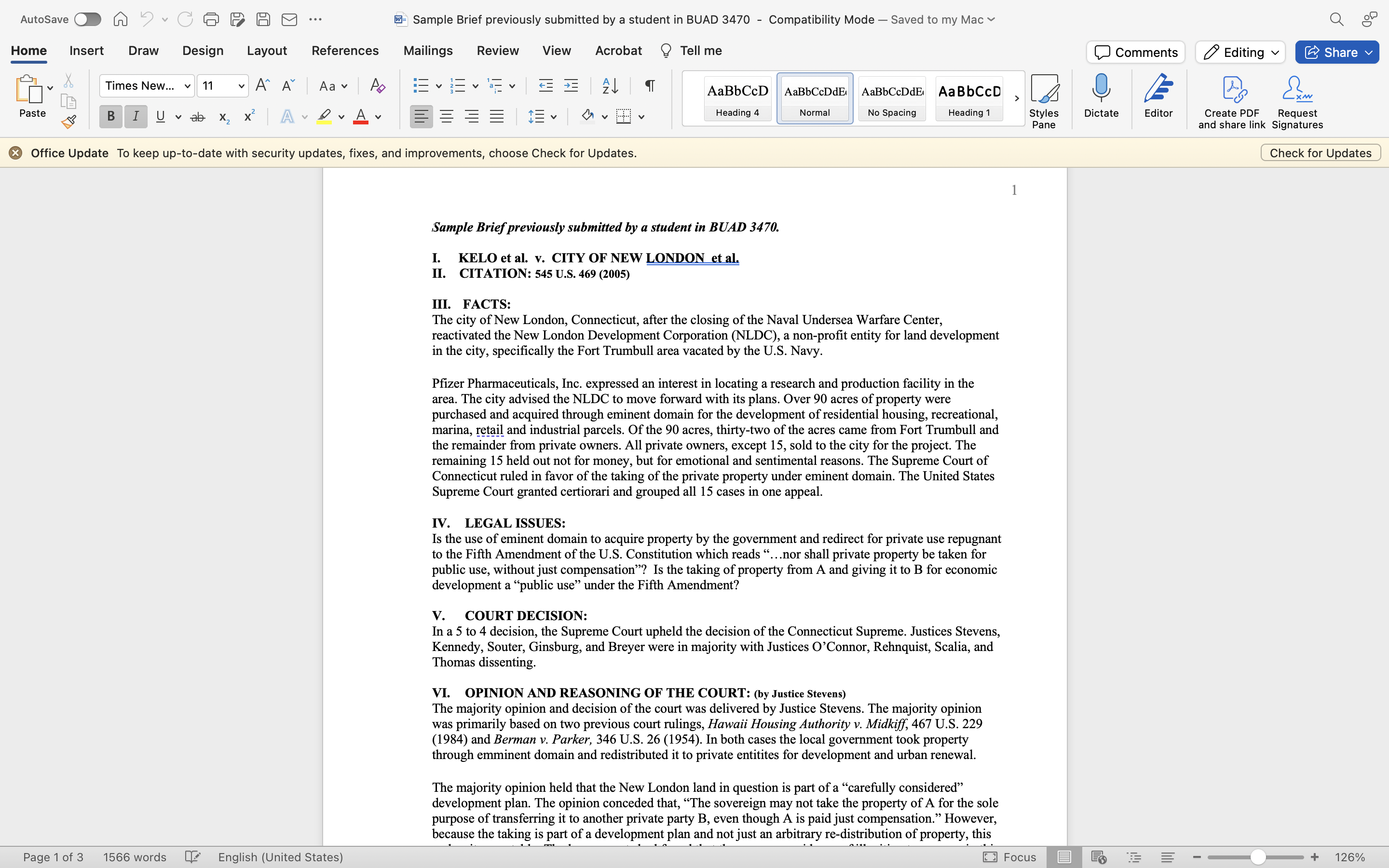
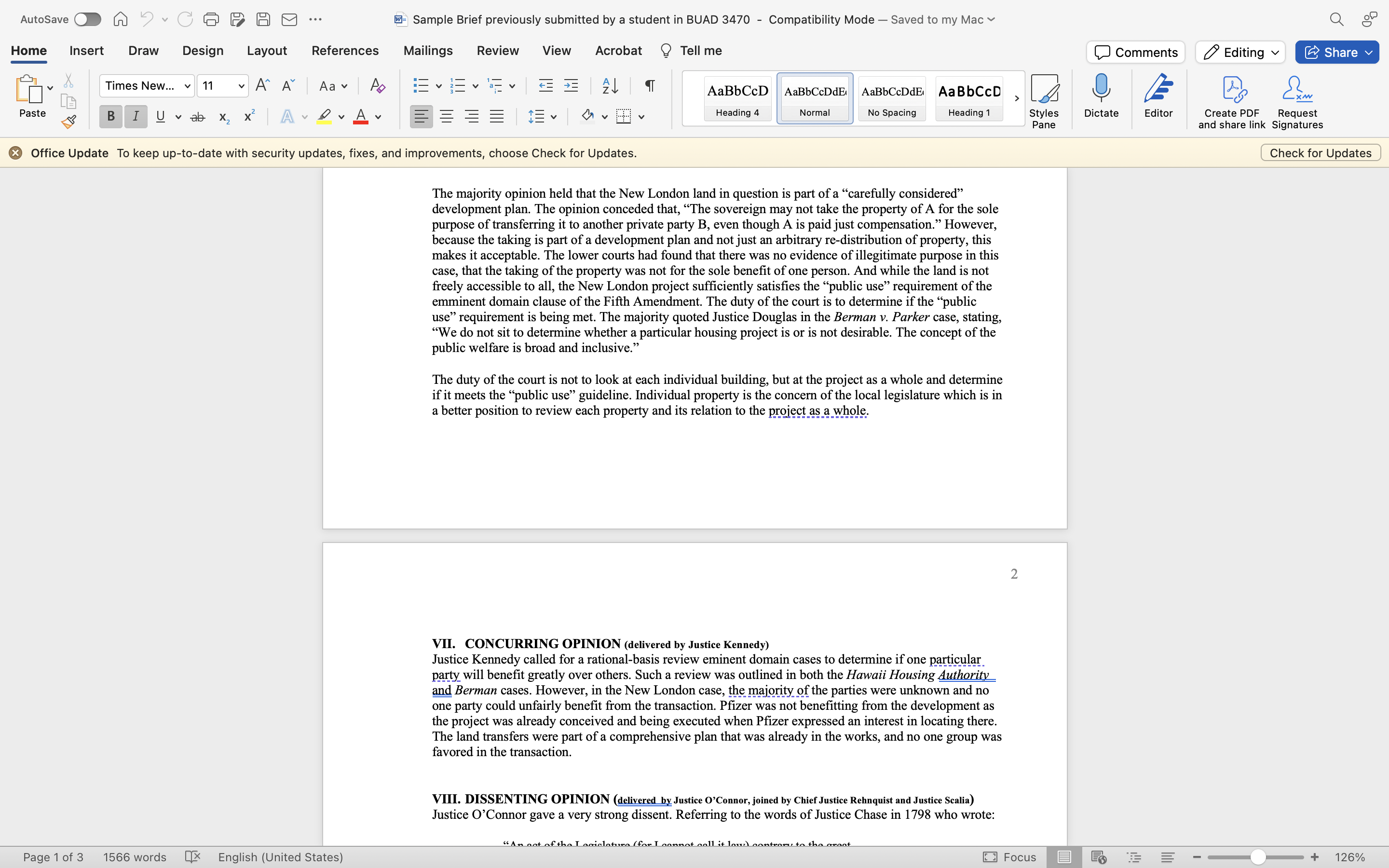
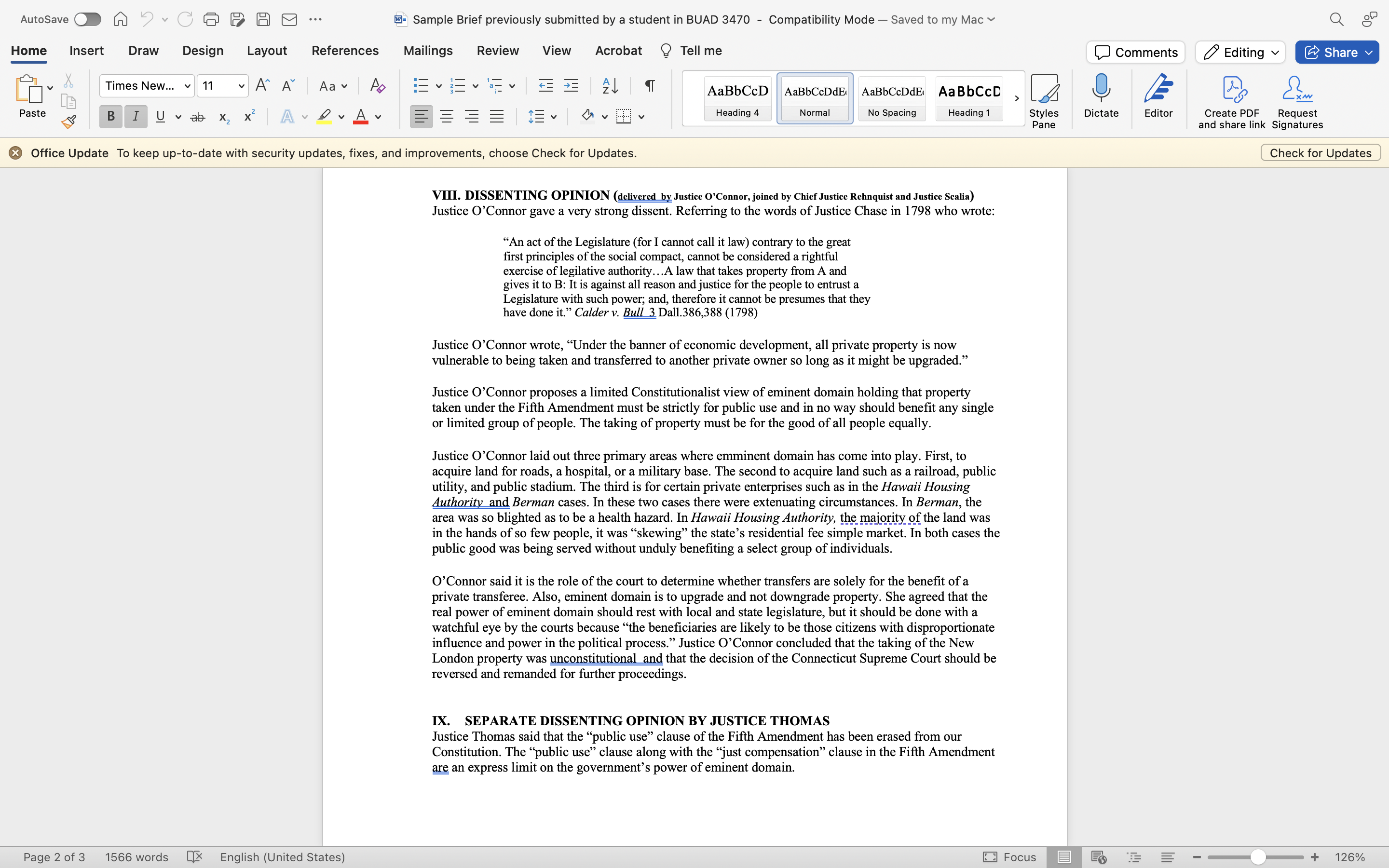
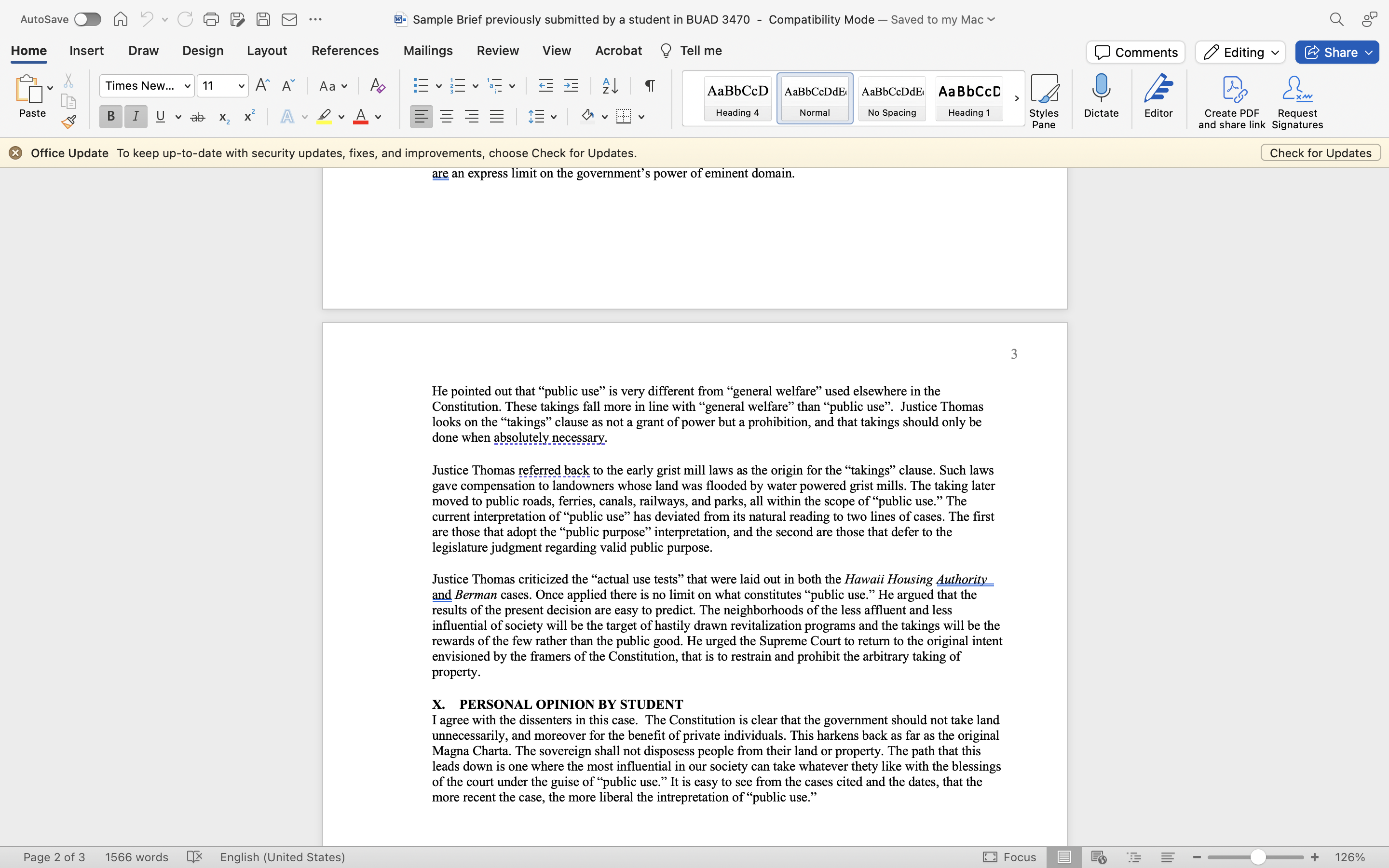
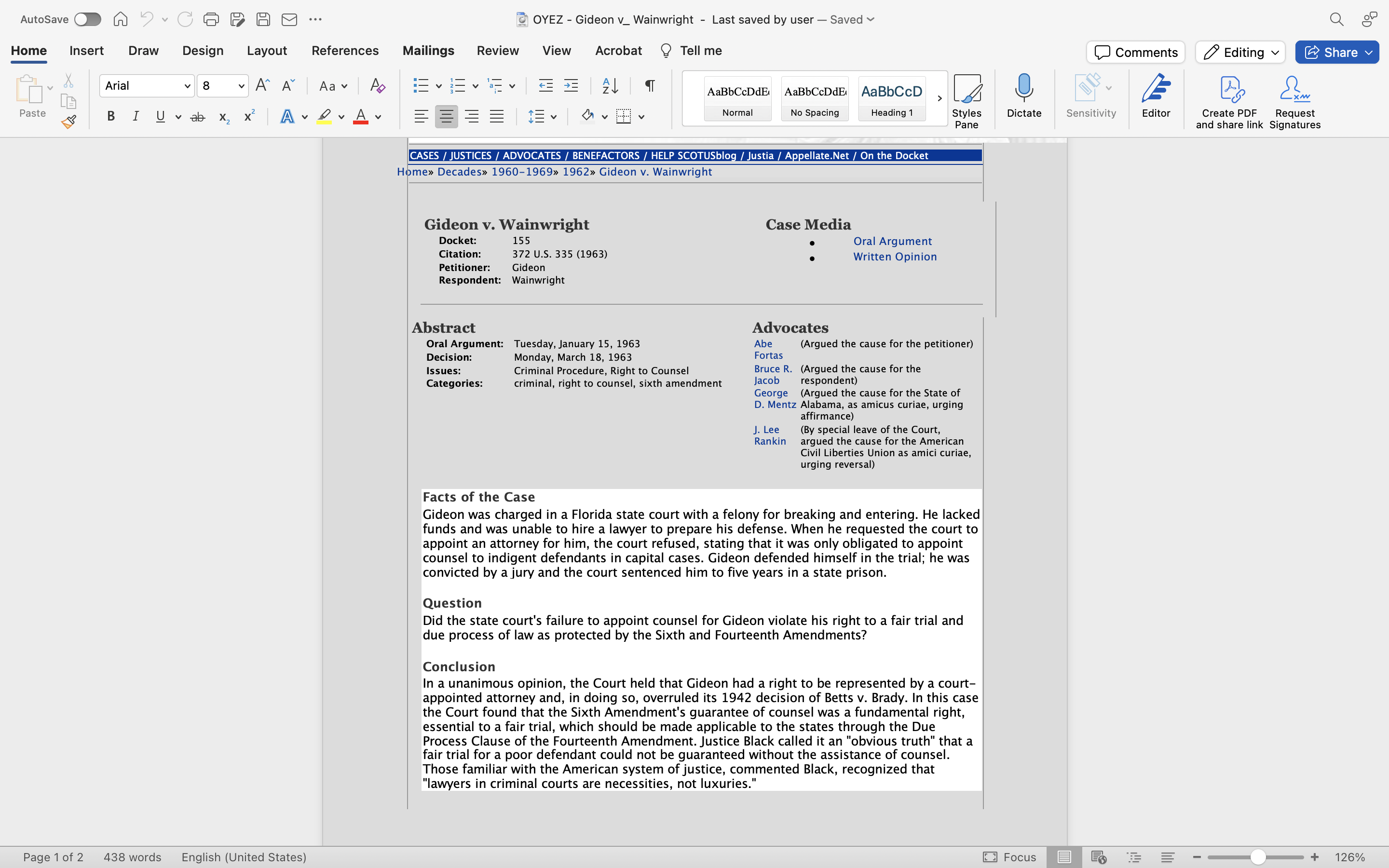
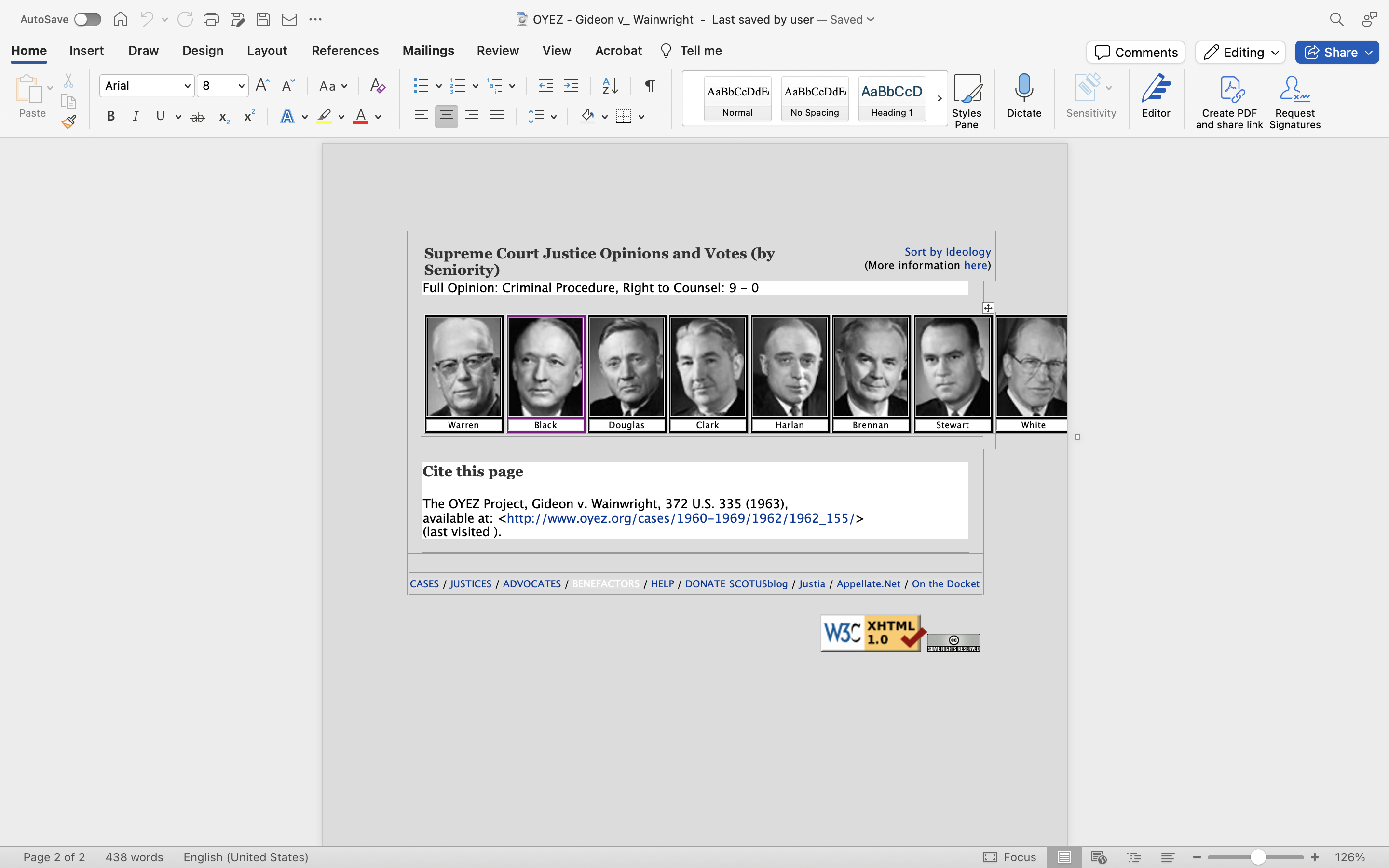
Autosave D () = B 5 - B Sample Brief previously submitted by a student in BUAD 3470 - Compatibility Mode Saved to my Mac v QP Home Insert Draw Design Layout References Mailings Review View Acrobat Q Tell me () Comments fEditing v 28 Oy - o A ' v TimesNew.. v 11 v A" A" Aav Ao AaBbCcD | AaBbCeDE: | AaBbCcDAE: AaBbCeD , | \\Q/ f @7 &W Heading 4 Normal No Spacing Heading 1 Styles Dictate Editor Create PDF Request = Pane and share link Signatures Paste -~ BARE U v &5 x, X 2 v A~ 0 Office Update To keep up-to-date with security updates, fixes, and improvements, choose Check for Updates. Check for Updates Sample Brief previously submitted by a student in BUAD 3470. L KELOetal v. CITY OF NEW LONDON etal, II. CITATION: 545 U.S. 469 (2005) 1. FACTS: The city of New London, Connecticut, after the closing of the Naval Undersea Warfare Center, reactivated the New London Development Corporation (NLDC), a non-profit entity for land development in the city, specifically the Fort Trumbull area vacated by the U.S. Navy. Pfizer Pharmaceuticals, Inc. expressed an interest in locating a research and production facility in the area. The city advised the NLDC to move forward with its plans. Over 90 acres of property were purchased and acquired through eminent domain for the development of residential housing, recreational, the remainder from private owners. All private owners, except 15, sold to the city for the project. The remaining 15 held out not for money, but for emotional and sentimental reasons. The Supreme Court of Connecticut ruled in favor of the taking of the private property under eminent domain. The United States Supreme Court granted certiorari and grouped all 15 cases in one appeal. IV. LEGAL ISSUES: Is the use of eminent domain to acquire property by the government and redirect for private use repugnant to the Fifth Amendment of the U.S. Constitution which reads \"...nor shall private property be taken for public use, without just compensation? Is the taking of property from A and giving it to B for economic development a \"public use\" under the Fifth Amendment? V. COURT DECISION: In a5 to 4 decision, the Supreme Court upheld the decision of the Connecticut Supreme. Justices Stevens, Kennedy, Souter, Ginsburg, and Breyer were in majority with Justices O'Connor, Rehnquist, Scalia, and Thomas dissenting. VI. OPINION AND REASONING OF THE COURT: (by Justice Stevens) The majority opinion and decision of the court was delivered by Justice Stevens. The majority opinion was primarily based on two previous court rulings, Hawaii Housing Authority v. Midkiff, 467 U.S. 229 (1984) and Berman v. Parker, 346 U.S. 26 (1954). In both cases the local government took property through emminent domain and redistributed it to private entitites for development and urban renewal. The majority opinion held that the New London land in question is part of a \"carefully considered\" development plan. The opinion conceded that, \"The sovereign may not take the property of A for the sole purpose of transferring it to another private party B, even though A is paid just compensation.\" However, because the taking is part of a development plan and not just an arbitrary re-distribution of property, this Page 10of 3 1566 words [J# English (United States) 3 Focus - c t 126% g\\l Iji! Il AutoSave O A . CG PAD ... Sample Brief previously submitted by a student in BUAD 3470 - Compatibility Mode - Saved to my Mac Home Insert Draw Design Layout References Mailings Review View Acrobat ? Tell me Comments Editing Share Times New... v 11 ~ A A Aav A EVENEV 24 T AaBbCcD AaBbCcDdE AaBbCcDdE Aa BbCCD Paste BIUvab X X ADVA v Heading 4 Norma No Spacing Heading Styles Dictate Editor Create PDF Request pane and share link Signatures x Office Update To keep up-to-date with security updates, fixes, and improvements, choose Check for Updates. Check for Updates The majority opinion held that the New London land in question is part of a "carefully considered" development plan. The opinion conceded that, "The sovereign may not take the property of A for the sole purpose of transferring it to another private party B, even though A is paid just compensation." However, because the taking is part of a development plan and not just an arbitrary re-distribution of property, this makes it acceptable. The lower courts had found that there was no evidence of illegitimate purpose in this case, that the taking of the property was not for the sole benefit of one person. And while the land is no freely accessible to all, the New London project sufficiently satisfies the "public use" requirement of the emminent domain clause of the Fifth Amendment. The duty of the court is to determine if the "public use" requirement is being met. The majority quoted Justice Douglas in the Berman v. Parker case, stating, 'We do not sit to determine whether a particular housing project is or is not desirable. The concept of the public welfare is broad and inclusive." The duty of the court is not to look at each individual building, but at the project as a whole and determine if it meets the "public use" guideline. Individual property is the concern of the local legislature which is in a better position to review each property and its relation to the project as a whole. N VII. CONCURRING OPINION (delivered by Justice Kennedy) Justice Kennedy called for a rational-basis review eminent domain cases to determine if one particular. party will benefit greatly over others. Such a review was outlined in both the Hawaii Housing Authority and Berman cases. However, in the New London case, the majority of the parties were unknown and no one party could unfairly benefit from the transaction. Pfizer was not benefitting from the development as the project was already conceived and being executed when Pfizer expressed an interest in locating there. The land transfers were part of a comprehensive plan that was already in the works, and no one group was favored in the transaction. VIII. DISSENTING OPINION (delivered by Justice O'Connor, joined by Chief Justice Rehnquist and Justice Scalia) Justice O'Connor gave a very strong dissent. Referring to the words of Justice Chase in 1798 who wrote: " An call it lower) a Page 1 of 3 1566 words x English (United States) Focus E + 126%AutoSave () @ @ F) 8 - - Sample Brief previously submitted by a student in BUAD 3470 - Compatibility Mode Saved to my Mac v Home Insert Draw Design Layout References Mailings Review View Acrobat Q Tell me o > Y iEl TimesNew.. v 11 v A" A" Aav Ao AaBbCcD | AaBbCeDAE: | AaBbCDAE AaBbCCD , | Paste BER U x 2v Av Heading 4 Normal No Spacing Heading 1 Styles Y iEl TimesNew.. v 11 v A" A" Aav Ao AaBbCcD | AaBbCeDAE: | AaBbCDAE AaBbCCD , | Paste BER U x 2v Av Heading 4 Normal No Spacing Heading 1 Styles > Decades>> 1960-1969> 1962> Gideon v. Wainwright Gideon v. Wainwright Case Media Docket: 155 Oral Argument Citation: 372 U.S. 335 (1963) tten Opinion Petitioner: Gideon Respondent: Wainwright Abstract Advocates Oral Argument: Tuesday, January 15, 1963 Abe (Argued the cause for the petitioner) Decision: Monday, March 18, 1963 ortas Issues: Criminal Procedure, Right to Counsel Bruce R. (Argued the cause for the Categories: criminal, right to counsel, sixth amendment Jacob respondent) George (Argued the cause for the State of D. Mentz Alabama, as amicus curiae, urging affirmance) 1. Lee (By special leave of the Court, Rankin argued the cause for the American Civil Liberties Union as amici curiae, urging reversal) Facts of the Case Gideon was charged in a Florida state court with a felony for breaking and entering. He lacked funds and was unable to hire a lawyer to prepare his defense. When he requested the court to appoint an attorney for him, the court refused, stating that it was only obligated to appoint counsel to indigent defendants in capital cases. Gideon defended himself in the trial; he was convicted by a jury and the court sentenced him to five years in a state prison. Question Did the state court's failure to appoint counsel for Gideon violate his right to a fair trial and due process of law as protected by the Sixth and Fourteenth Amendments? Conclusion In a unanimous opinion, the Court held that Gideon had a right to be represented by a court- appointed attorney and, in doing so, overruled its 1942 decision of Betts v. Brady. In this case the Court found that the Sixth Amendment's guarantee of counsel was a fundamental right, essential to a fair trial, which should be made applicable to the states through the Due Process Clause of the Fourteenth Amendment. Justice Black called it an "obvious truth" that a fair trial for a poor defendant could not be guaranteed without the assistance of counsel. Those familiar with the American system of justice, commented Black, recognized that "lawyers in criminal courts are necessities, not luxuries." Page 1 of 2 438 words English (United States) Focus E + 126%AutoSave O A . CG PAD ... OYEZ - Gideon v_ Wainwright - Last saved by user - Saved Home Insert Draw Design Layout References Mailings Review View Acrobat ? Tell me Comments Editing Share Arial v 8 A" A Aa Ap EEVEEVEE 24 T AaBbCcDdE AaBbCcDdE AaBbCCD Paste BIUvab X X|A DAY Norma No Spacing Heading 1 Styles Dictate Sensitivity Editor Create PDF Request Pane and share link Signatures Supreme Court Justice Opinions and Votes (by Sort by Ideology Seniority) (More information here) Full Opinion: Criminal Procedure, Right to Counsel: 9 - 0 Warren Black Douglas Clark Harlan Brennan Stewart White Cite this page The OYEZ Project, Gideon v. Wainwright, 372 U.S. 335 (1963), available at:
Step by Step Solution
There are 3 Steps involved in it

Get step-by-step solutions from verified subject matter experts