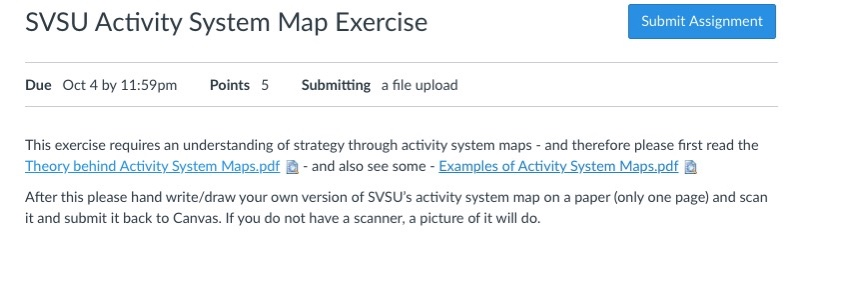
Question: SVSU Activity System Map Exercise Submit Assignment Due Oct 4 by 11:59pm Points 5 Submitting a file upload This exercise requires an understanding of strategy
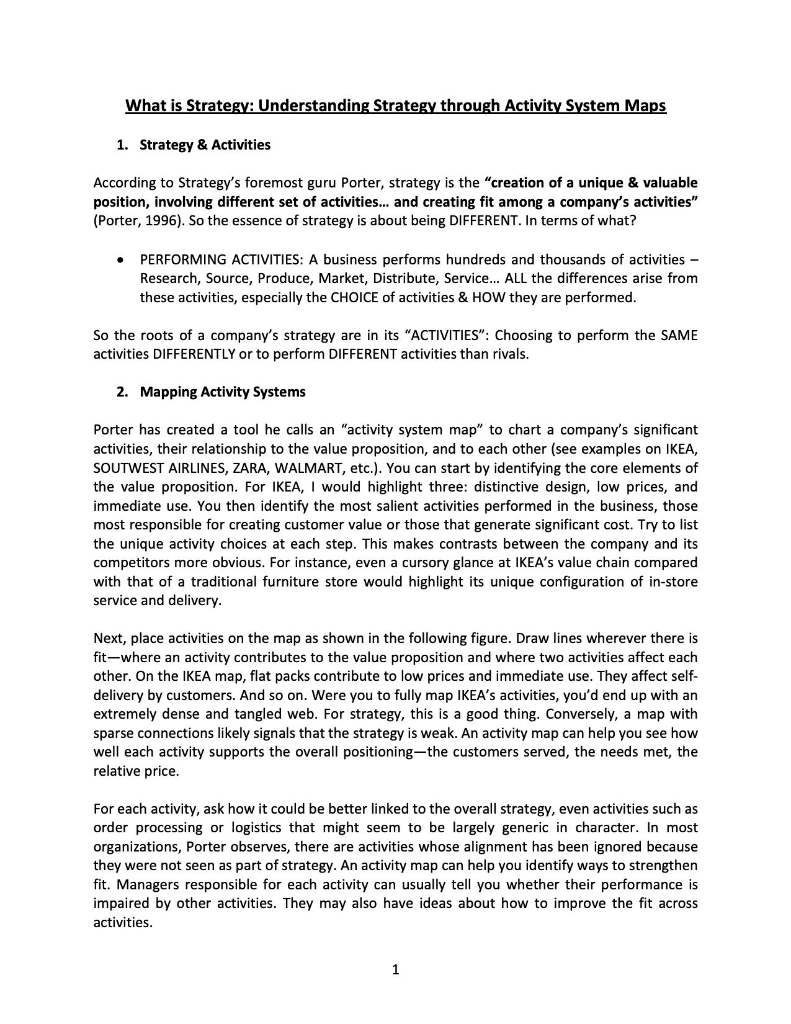
SVSU Activity System Map Exercise Submit Assignment Due Oct 4 by 11:59pm Points 5 Submitting a file upload This exercise requires an understanding of strategy through activity system maps - and therefore please first read the Theory behind Activity System Maps.pdf - and also see some - Examples of Activity System Maps.pdf a After this please hand write/draw your own version of SVSU's activity system map on a paper (only one page) and scan it and submit it back to Canvas. If you do not have a scanner, a picture of it will do. What is Strategy: Understanding Strategy through Activity System Maps 1. Strategy & Activities According to Strategy's foremost guru Porter, strategy is the "creation of a unique & valuable position, involving different set of activities... and creating fit among a company's activities" (Porter, 1996). So the essence of strategy is about being DIFFERENT. In terms of what? PERFORMING ACTIVITIES: A business performs hundreds and thousands of activities - Research, Source, Produce, Market, Distribute, Service... ALL the differences arise from these activities, especially the CHOICE of activities & HOW they are performed. So the roots of a company's strategy are in its "ACTIVITIES": Choosing to perform the SAME activities DIFFERENTLY or to perform DIFFERENT activities than rivals. 2. Mapping Activity Systems Porter has created a tool he calls an "activity system map" to chart a company's significant activities, their relationship to the value proposition, and to each other (see examples on IKEA, SOUTWEST AIRLINES, ZARA, WALMART, etc.). You can start by identifying the core elements of the value proposition. For IKEA, I would highlight three: distinctive design, low prices, and immediate use. You then identify the most salient activities performed in the business, those most responsible for creating customer value or those that generate significant cost. Try to list the unique activity choices at each step. This makes contrasts between the company and its competitors more obvious. For instance, even a cursory glance at IKEA's value chain compared with that of a traditional furniture store would highlight its unique configuration of in-store service and delivery. Next, place activities on the map as shown in the following figure. Draw lines wherever there is fit-where an activity contributes to the value proposition and where two activities affect each other. On the IKEA map, flat packs contribute to low prices and immediate use. They affect self- delivery by customers. And so on. Were you to fully map IKEA's activities, you'd end up with an extremely dense and tangled web. For strategy, this is a good thing. Conversely, a map with sparse connections likely signals that the strategy is weak. An activity map can help you see how well each activity supports the overall positioning-the customers served, the needs met, the relative price. For each activity, ask how it could be better linked to the overall strategy, even activities such as order processing or logistics that might seem to be largely generic in character. In most organizations, Porter observes, there are activities whose alignment has been ignored because they were not seen as part of strategy. An activity map can help you identify ways to strengthen fit. Managers responsible for each activity can usually tell you whether their performance is impaired by other activities. They may also have ideas about how to improve the fit across activities. 1 SVSU Activity System Map Exercise Submit Assignment Due Oct 4 by 11:59pm Points 5 Submitting a file upload This exercise requires an understanding of strategy through activity system maps - and therefore please first read the Theory behind Activity System Maps.pdf - and also see some - Examples of Activity System Maps.pdf a After this please hand write/draw your own version of SVSU's activity system map on a paper (only one page) and scan it and submit it back to Canvas. If you do not have a scanner, a picture of it will do. What is Strategy: Understanding Strategy through Activity System Maps 1. Strategy & Activities According to Strategy's foremost guru Porter, strategy is the "creation of a unique & valuable position, involving different set of activities... and creating fit among a company's activities" (Porter, 1996). So the essence of strategy is about being DIFFERENT. In terms of what? PERFORMING ACTIVITIES: A business performs hundreds and thousands of activities - Research, Source, Produce, Market, Distribute, Service... ALL the differences arise from these activities, especially the CHOICE of activities & HOW they are performed. So the roots of a company's strategy are in its "ACTIVITIES": Choosing to perform the SAME activities DIFFERENTLY or to perform DIFFERENT activities than rivals. 2. Mapping Activity Systems Porter has created a tool he calls an "activity system map" to chart a company's significant activities, their relationship to the value proposition, and to each other (see examples on IKEA, SOUTWEST AIRLINES, ZARA, WALMART, etc.). You can start by identifying the core elements of the value proposition. For IKEA, I would highlight three: distinctive design, low prices, and immediate use. You then identify the most salient activities performed in the business, those most responsible for creating customer value or those that generate significant cost. Try to list the unique activity choices at each step. This makes contrasts between the company and its competitors more obvious. For instance, even a cursory glance at IKEA's value chain compared with that of a traditional furniture store would highlight its unique configuration of in-store service and delivery. Next, place activities on the map as shown in the following figure. Draw lines wherever there is fit-where an activity contributes to the value proposition and where two activities affect each other. On the IKEA map, flat packs contribute to low prices and immediate use. They affect self- delivery by customers. And so on. Were you to fully map IKEA's activities, you'd end up with an extremely dense and tangled web. For strategy, this is a good thing. Conversely, a map with sparse connections likely signals that the strategy is weak. An activity map can help you see how well each activity supports the overall positioning-the customers served, the needs met, the relative price. For each activity, ask how it could be better linked to the overall strategy, even activities such as order processing or logistics that might seem to be largely generic in character. In most organizations, Porter observes, there are activities whose alignment has been ignored because they were not seen as part of strategy. An activity map can help you identify ways to strengthen fit. Managers responsible for each activity can usually tell you whether their performance is impaired by other activities. They may also have ideas about how to improve the fit across activities. 1









 Study Help