



Question: system. Given the following conditions, please answer the questions below. Pay close attention to units. - The system is in steady state - River input
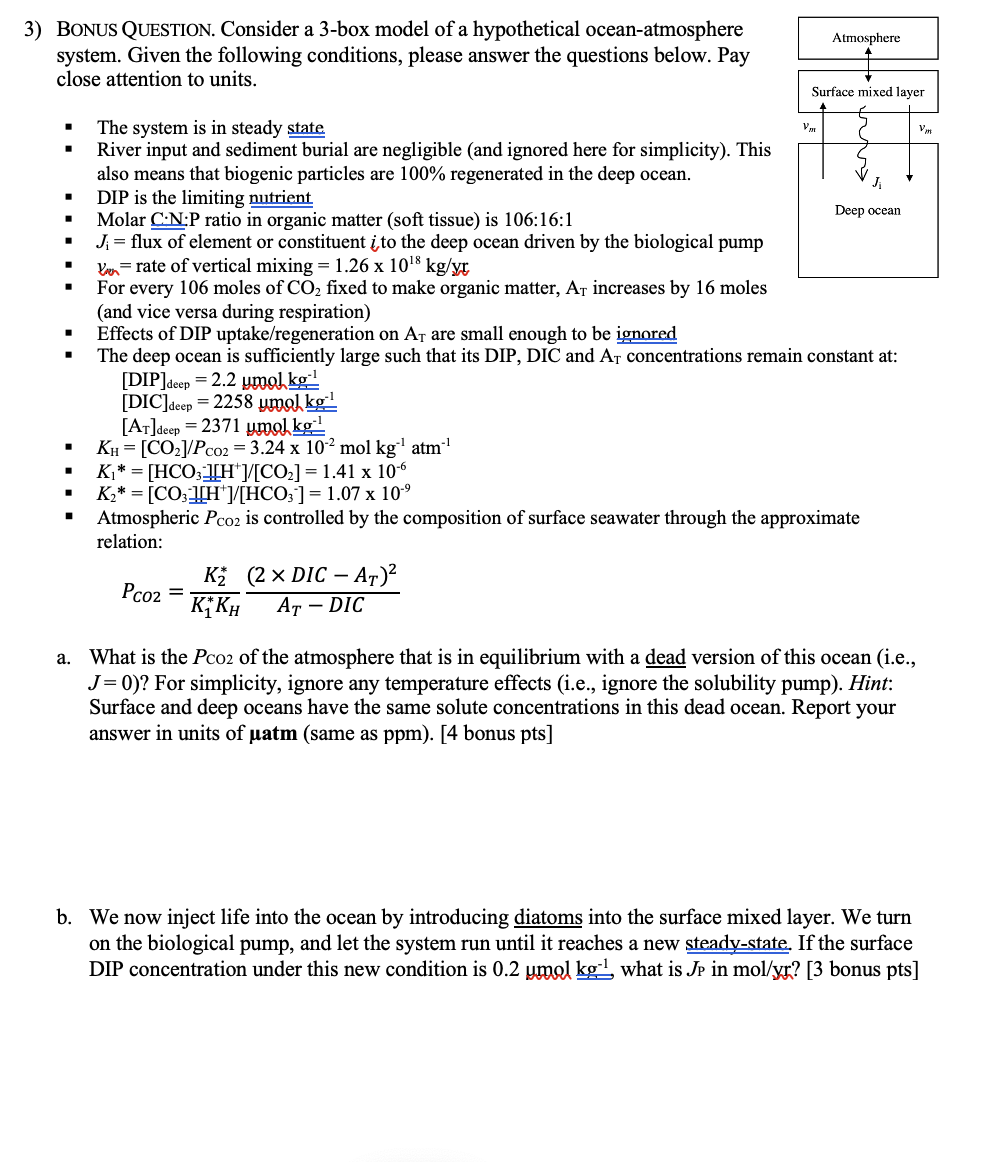
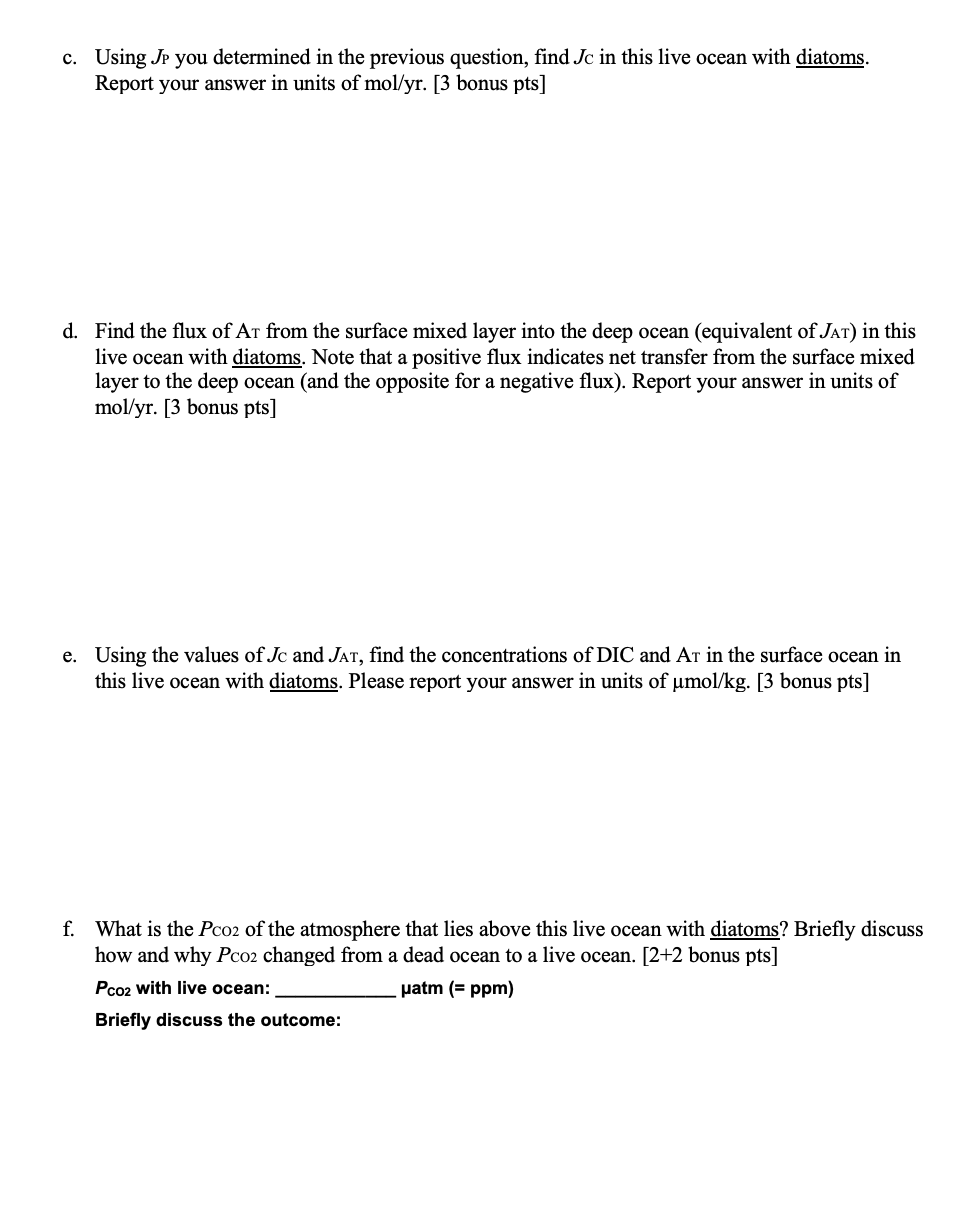
system. Given the following conditions, please answer the questions below. Pay close attention to units. - The system is in steady state - River input and sediment burial are negligible (and ignored here for simplicity). This also means that biogenic particles are 100% regenerated in the deep ocean. - DIP is the limiting nutrient - Molar C.N:P ratio in organic matter (soft tissue) is 106:16:1 - Ji= flux of element or constituent i, to the deep ocean driven by the biological pump - ven= rate of vertical mixing =1.261018kg/yr - For every 106 moles of CO2 fixed to make organic matter, AT increases by 16 moles (and vice versa during respiration) - Effects of DIP uptake/regeneration on AT are small enough to be ignored - The deep ocean is sufficiently large such that its DIP, DIC and AT concentrations remain constant at: [DIP]deep=2.2umolkg1[DIC]deep=2258umolkg1[AT]deep=2371umohkg1 - KH=[CO2]/PCO2=3.24102molkg1atm1 - K1=[HCO3][H+]/[CO2]=1.41106 - K2=[CO3][H+]/[HCO3]=1.07109 - Atmospheric PCO2 is controlled by the composition of surface seawater through the approximate relation: PCO2=K1KHK2ATDIC(2DICAT)2 a. What is the PCO2 of the atmosphere that is in equilibrium with a dead version of this ocean (i.e., J=0) ? For simplicity, ignore any temperature effects (i.e., ignore the solubility pump). Hint: Surface and deep oceans have the same solute concentrations in this dead ocean. Report your answer in units of atm (same as ppm). [4 bonus pts] b. We now inject life into the ocean by introducing diatoms into the surface mixed layer. We turn on the biological pump, and let the system run until it reaches a new steady-state If the surface DIP concentration under this new condition is 0.2molkg1 what is JPP in mol/yr ? [3 bonus pts ] c. Using JP you determined in the previous question, find JC in this live ocean with diatoms. Report your answer in units of mol/yr. [ 3 bonus pts] d. Find the flux of A from the surface mixed layer into the deep ocean (equivalent of JAT ) in this live ocean with diatoms. Note that a positive flux indicates net transfer from the surface mixed layer to the deep ocean (and the opposite for a negative flux). Report your answer in units of mol/yr. [ 3 bonus pts] e. Using the values of JC and JAT, find the concentrations of DIC and A in the surface ocean in this live ocean with diatoms. Please report your answer in units of mol/kg. [3 bonus pts] f. What is the PCO2 of the atmosphere that lies above this live ocean with diatoms? Briefly discuss how and why PCO2 changed from a dead ocean to a live ocean. [2+2 bonus pts] Pco2 with live ocean: ratm (= ppm) Briefly discuss the outcome
Step by Step Solution
There are 3 Steps involved in it

Get step-by-step solutions from verified subject matter experts