Question: System: Template: Question: Elections Ontario is looking to develop and adopt an automated solution to either aid or take care of casting and counting votes.
Question:

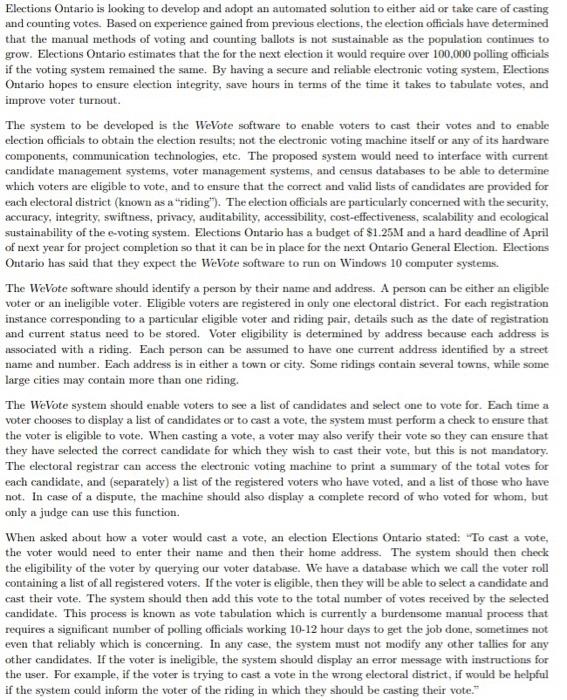
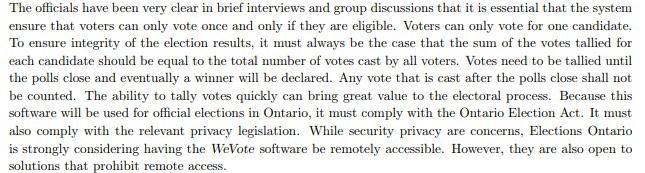
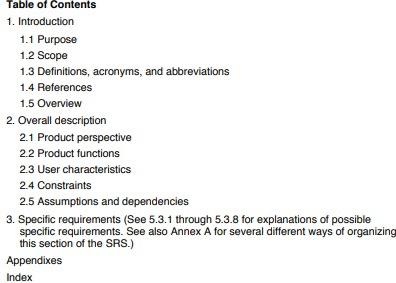
Elections Ontario is looking to develop and adopt an automated solution to either aid or take care of casting and counting votes. Based on experience gained from previous elections, the election officials have determined that the manual methods of voting and counting ballots is not sustainable as the population continues to grow. Elections Ontario estimates that the for the next election it would require over 100,000 polling officials if the voting system remained the same. By having a secure and reliable electronic voting system, Elections Ontario hopes to ensure election integrity, save hours in terms of the time it takes to tabulate votes, and improve voter turnout. The system to be developed is the WeVote software to enable voters to cast their votes and to enable election officials to obtain the election results, not the electronic voting machine itself or any of its hardware components, communication technologies, etc. The proposed system would need to interface with current candidate management systems, voter management systems, and census databases to be able to determine which voters are eligible to vote, and to ensure that the correct and valid lists of candidates are provided for each electoral district (known as a "riding"). The election officials are particularly concerned with the security, accuracy, integrity, swiftness, privacy, anditability, accessibility, cost-effectiveness, scalability and ecological sustainability of the e-voting system. Elections Ontario has a budget of $1.25M and a hard deadline of April of next year for project completion so that it can be in place for the next Ontario General Election. Elections Ontario has said that they expect the WeVote software to run on Windows 10 computer systems. The WeVote software should identify a person by their name and address. A person can be either an eligible voter or an ineligible voter. Eligible voters are registered in only one electoral district. For each registration instance corresponding to a particular eligible voter and riding pair, details such as the date of registration and current status need to be stored. Voter eligibility is determined by address because each address is associated with a riding. Each person can be assumed to have one current address identified by a street name and mumber. Each address is in either a town or city. Some ridings contain several towns, while some large cities may contain more than one riding. The Wevote system should enable voters to see a list of candidates and select one to vote for. Each time a voter chooses to display a list of candidates or to cast a vote, the system must perform a check to ensure that the voter is eligible to vote. When casting a vote, a voter may also verify their vote so they can ensure that they have selected the correct candidate for which they wish to cast their vote, but this is not mandatory. The electoral registrar can access the electronic voting machine to print a summary of the total votes for each candidate, and (separately) a list of the registered voters who have voted, and a list of those who have not. In case of a dispute, the machine should also display a complete record of who voted for whom, but only a judge can use this function. When asked about how a voter would cast a vote, an election Elections Ontario stated: "To cast a vote, the voter would need to enter their name and then their home address. The system should then check the eligibility of the voter by querying our voter database. We have a database which we call the voter roll containing a list of all registered voters. If the voter is eligible, then they will be able to select a candidate and cast their vote. The system should then add this vote to the total number of votes received by the selected candidate. This process is known as vote tabulation which is currently a burdensome manual process that requires a siguificant number of polling officials working 10-12 hour days to get the job donc, sometimes not even that reliably which is concerning. In any case, the system must not modify any other tallies for any other candidates. If the voter is ineligible, the system should display an error message with instructions for the user. For example, if the voter is trying to cast a vote in the wrong electoral district, if would be helpful if the system could inform the voter of the riding in which they should be casting their vote." The officials have been very clear in brief interviews and group discussions that it is essential that the system ensure that voters can only vote once and only if they are eligible. Voters can only vote for one candidate. To ensure integrity of the election results, it must always be the case that the sum of the votes tallied for each candidate should be equal to the total number of votes cast by all voters. Votes need to be tallied until the polls close and eventually a winner will be declared. Any vote that is cast after the polls close shall not be counted. The ability to tally votes quickly can bring great value to the electoral process. Because this software will be used for official elections in Ontario, it must comply with the Ontario Election Act. It must also comply with the relevant privacy legislation. While security privacy are concerns, Elections Ontario is strongly considering having the WeVote software be remotely accessible. However, they are also open to solutions that prohibit remote access. Table of Contents 1. Introduction 1.1 Purpose 1.2 Scope 1.3 Definitions, acronyms, and abbreviations 1.4 References 1.5 Overview 2. Overall description 2.1 Product perspective 2.2 Product functions 2.3 User characteristics 2.4 Constraints 2.5 Assumptions and dependencies 3. Specific requirements (See 5.3.1 through 5.3.8 for explanations of possible specific requirements. See also Annex A for several different ways of organizing this section of the SRS.) Appendixes Index Prepare a high-quality software requirements specification for the WeVote system using the IEEE Standard 830-1998: Recommended Practice for Software Requirements Specifications template. Be sure to include all sections of the temaplate and to organize your document and ensure that your requirements are written in standard form. Please document any assumptions that you make to fill in missing information to make your requirements unambiguous, consistent, complete, etc. Make sure that all of the models included in your SRS are consistent









 Study Help