







Question: systems and simulation Exercise 4) Vertical landing for rockets relies on a technique known as propulsive landing - a way of using rocket engines to
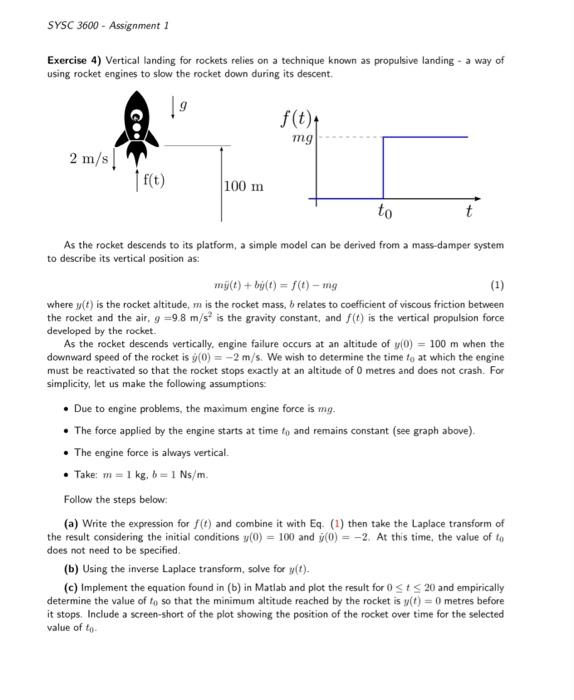
Exercise 4) Vertical landing for rockets relies on a technique known as propulsive landing - a way of using rocket engines to slow the rocket down during its descent. As the rocket descends to its platform, a simple model can be derived from a mass-damper system to describe its vertical position as: my(t)+bj(t)=f(t)mg where y(t) is the rocket altitude, m is the rocket mass, b relates to coefficient of viscous friction between the rocket and the air, g=9.8m/s2 is the gravity constant, and f(t) is the vertical propulsion force developed by the rocket. As the rocket descends vertically, engine failure occurs at an altitude of y(0)=100m when the downward speed of the rocket is y(0)=2m/s. We wish to determine the time t0 at which the engine must be reactivated so that the rocket stops exactly at an altitude of 0 metres and does not crash. For simplicity, let us make the following assumptions: - Due to engine problems, the maximum engine force is mg. - The force applied by the engine starts at time t0 and remains constant (see graph above). - The engine force is always vertical. - Take: m=1kg,b=1Ns/m. Follow the steps below: (a) Write the expression for f(t) and combine it with Eq. (1) then take the Laplace transform of the result considering the initial conditions y(0)=100 and y(0)=2. At this time, the value of t0 does not need to be specified. (b) Using the inverse Laplace transform, solve for y(t). (c) Implement the equation found in (b) in Matiab and plot the result for 0t20 and empirically determine the value of t0 so that the minimum altitude reached by the rocket is y(t)=0 metres before it stops. Include a screen-short of the plot showing the position of the rocket over time for the selected value of t0
Step by Step Solution
There are 3 Steps involved in it

Get step-by-step solutions from verified subject matter experts
 Study Help