



Question: t P(BA) P(BA) If the conditional odds are greater than the unconditional odds, the conditioning event is said to have an influence on the event
t
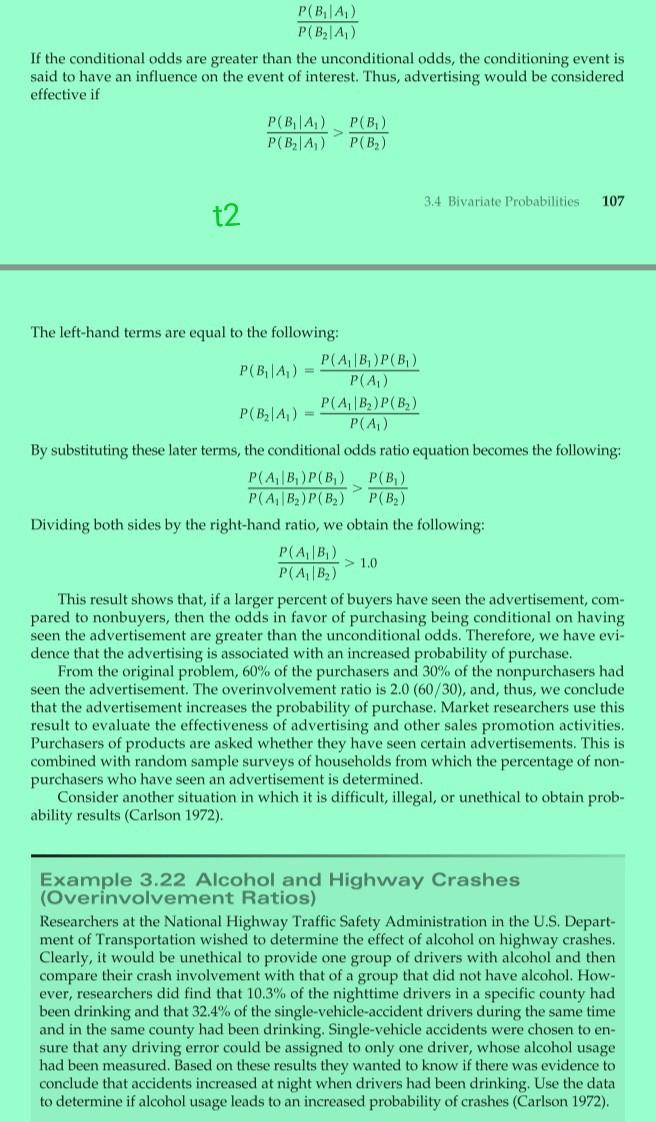
P(BA) P(BA) If the conditional odds are greater than the unconditional odds, the conditioning event is said to have an influence on the event of interest. Thus, advertising would be considered effective if P(BA) P(B) P(B,A,) P(B2) 3.4 Bivariate Probabilities 107 t2 The left-hand terms are equal to the following: P(A, B, PB) P(BA) = P(A) P(AB) P(B) P(BA) P(A) By substituting these later terms, the conditional odds ratio equation becomes the following: P(A,B)P(B) P(B) P(A,B2) P(B2) P(B) Dividing both sides by the right-hand ratio, we obtain the following: P(AB) > 1.0 P(A, B2) This result shows that, if a larger percent of buyers have seen the advertisement, com- pared to nonbuyers, then the odds in favor of purchasing being conditional on having seen the advertisement are greater than the unconditional odds. Therefore, we have evi- dence that the advertising is associated with an increased probability of purchase. From the original problem, 60% of the purchasers and 30% of the nonpurchasers had seen the advertisement. The overinvolvement ratio is 2.0 (60/30), and, thus, we conclude that the advertisement increases the probability of purchase. Market researchers use this result to evaluate the effectiveness of advertising and other sales promotion activities. Purchasers of products are asked whether they have seen certain advertisements. This is combined with random sample surveys of households from which the percentage of non- purchasers who have seen an advertisement is determined. Consider another situation in which it is difficult, illegal, or unethical to obtain prob- ability results (Carlson 1972). Example 3.22 Alcohol and Highway Crashes (Overinvolvement Ratios) Researchers at the National Highway Traffic Safety Administration in the U.S. Depart- ment of Transportation wished to determine the effect of alcohol on highway crashes. Clearly, it would be unethical to provide one group of drivers with alcohol and then compare their crash involvement with that of a group that did not have alcohol. How- ever, researchers did find that 10.3% of the nighttime drivers in a specific county had been drinking and that 32.4% of the single-vehicle-accident drivers during the same time and in the same county had been drinking. Single-vehicle accidents were chosen to en- sure that any driving error could be assigned to only one driver, whose alcohol usage had been measured. Based on these results they wanted to know if there was evidence to conclude that accidents increased at night when drivers had been drinking. Use the data to determine if alcohol usage leads to an increased probability of crashes (Carlson 1972)Step by Step Solution
There are 3 Steps involved in it
1 Expert Approved Answer
Step: 1 Unlock

Question Has Been Solved by an Expert!
Get step-by-step solutions from verified subject matter experts
Step: 2 Unlock
Step: 3 Unlock