







Question: t Proportion Random Variable In a number of applied problems we need to compute probabilities for proportion or per- centage intervals. We can do this
t
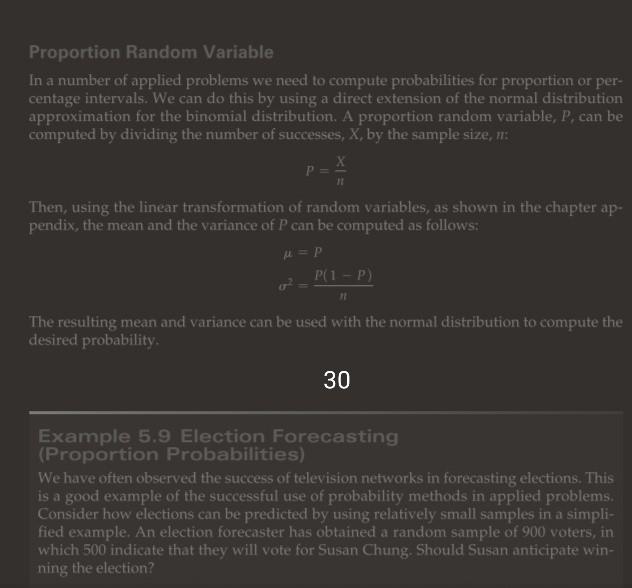
Proportion Random Variable In a number of applied problems we need to compute probabilities for proportion or per- centage intervals. We can do this by using a direct extension of the normal distribution approximation for the binomial distribution. A proportion random variable, P, can be computed by dividing the number of successes, X, by the sample size, : 11 Then, using the linear transformation of random variables, as shown in the chapter ap- pendix, the mean and the variance of P can be computed as follows: M =P P(1-P) 1 The resulting mean and variance can be used with the normal distribution to compute the desired probability: 30 Example 5.9 Election Forecasting (Proportion Probabilities) We have often observed the success of television networks in forecasting elections. This is a good example of the successful use of probability methods in applied problems. Consider how elections can be predicted by using relatively small samples in a simpli- fied example. An election forecaster has obtained a random sample of 900 voters, in which 500 indicate that they will vote for Susan Chung. Should Susan anticipate win- ning the electionStep by Step Solution
There are 3 Steps involved in it
1 Expert Approved Answer
Step: 1 Unlock

Question Has Been Solved by an Expert!
Get step-by-step solutions from verified subject matter experts
Step: 2 Unlock
Step: 3 Unlock
 Study Help