







Question: !t-...a ITNormal TNoSpoc.. Heading 1 Heading 2 Paragraph Styles 1. What is the objective of the chapter? lHints: read through the chapter, and then re-read
![this Case.] 2. Briefly talk about the Sampl selection process. 3. Highlight](https://dsd5zvtm8ll6.cloudfront.net/si.experts.images/questions/2024/10/6702118664dce_80567021185c4ba4.jpg)
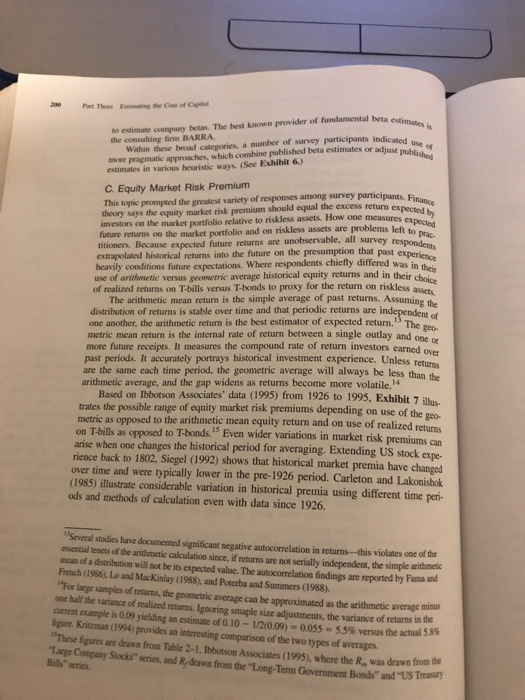
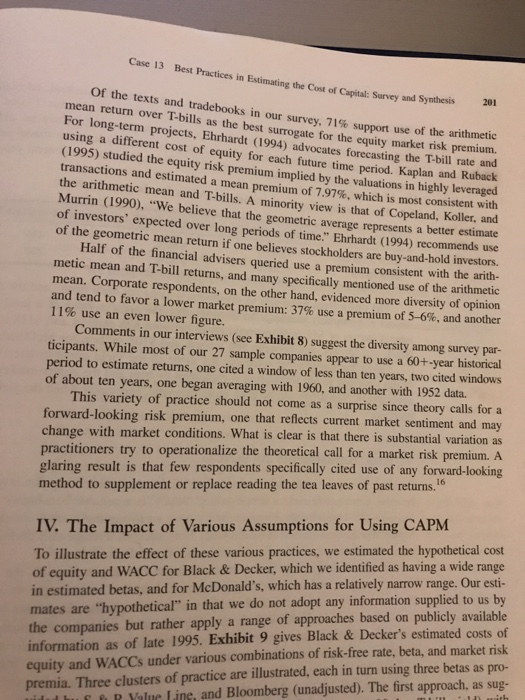
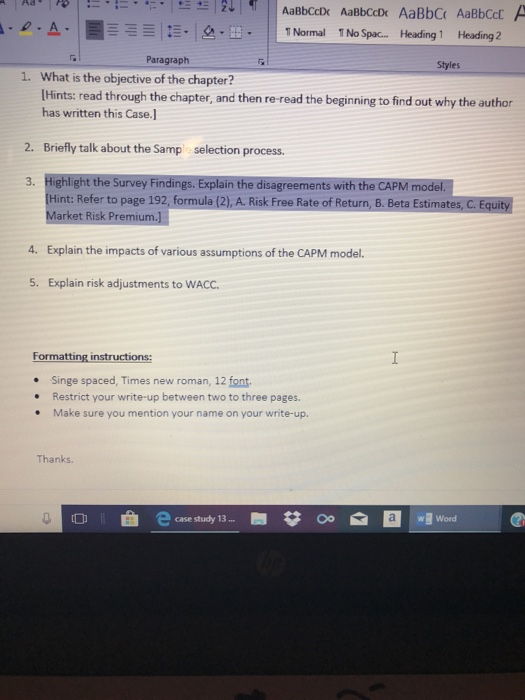
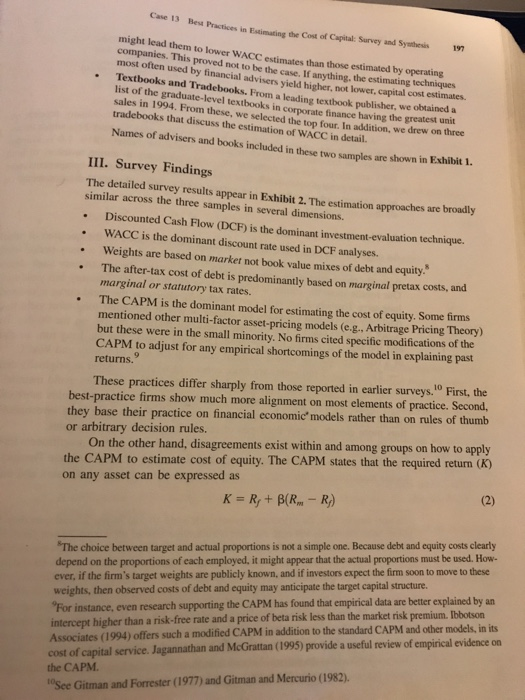
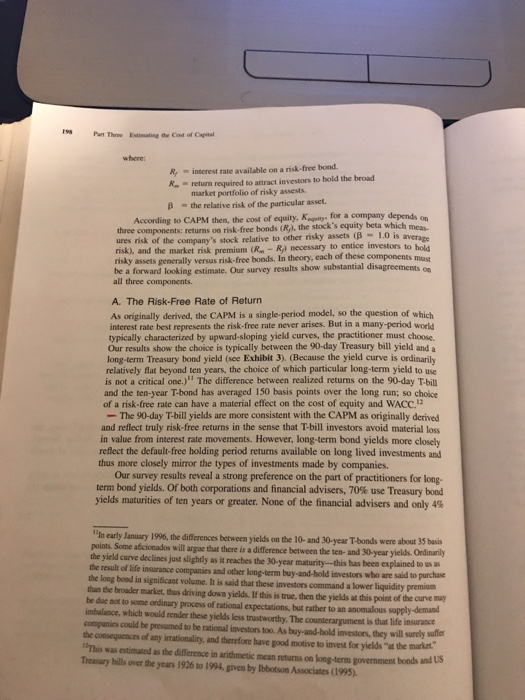
!t-...a ITNormal TNoSpoc.. Heading 1 Heading 2 Paragraph Styles 1. What is the objective of the chapter? lHints: read through the chapter, and then re-read the beginning to find out why the author has written this Case.] 2. Briefly talk about the Sampl selection process. 3. Highlight the Survey Findings. Explain the disagreements with the CAPM model Hint: Refer to page 192, formula (2), A. Risk Free Rate of Return, B. Beta Estimates, C. Equity Market Risk Premium.] 4. Explain the impacts of various assumptions of the CAPM model. 5. Explain risk adjustments to WACC Formatting instructions: . Singe spaced, Times new roman, 12 font . Restrict your write-up between two to three pages. .Make sure you mention your name on your write-up. Thanks. ecase study 13-- # 00 w word Case 13 Best Practices in Estimating the Cost of Capital: Survey and Sywthesis 197 might lead them to lower WACC estimates than those estimated by operating companies. This proved not to most often used by financial advisers yield higher, not lower, capital cost estimaties be the case. If anything, the estimating techniques Textbooks and Tradebooks. Fron a leading textbook publisher, we obtained . list of the graduate-level textbooks in corporate finance having the gaet sales in 1994. From these, we selected the top four. In addition, we drew on three tradebooks that discuss the estimation of WACC in detail. Names of advisers and books included in these two samples are shown in Exhibit 1. III. Survey Findings The detailed survey results appear in Exhibit 2. The estimation approaches are broadly similar across the three samples in several dimensions. Discounted Cash Flow (DCF) is the dominant investment-evaluation technique. WACC is the dominant discount rate used in DCF analyses. Weights are based on market not book value mixes of debt and equity. . . The after-tax cost of debt is predominantly based on marginal pretax costs, marginal or statutory tax rates. The CAPM is the dominant model for estimating the cost of equity. Some firms mentioned other multi-factor asset-pricing models (e.g.. Arbitrage Pricing Theory) but these were in the small minority. No firms cited specific modifications of the CAPM to adjust for any empirical shortcomings of the model in explaining past returns. These practices differ sharply from those reported in earlier surveys. 0 First, the best-practice firms show much more alignment on most elements of practice. Second, they base their practice on financial economic' models rather than on rules of thumb or arbitrary decision rules. On the other hand, disagreements exist within and among groups on how to apply the CAPM to estimate cost of equity. The CAPM states that the required return (K) on any asset can be expressed as The choice between target and actual proportions is not a simple one. Because debt and equity costs clearly depend on the proportions of each employed, it might appear that the actual proportions must be used. How ever, if the firm's target weights are publicly known, and if investors expect the firm soon to move to these weights, then observed costs of debt and equity may anticipate the target capital structure For instance, even research supporting the CAPM has found that empirical data are better explained by an intercept higher than a risk-free rate and a price of beta risk less than the market risk premium. Ibbotson Associates ( Associates (1994) offers such a modified CAPM in aditin to the standard CAPM and other modes in ts cost of capital service. Jagannathan and McGrattan (1995) provide a useful review of empirical evidence on the CAPM See Gitman and Forrester (1977) and Gitman and Mercurio (1982) to estimate compuny betas. The best known provider of fundamental beta use of the consalting firm BARRA move pragmatic approaches, which combine published beta estimates or adjust Within these broad categories, a number of survey participants indicated estimates in various heuristic ways. (See Exhibit 6.) C. Equity Market Risk Premium This topic prompted the greatest variety of responses among survey partici s. Finance theory says the equity market risk premium should equal the excess return expertne investors on the market portfolio relative to riskless assets. How one measures exb future returns on the market portfolio and on riskless assets are problems left toed prac. extrapolated historical returns into the future on the presumption that past exper s heavily conditions future expectations. Where respondents chiefly differed was in t.i use of arithmetic versus geometric average historical equity returns and in their choia of realized returns on T-bills versus T-bonds to proxy for the return on risklessats titioners. Because expected future returns are unobservable, all survey assets distribution of returns is stable over time and that periodic returns are independent of one another, the arithmetic return is the best estimator of expected return.1" The gen metric mean return is the internal rate of return between a single outlay and one or The arithmetic mean return is the simple average of past returns. Assumine t The geo more future receipts. It measures the compound rate of return investors earned past periods. It accurately portrays historical investment experience. Unless over returns are the same each time period, the geometric average will always be less than the arithmetic average, and the gap widens as returns become more volatile.14 Based on Ibbotson Associates' data (1995) from 1926 to 1995, Exhibit 7 illus the possible range of equity market risk premiums depending on use of the geo- metric as opposed to the arithmetic mean equity return and on use of realized returns on Thills as opposed to T-bonds. 5 Even wider variations in market risk premiums can arise when one changes the historical period for averaging. Extending US stock expe rience back to 1802, Siegel (1992) shows that historical market premia have changed over time and were typically lower in the pre-1926 period. Carleton and Lakonishok (1985) illustrate considerable variation in historical premia using different time peri- ods and methods of calculation even with data since 1926. "Several studies have documented significant negative autocorrelation in returns-this violates one of the essencial tenets of the arithmetic calculation since, if returns are not serially independent, the simple arihmesc mcan of a distaribution will not be its expected value. The autocorrelation findings are reported by Fama and French (1986), Lo and MacKinlay (1988), and Poterba and Summers (1988) large samples of returns, the geometric average can be approximated as the arithmetic average mins one half the variance of realized returns. Ignoring smaple size adjustments, the variance of current example is 009 yielding an estimate of 0.10-1/2009)-0055-55% versus the ctual SS figaure. Kritzman (1994) provides an interesting comparison of the two types of averages. These igures are drawn from Table 2-1, Ibbotson Associates (195), where the R, was drawn from Large Company Stocks" series, and R drawn from the "Long-Term Govemment Bills" series Bonds" and "US Treasury ces in Estimating the Cost of Capital: Survey and Symthesis 201 Of the texts and tr adebooks in our survey, 71% support use of the arithmetic over T-bills as the best surrogate for the equity market risk premium. For long-term projects, Ehrhardt (1994) advocates forecasting the T-bill rate and using a different cost of equity for each future time period. Kaplan and Ruback (1995) studied the equity risk premium implied by the valuations in highly leveraged transactions and estimated a mean premium of 7.97%, which is most consistent with mean return the arithmetic mean and T-bills. A minority view is that of Copeland, Koller, and Murrin (1990), "We believe that the geometric average represents a better estimate of investors' expected over long periods of time." Ehrhardt (1994) recommends use of the geometric mean return if one believes stockholders are buy-and-hold investors. Half of the financial advisers queried use a premium consistent with the arit metic mean and T-bill returns, and many specifically men mean. Corporate respondents, on the other hand, evidenced more diversity of opinion and tend to favor a lower market premium: 37% use a premium of 5-6%, and another 11% use an even lower figure. tioned use of the arithmetic Comments in our interviews (see Exhibit 8) suggest the diversity among survey par ticipants. While most of our 27 sample companies appear to use a 60+-year historical period to estimate returns, one cited a window of less than ten years, two cited windows of about ten years, one began averaging with 1960, and another with 1952 data. This variety of practice should not come as a surprise since theory calls for a forward-looking risk premium, one that reflects current market sentiment and may change with market conditions. What is clear is practitioners try to operationalize the theoretical call for a market risk premium. A glaring result is that few respondents specifically cited use of any forward-looking method to supplement or replace reading the tea leaves of past returns. that there is substantial variation as IV. The Impact of Various Assumptions for Using CAPM To illustrate the effect of these various practices, we estimated the hypothetical cost uity and WACC for Black& Decker, which we identified as having a wide range in estimated betas, and for McDonald's, which has a relatively narrow range. Our esti- mates are "hypothetical" in that we do not adopt any information supplied to us by the companies but rather apply a range of approaches based on publicly available equity and WACCs under various combinations of risk-free rate, beta, and market risk premia. Three clusters of practice are illustrated, each in turn using three betas as pro- lul hut fYalu Line, and Bloomberg (unadjusted). The first approach, as sug information as of late 1995. Exhibit 9 gives Black &Decker's estimated
Step by Step Solution
There are 3 Steps involved in it

Get step-by-step solutions from verified subject matter experts
 Study Help