







Question: Table 1: Data for Put Example .4 Time to expiry (T ) 1.0 years Strike Price $ 100 Initial asset price SO $ 100 where
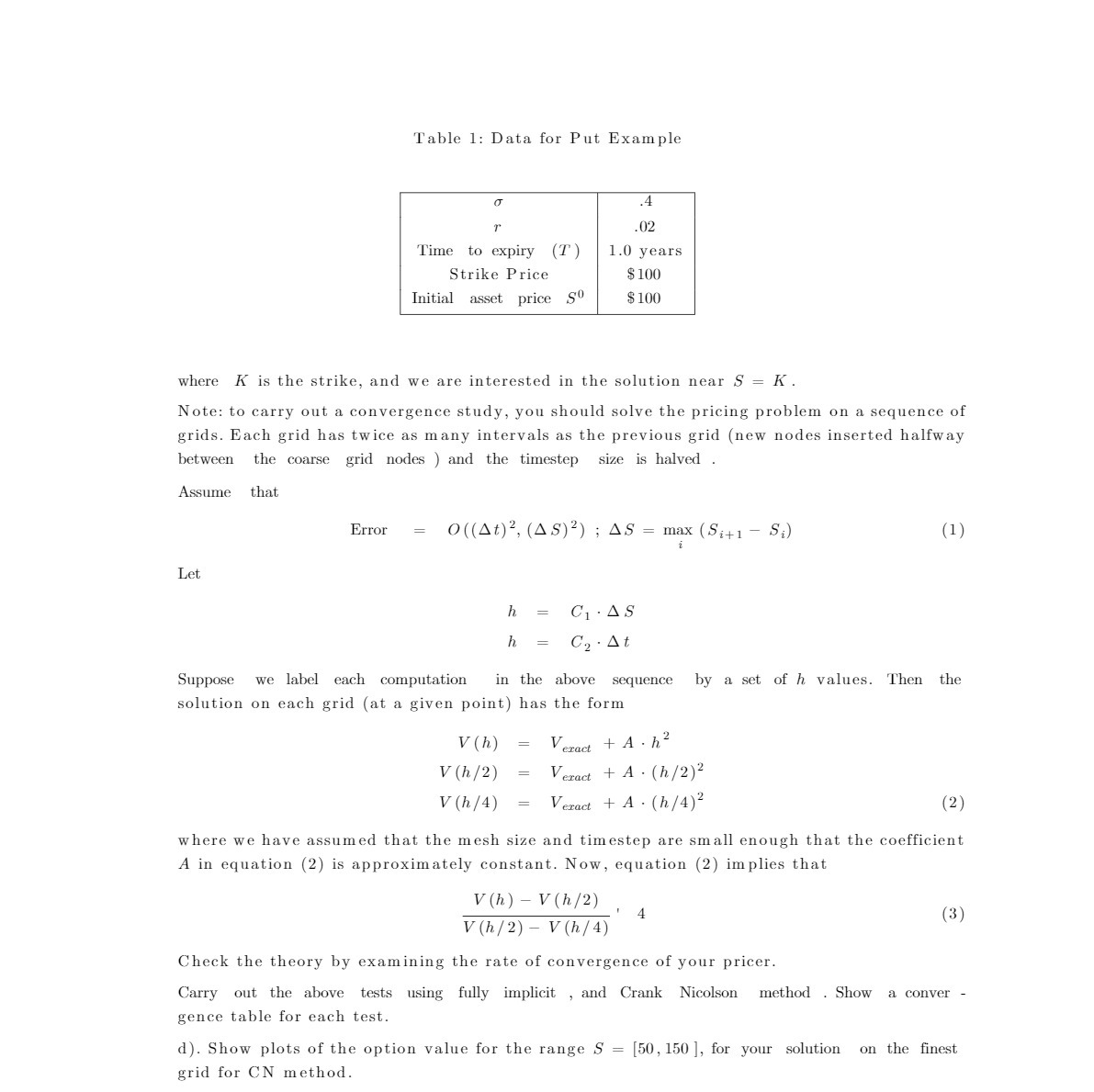
Table 1: Data for Put Example .4 Time to expiry (T ) 1.0 years Strike Price $ 100 Initial asset price SO $ 100 where K is the strike, and we are interested in the solution near S = K . Note: to carry out a convergence study, you should solve the pricing problem on a sequence of grids. Each grid has twice as many intervals as the previous grid (new nodes inserted halfway between the coarse grid nodes ) and the timestep size is halved . Assume that Error O ((At) ?, (AS ) ? ) ; AS = max ( Sit1 - S (1) Let h = C1 . AS h = C2 . At Suppose we label each computation in the above sequence by a set of h values. Then the solution on each grid (at a given point) has the form V (h) = Veract + A . h? V (h/2) = Veract + A . (h/2) 2 V (h/4) = Vexact + A . (h/4)? (2) where we have assumed that the mesh size and timestep are small enough that the coefficient A in equation (2) is approximately constant. Now, equation (2) implies that V(h) - V (h/2) (3) V (h/2) - V (h/ 4) Check the theory by examining the rate of convergence of your pricer. Carry out the above tests using fully implicit , and Crank Nicolson method . Show a conver - gence table for each test. d). Show plots of the option value for the range S = [50, 150 ], for your solution on the finest grid for CN method
Step by Step Solution
There are 3 Steps involved in it

Get step-by-step solutions from verified subject matter experts
 Study Help