







Question: Table 1. Type of bond based on electronegativity difference (AEN ) of bonded atoms Type of Bond Electronegativity Difference (4EN) Ionic 21.7 Polar Covalent 0.5
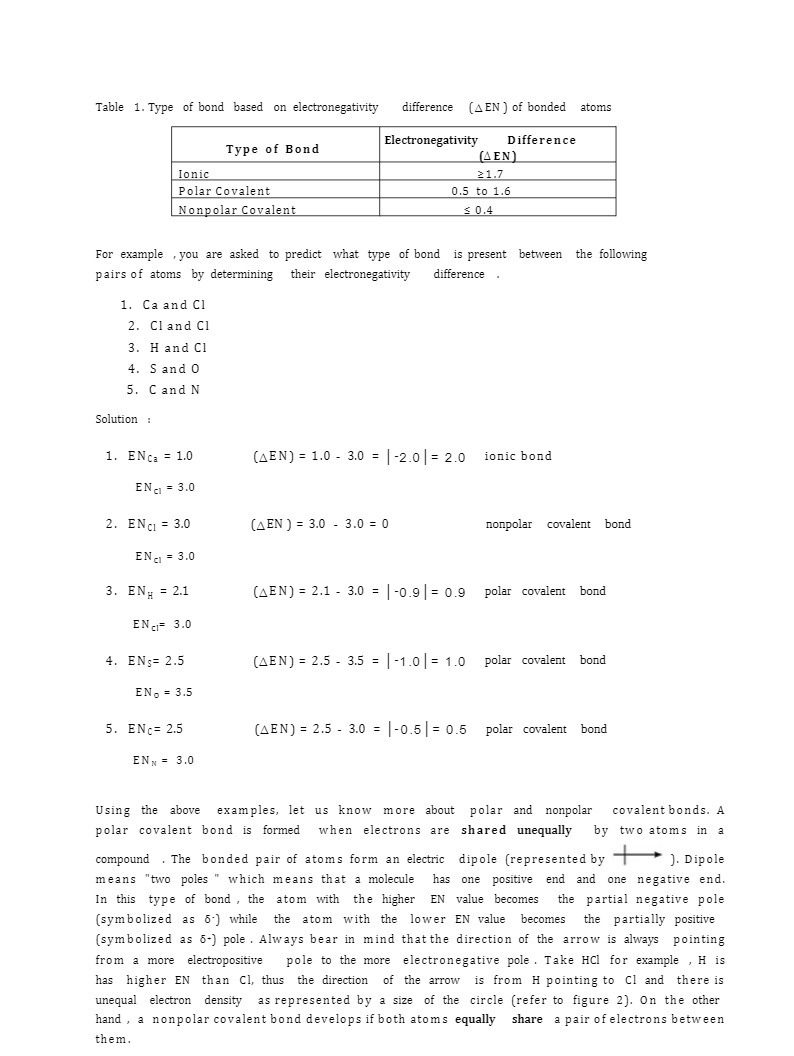
Table 1. Type of bond based on electronegativity difference (AEN ) of bonded atoms Type of Bond Electronegativity Difference (4EN) Ionic 21.7 Polar Covalent 0.5 to 1.6 Nonpolar Covalent $ 0.4 For example , you are asked to predict what type of bond is present between the following pairs of atoms by determining their electronegativity difference 1. Ca and Cl 2. Cland CI 3. H and Cl 4. Sand O 5. C and N Solution : 1. ENca = 1.0 (AEN) = 1.0 - 3.0 = |-2.0 | = 2.0 ionic bond EN- = 3.0 2. ENCI = 3.0 (AEN ) = 3.0 - 3.0 = 0 nonpolar covalent bond EN - = 3.0 3. ENy = 2.1 (AEN) = 2.1 - 3.0 = |-0.9 /= 0.9 polar covalent bond EN -1= 3.0 4. ENs= 2.5 (AEN) = 2.5 - 3.5 = |-1.0 | = 1.0 polar covalent bond EN. = 3.5 5. ENc= 2.5 (AEN) = 2.5 - 3.0 = |-0.5 = 0.5 polar covalent bond ENN = 3.0 Using the above examples, let us know more about polar and nonpolar covalent bonds. A polar covalent bond is formed when electrons are shared unequally by two atoms in a compound . The bonded pair of atoms form an electric dipole (represented by | * ). Dipole means "two poles " which means that a molecule has one positive end and one negative end. In this type of bond , the atom with the higher EN value e becomes the partial negative pole (symbolized as 6.) while the atom with the lower EN value becomes e partially positive (symbolized as 6-) pole . Always bear in mind that the direction of the arrow is always pointing from a more electropositive pole to the more electronegative pole . Take HCI for example , H is has higher EN than Cl, thus the direction of the arrow is from H pointing to Cl and there is unequal electron density as represented by a size of the circle (refer to figure 2). On the other hand , a nonpolar covalent bond develops if both atoms equally share a pair of electrons between them
Step by Step Solution
There are 3 Steps involved in it

Get step-by-step solutions from verified subject matter experts
 Study Help