







Question: TABLE OF ELECTRO-NEGATIVITY FORMAT: FAMILY ATOMIC # 7 ELEMENT ELECTRO-NEGATIVITY = 3.0 # 1 # 2 # 3 # 4 # 5 # 6
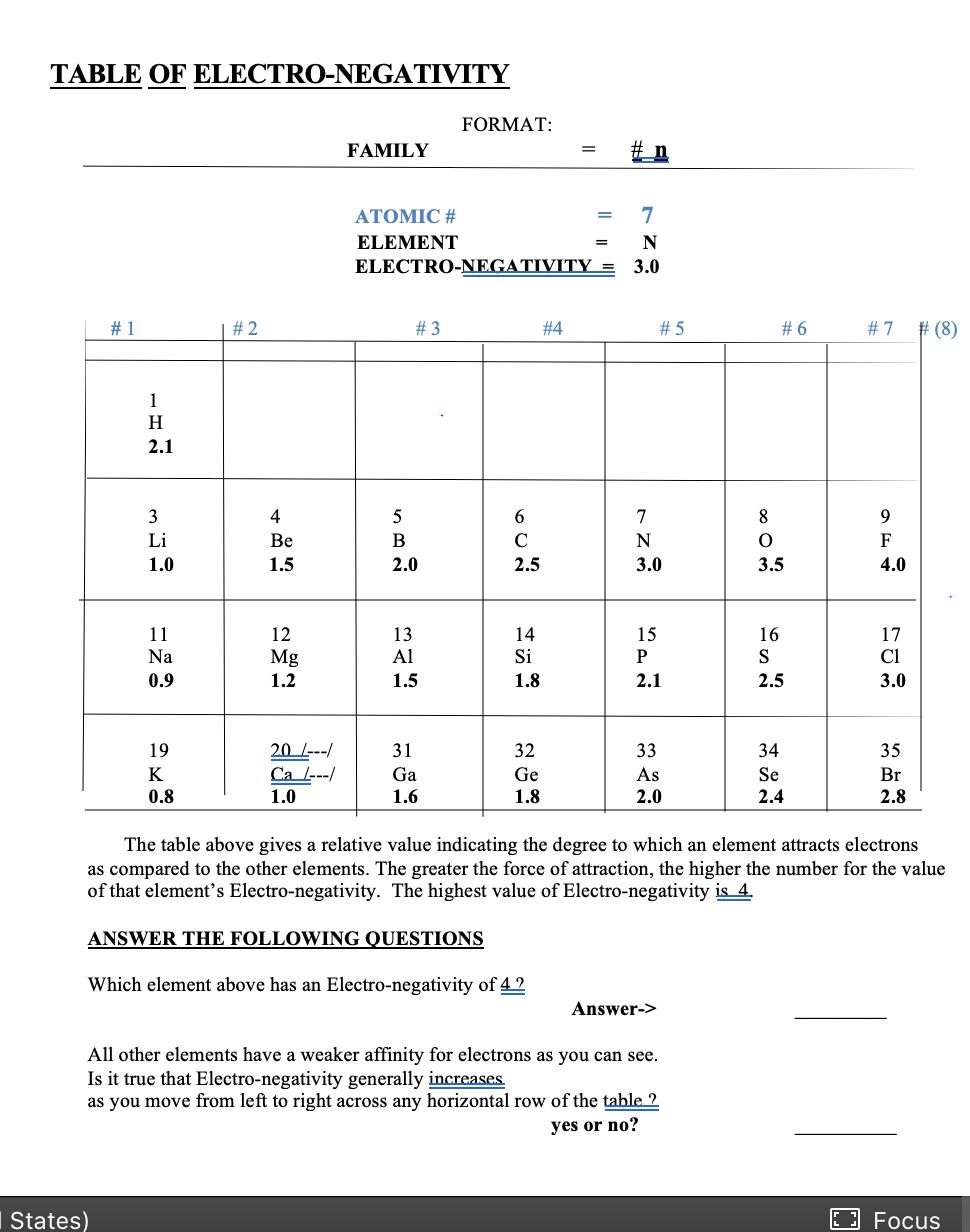

TABLE OF ELECTRO-NEGATIVITY FORMAT: FAMILY ATOMIC # 7 ELEMENT ELECTRO-NEGATIVITY = 3.0 # 1 # 2 # 3 # 4 # 5 # 6 #7 # (8) 1 H 2.1 3 4 6. 7 8 9 Li Be C N F 1.0 1.5 2.0 2.5 3.0 3.5 4.0 11 12 13 14 15 16 17 Na Mg Al Si P S Cl 0.9 1.2 1.5 1.8 2.1 2.5 3.0 20 L---/ Ca l---/ 19 31 32 33 34 35 K Ga Ge As Se Br 0.8 1.0 1.6 1.8 2.0 2.4 2.8 The table above gives a relative value indicating the degree to which an element attracts electrons as compared to the other elements. The greater the force of attraction, the higher the number for the value of that element's Electro-negativity. The highest value of Electro-negativity is 4. ANSWER THE FOLLOWING QUESTIONS Which element above has an Electro-negativity of 4 2 Answer-> All other elements have a weaker affinity for electrons as you can see. Is it true that Electro-negativity generally increases as you move from left to right across any horizontal row of the tahle ? yes or no? States) E Focus Does Electro-negativity increase as you read down each column towards the heavier elements ? yes or no? (1) Using the table on the previous page answer the following questions: Is the difference in electro-negativity between the two elements; Carbon compared to Nitrogen equal to 0.5 ? Nitrogen Carbon 30 -- attracts electrons more strongly than- - 2.5 (Subtract the smaller value from the greater of the 2. Nitrogen has the greater value= 3.) Difference 0.5 The electrons shared in a bond between Carbon and Nitrogen will spend a little more time around the Nitrogen atom. That will make the Nitrogen atom a little more negative and the Carbon atom a little more positive. This may create a dipole, a weak measurable atomic magnetic force. A bond which is a dipole will behave like an atomic level magnet Will the difference between Carbon and Nitrogen be enough to create an ionic bond? Will a non-polar covalent bond form? Or, will it be a polar covalent bond? Experiment has shown that if the difference in Electro-negativity between 2 atoms falls within certain values, we can predict the type of bond which forms.
Step by Step Solution
3.37 Rating (150 Votes )
There are 3 Steps involved in it
y 23 fhuosune F has electronegativiti 4 Yes increases elutronegativi... View full answer

Get step-by-step solutions from verified subject matter experts
 Study Help