







Question: Table 2.2 (p. 46) explains three models of ethics - Utilitarianism, Moral rights and Justice. Which model best describes your own view of ethics? 46
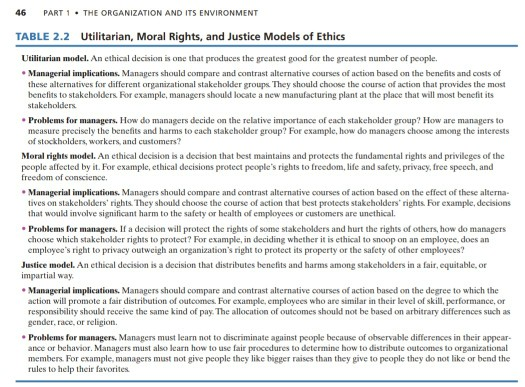
Table 2.2 (p. 46) explains three models of ethics - Utilitarianism, Moral rights and Justice. Which model best describes your own view of ethics?
46 PART 1 . THE ORGANIZATION AND ITS ENVIRONMENT TABLE 2.2 Utilitarian, Moral Rights, and Justice Models of Ethics Utilitarian model. An ethical decision is one that produces the greatest good for the greatest number of people. Managerial implications Managers should compare and contrast alternative course of action based on the benefits and costs of these alternatives for different organizational stakeholder groups. They should choose the course of action that provides the most benefits to stakeholders. For example, managers should locate a new manufacturing plant at the place that will most benefit its stakeholders Problems for managers. How do managers decide on the relative importance of each stakeholder group? How are managers to measure precisely the benefits and harms to each stakeholder group? For example, how do managers choose among the interests of stockholders, workers and customers? Moral rights model. An ethical decision is a decision that best maintains and protects the fundamental rights and privileges of the people affected by it. For example, ethical decisions protect people's rights to freedom, life and safety, privacy, free speech, and freedom of conscience. Managerial implications Managers should compare and contrast alternative courses of action based on the effect of these alterna tives on stakeholders' rights. They should choose the course of action that best protects stakeholders' rights. For example, decisions that would involve significant harm to the safety or health of employees or customers are unethical. Problems for managers. If a decision will protect the rights of some stakeholders and hurt the rights of others, how do managers choose which stakeholder rights to protect? For example, in deciding whether it is ethical to snoop on an employee, does an employee's right to privacy outweigh an organization's right to protect its property or the safety of other employees? Justice model. An ethical decision is a decision that distributes benefits and harms among stakeholders in a fair, equitable, or impartial way. Managerial implications. Managers should compare and contrast alternative courses of action based on the degree to which the action will promote a fair distribution of outcomes. For example, employees who are similar in their level of skill, performance, or responsibility should receive the same kind of pay. The allocation of outcomes should not be based on arbitrary differences such as gender, race, or religion. Problems for managers. Managers must learn not to discriminate against people because of observable differences in their appear- ance or behavior Managers must also learn how to use fair procedures to determine how to distribute outcomes to organizational members. For example, managers must not give people they like bigger raises than they give to people they do not like or bend the rules to help their favoritesStep by Step Solution
There are 3 Steps involved in it
1 Expert Approved Answer
Step: 1 Unlock

Question Has Been Solved by an Expert!
Get step-by-step solutions from verified subject matter experts
Step: 2 Unlock
Step: 3 Unlock
 Study Help