Question: Take detailed notes while in class during lecture, video or class discussions. Do your detailed class notes. Paste your in class notes in the space
Take detailed notes while in class during lecture, video or class discussions.
Do your detailedclass notes.
Paste your in class notes in the space provided below.
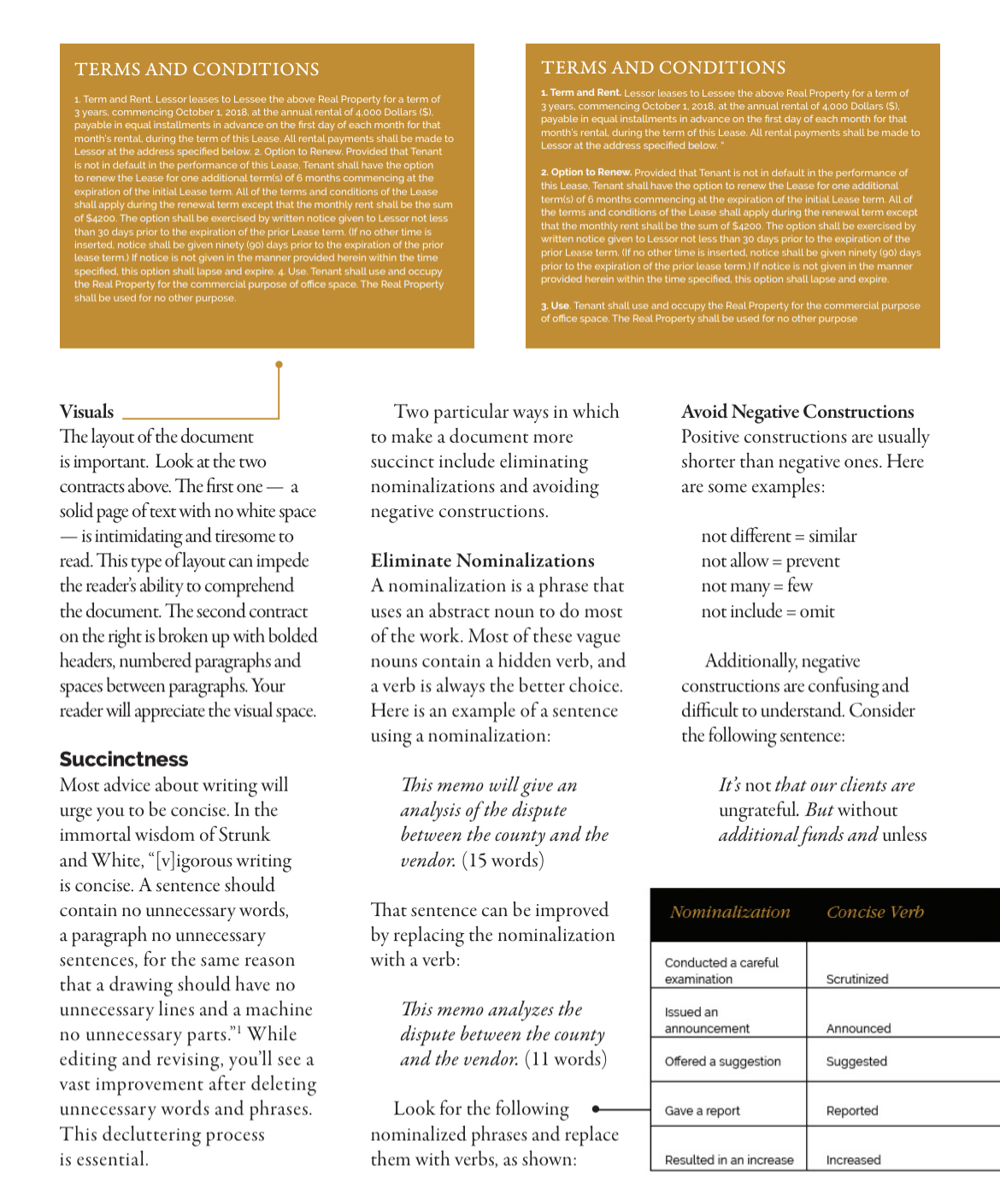
I_::'gal writingis a skill. And as ith any skill, you must prac- tice to improve. If you are a new or young lawyer without a lot of real-world writing experience, the information that you learned from your first-year legal writing course in law school might be a bit hazy. But even if you are a more seasoned law- yer and many years removed from that daunting first memorandum of law, you probably could bene- fit from a refresher. So, read on for some tips, pointers and guidance to improve your writing, The Basics Let's start with this very simple premise: Your goal is to create an casy-to-comprehend document with information that will per- suade the reader that your position is the correct one. A well-written legal document is one of the most important tools in a lawyer's arse- nal. No matter who your audience is or what type of writing you are doing, you don't want your reader to struggle to understand what you are trying to convey. First Draft Everyone has different approaches to writing a first draft. Some peo- ple like to write quickly, not looking back at what they have written and leaving notes on what to fill in lacer. Others set deadlines or goals, such as to have section X completed by a certain date. Whatever your Better Legal Writing approach is, don't worry too much about spelling and punctuation, word choice, or \"sounding good\" Your goal is to establish your main points, ideas and reasoning in black and white. Revising and editing is the essential stage that is when you craft a cohesive, competent and easily understood document. Audience For most legal writing, you will know your audience. Whether it is your senior manager, a partner or the court, write in a professional tone. The breezier you are, the less seriously you will be taken. Organization Organization has many elements, including structure, flow and visuals. Structure Many writers find it helpful to cre- ate an outline before drafting, Even ashort ouline like the following will ]u.']p guidc you to where you want to go and the points that you want to make: A Issue B. Answer C. Facts D. Discussion 1. First Cause of Action (discrimination based on race) 2. Second Cause of Action (intentional infliction of emotional distress) E. Conclusion For persuasive writing, consider the order of your arguments. Ask yourself what will make the biggest impact. Most of the time, use your strongest argument first. Other times, you may want to lead with the most contentious issue, getting that out of the way for less prickly topics later. Sometimes a substantive or jurisdictional threshold ques- tion may affect the rest of your argument, so start with that. Always keep your reader in mind. You may have been researching, contemplating and musing with colleagues for several weeks or even months on the issues. But your reader must catch up with you in the span of several minutes. To case the reader into your world, consider writing broadly and then gradually narrowing down your issues. Alternatively, think of starting with simple concepts and then advancing to the more complex. When possible, use examples to aid the reader's comprehension. Flow The How of a document helps guide the reader, so provide as many road signs as possible, including transi- tions, topic sentences and headings/ subheadings. To ease the reader Into your world, consider writing broadly and then gradually narrowing down your ISsues. Use connecting or transitioning words liberally, between both para- graphs and sentences. Your building blocks are sentences and paragraphs. Sentences should connect ro each other and then logically flow into paragraphs. (See sidebar p. 12 for some frequently used eransitional words and phrases). Paragraphs are your basic unit of composi- tion. Don't worry about their length too much (although you should avoid very long paragraphs that may make it hard for your reader to maintain her attention). Instead, focus on whether each paragraph represents a single idea. Generally, the first few paragraphs will give you the best recurn on investment, so they are the most valuable in terms of expressing your point. Each paragraph should start with a topic sentence. A topic sentence will tell the reader what the rest of the paragraph is about. Here is an example: Like the worker in Jackson v. Charter Industries, Alice Corcoran was not an employee because Cook County did not control the performance of her work. Here, the topic sentence illus- trates the author's conclusion about the application of the rule to the facts of the client's case. The rest of the paragraph would describe the reasons why Cook County was not in control of her work. Finally, in any document lon- ger than a few pages, use headings and/or subheadings. Think of headings and subheadings as signs on a highway, giving read- ers directions to guide them on the proper path to take in com- prehending the subject matter of cach section. TERMS AND CONDITIONS TERMS AND CONDITIONS . Term and Rent. Lessor leases to Less rty for a term of 1. Term and Rent. Lessor leases to Lessee the above Real Property for a term of 3 years, commencing October 1, 2018, at the annual rental of 4.000 Dollars ($). 3 years, commencing October 1, 2018, at the annual rent annual rental of 4,000 Dollars ($). payable in equal installments in advance o rst day of each month for that payable in equal installments in advance on the first day of each month for that ll be made to month's rental. during the term of this Lease. All rental payments shall be made to ovided that Tenant Lessor at the address specified below. " to renew the Lease for one additional term(s) of mmencing at the 2. Option to Renew. Provided that Tenant is not in expiration of the initial this Lease, Tenant shall have the option to renew shall apply during the renewal ent shall be the sum term(s) of 6 months commencing at the expiration of the Lease term. All of of $4200. The option s to Lessor not less the terms and con than 30 days prior to the expiration of the that the monthly rent shall be the sum of ed by Inserted. notice shall be given lease term.) If notice is not given in the manner provided herein within the time prior Lease term. (If no other time is insert be given ninety (90) days specified, this option shall lapse and expire. 4. Use. Tenant shall use and occupy prior to the expiration of the prior lea he manner the Real Property for the commercial purpose of office space. The Real Property provided herein within the tir expire. shall be used for no other purpose. 3. Use. Tenant shall use and occupy the Real Property for the commercial purpose of office space. The Real Property shall be used for no other purpose Visuals Two particular ways in which Avoid Negative Constructions The layout of the document to make a document more Positive constructions are usually is important. Look at the two succinct include eliminating shorter than negative ones. Here contracts above. The first one - a nominalizations and avoiding are some examples: solid page of text with no white space negative constructions. - is intimidating and tiresome to not different = similar read. This type of layout can impede Eliminate Nominalizations not allow = prevent the reader's ability to comprehend A nominalization is a phrase that not many = few the document. The second contract uses an abstract noun to do most not include = omit on the right is broken up with bolded of the work. Most of these vague headers, numbered paragraphs and nouns contain a hidden verb, and Additionally, negative spaces between paragraphs. Your a verb is always the better choice. constructions are confusing and reader will appreciate the visual space. Here is an example of a sentence difficult to understand. Consider using a nominalization: the following sentence: Succinctness Most advice about writing will This memo will give an It's not that our clients are urge you to be concise. In the analysis of the dispute ungrateful. But without immortal wisdom of Strunk between the county and the additional funds and unless and White, "[vigorous writing vendor. (15 words) is concise. A sentence should contain no unnecessary words, That sentence can be improved Nominalization Concise Verb a paragraph no unnecessary by replacing the nominalization sentences, for the same reason with a verb: Conducted a careful that a drawing should have no examination Scrutinized unnecessary lines and a machine This memo analyzes the Issued an no unnecessary parts." While dispute between the county announcement Announced editing and revising, you'll see a and the vendor. (1 1 words) Offered a suggestion Suggested vast improvement after deleting unnecessary words and phrases. Look for the following Gave a report Reported This decluttering process nominalized phrases and replace is essential. them with verbs, as shown: Resulted in an increase Increasedthere are no fewer than five people to work on the proj- ect, it would be imp{)ssih]c to meet the deadline. Can you quickly work out what it means without having to translate the negatives in your head? Here is a better way to reword that sentence: Our clients are grateful. But they need additional funds and at least five people to meet the deadline. Legalese Ahhh, legalese. You may think that legalese makes you sound like a lawyer. And it does a pompous one. Just because you attended law school for three yearsand then had the wherewithal to pass the bar does not give you a free pass to use legal- ese. Atits best, legalese is verbose; at its worst, it is conu;ing and patron- izing. Forget about trying to sound like those cases you read in law school. They were written eons ago. Remember the premise we opened with: Your goal is to create an casily understood document. Wordy Idioms Try to avoid wordy idioms. Here are some examples of less wordy alternatives: despite the fact that = although for the period of = for until such time as = until Redundant Legalisms Also avoid redundant legalisms, where one or two words can do the work of three or four: fitll and com- plete becomes full, null and void becomes null, and true and correct becomes true. Latin Phrases If possible, don't use Latin phrases. Yes, we know that the legal profession is replete with them and that they are sometimes terms of art and cannot be avoided, but often your reader will have to scramble to Google them. Use perfectly good English words/ phrases instead: apriori = from carlier bona fide = in good faith de facto = in fact inter alia = among others locus = place sub modo = subject to modification Fancy Words and Foreign Phrases Briefs and motions are chock- full of highfalutin' words even though easier words are a better choice. You may think that fancy words will make you sound important, but simpler words will improve reader comprehen- sion. Do you want the reader to have to read a sentence twice to understand it? Instead of behav- ioval dynamics, use bebavior. Instead ()Fpredimred and initi- ated, use decided. Instead of Sturm und Drang, use turmoil. Instead of sub rosa, use performed in secret. Passive Voice Passive voice can trip up new writers. Passive voice occurs when the object ofan action is turned into the subject of the sentence. Huh? Let's untang]c this knot with an example of passive voice: The county offices were dam- aged by fire. A better way to write this sen- tence would be in active voice: Fire damaged the county offices. To identify passive voice, ask yourself who or what is doing the action. Is the person or thing doing the action (active voice) or having the action done to it (passivc voice)? In the firse example sentence above, county offices is in the subject position even though it is the objcct of the action (damage). Because the fire is doing the action, it should be at the front of the sentence as the subject, as it is in the second example sentence. To spot passive voice, look for a form of the verb 10 be (e.g., am, are, is, was, were, have been, had been, will be, will have been, being) plus the past participle (a verb that typically ends in ed). In the above example, the phrase were damaged indicates passive voice. Strunk and White urge writers to use active voice because it is \"usually more direct and vigorous than the passive.\" It is also usually more concise. So why is passive voice used? One reason is to deflect culpability: first try. Quite often, you will spots that trip you up? Your ear Mistakes were made by discover, on examining the might be more attuned than your our client. (6 words) completed work, that there are eye to clunky construction. serious flaws in the arrangement Also think about sentence end- This sounds a little less blame- of material, calling for ings. Writers sometimes think that worthy than the following, transpositions."3 the most prominent position in a which is in active voice: In the fourth edition of sentence is the beginning. Actually, Elements of Style, Strunk and it's the end of a sentence that usually Our client made mis- White urge writers to use the has the most impact. For example, takes. (4 words) cut-and-paste function of a look at the following sentence: word processor (obviously not Sometimes passive voice is pref- in play when the little treatise The City of Springdale erable, but we will leave the politics was first published in 1959) and respectfully asks this court to and ethics of that for another day. to "not be afraid to experiment enter a summary judgment The important point is to know with what you have written." and find that there is no the difference between active voice Make a new version, dating it reason to delay enforcement and passive voice and to stick with or using some kind of naming or appeal under Rule 304. active voice most of the time. convention (e.g., Brief edit 2) so you can keep track of your Now look at this revision: Revisions various versions. Edit line by line Revising is the most crucial and cut unnecessary words. If you The City of Springdale phase of writing. Strunk and don't like your edits after a day or respectfully asks this court to White said, "Revising is part two, you can always go back to a enter a summary judgment of writing. Few writers are so previous version. and to find under Rule 304 expert that they can produce Read your work out loud at least what they are after on the once to gauge the rhythm. Are there continued on p. 15 Frequently Used Transitional Words and Phrases To express similarity: similarly, analogously, as, accordingly, likewise To express contrast: but, in contrast, conversely, however, yet, nonetheless, despite, instead To indicate examples: specifically, namely, such as, including, including but not limited to To indicate explanation: thus, therefore, accordingly, consequently To expand upon points: indeed, moreover, further, in other words, in fact To indicate summarization: finally, in conclusion, in summaryUltimately, the decision was made to ship most of the horses to America because they stood the best chance for survival on a continent not recovering from war. The horses embarked on their journey to the States in a cargo ship on October 1, 1945, which was fraught with danger and delays, including a ter- rible storm that resulted in food shortages and most of the horses falling ill. At last, the war orphans, as the horses were called, arrived in Newport News, Virginia, on October 28, 1945, and would go on to thrive. Rudofsky and Lessing stayed behind with their fam- ilies; the others involved left with the horses. Patcton was severely injured in a car accident, which paralyzed him from the neck down; he died 13 days later of a pul- monary embolism on December 21, 1945. The last part of the book touchingly reveals what became of the rescued horses and the determined men who risked their lives to save them. In 1949 in Fort Reno, Oklahoma, Caprain Tom Stewart was reunited with one of the horses that he fought to save, and this allowed him to make peace with his survivor's guilt.\" In 1950, General 2atton's widow met Colonel Podhajsky at Madison Square Garden. Though on opposite sides of the war, Colonel Reed and Podhajsky were reunited after 19 years and embraced as friends.\" Letts spoke to the families of veterans and combed through photo albums, scrapbooks, old letters and other archived material to piece together this extraordinary story." Horse lovers or not, readers will enjoy this book not only for its incredible tale but also because it serves as ales- son in bipartisanship, and illustrates how working together for a common goal and shared interests and setting aside enmity are more rewarding than winning the bactle. Endnotes 1. ELizaBeTH LETTS, THE PERFECT HORSE: THE DarinGg ULS, MISS10N TO RESCUE THE PRICELESS STALLIONS KIDNAPPED BY THE Nazis 222,293 (2016). 2. Id. ac xviii. 3. 1d a4 4. Id ac 195, S5.1d. ac 176. 6. 1d. ar 33, 146, 7.1d ac 182, 8. Jd ac279. 9. Id ac292. 10. Id. at 309. that there is no reason to delay enforcement or appeal. See how the second version pops a bit more? End your sentences emphatically, and you will create oomph. If possible, allow edits and revisions to percolate in your brain for a day or so that is, \"sleep on it Then, give your piece a comprehensive final proof- reading. Double-check spelling. Revise punctuation. Review grammar. Don't rely on spell-check or your word processor's grammar feature. Ask a colleague to proofread one last time before submitting, espe- cially if you have revised many times and are sick to death of looking at your work. You may be surprised at the number of errors that he will catch. Conclusion Whether you are right out of law school or a grizzled veteran, legal writing is no easy task. A well- crafted legal document is one of the most important tools of a lawyer. Edit robustly; experiment liberally; and always, always remember the goal: to transmit casily comprehensible information to your reader. Endnotes 1. WILLIAM STRUNK JR. & E. B. WHITE, THE ELEMENTS OF STYLE 23 (4ch ed. 2000). 2.0d. ar 18, 3.0d ac72. 4. 1d
Step by Step Solution
There are 3 Steps involved in it
1 Expert Approved Answer
Step: 1 Unlock
Question Has Been Solved by an Expert!
Get step-by-step solutions from verified subject matter experts
Step: 2 Unlock
Step: 3 Unlock
Students Have Also Explored These Related Business Writing Questions!









 Study Help