







Question: tarleton.instructure.com C + 88 hw10.pdf & Download i Info X _Close ZOOM + PSYC 2317: Statistical Methods for Psychology Tarleton State University Unit 10 Homework
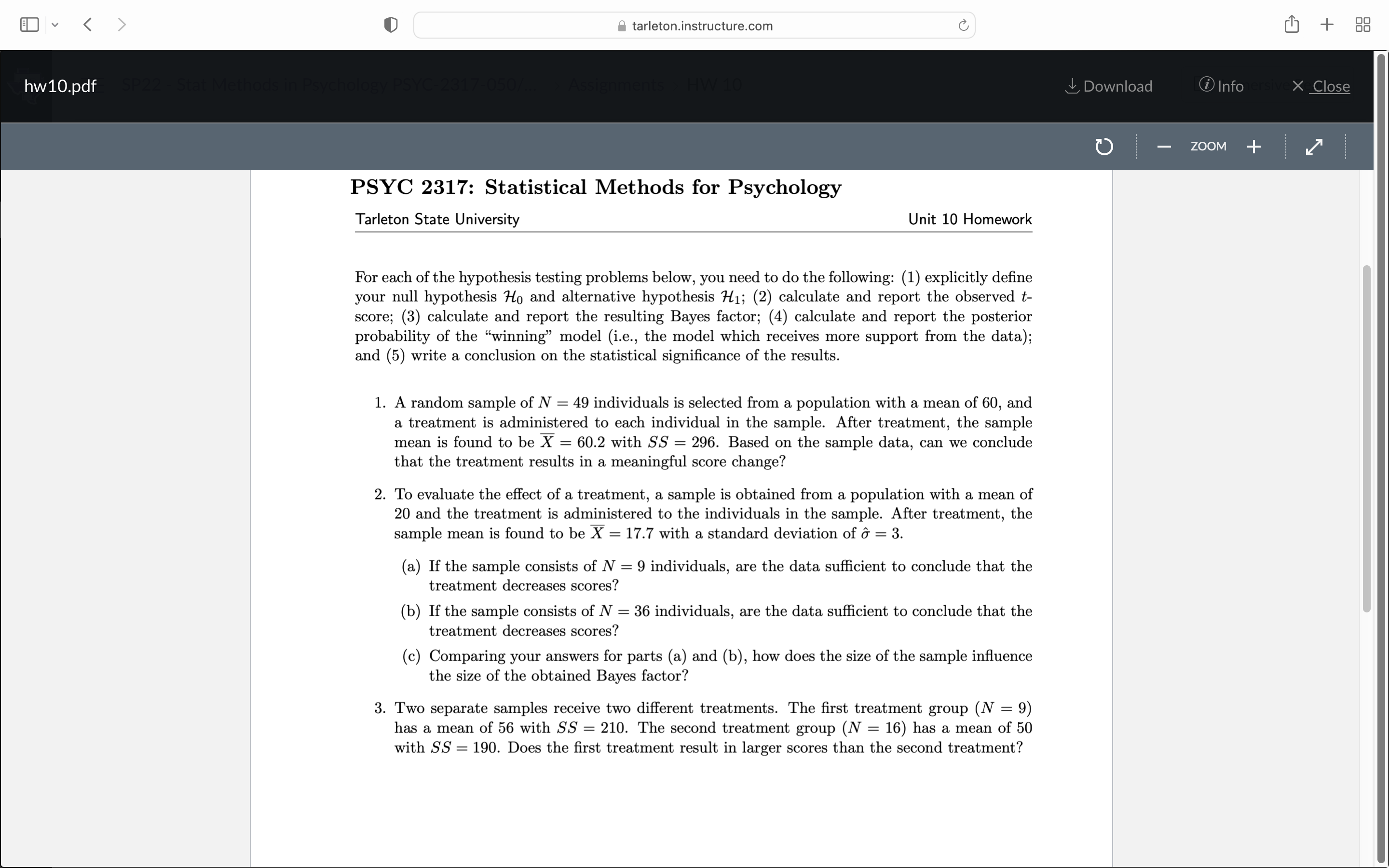
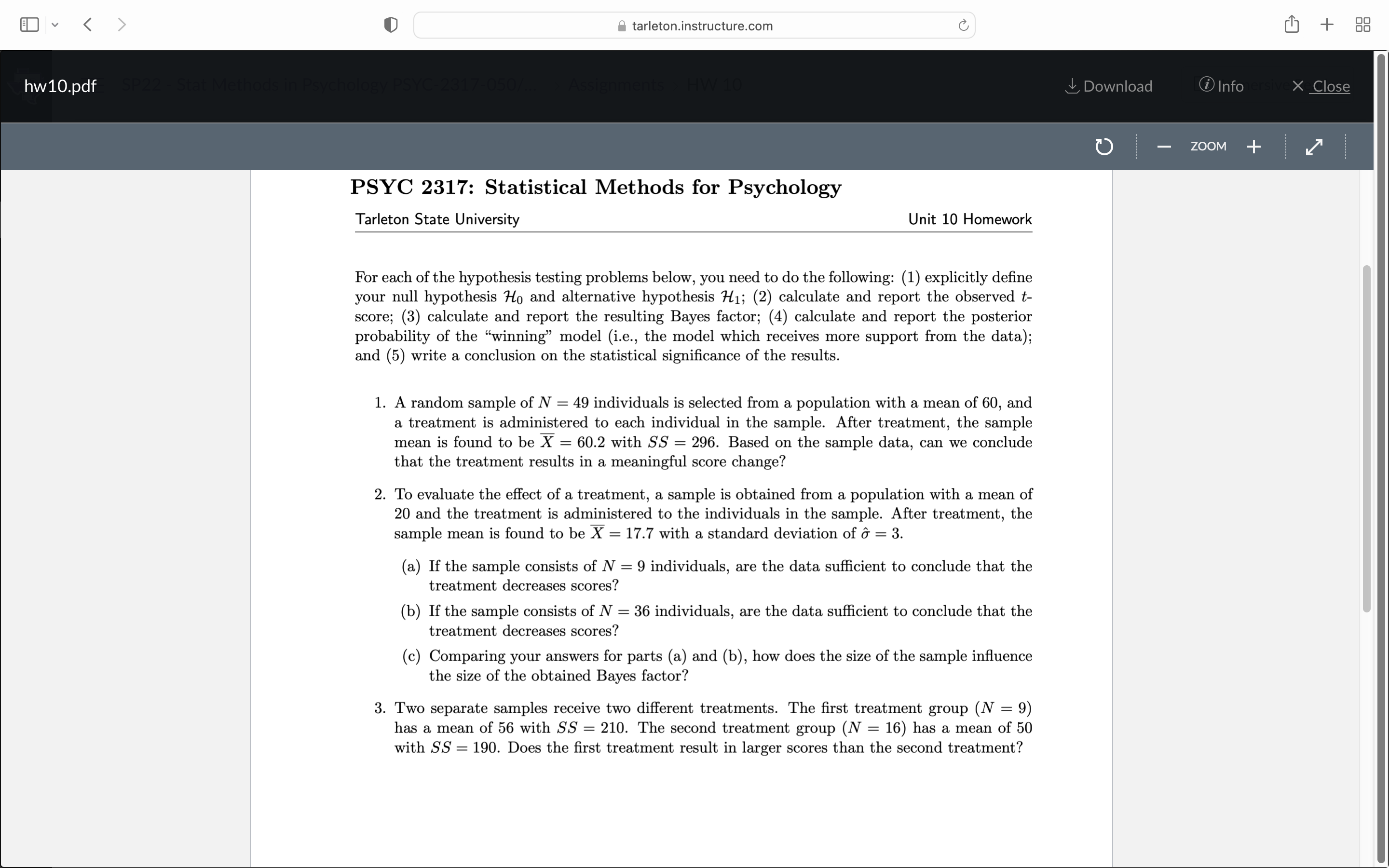
tarleton.instructure.com C + 88 hw10.pdf & Download i Info X _Close ZOOM + PSYC 2317: Statistical Methods for Psychology Tarleton State University Unit 10 Homework For each of the hypothesis testing problems below, you need to do the following: (1) explicitly define your null hypothesis Ho and alternative hypothesis 7/1; (2) calculate and report the observed t- score; (3) calculate and report the resulting Bayes factor; (4) calculate and report the posterior probability of the "winning" model (i.e., the model which receives more support from the data); and (5) write a conclusion on the statistical significance of the results. 1. A random sample of N = 49 individuals is selected from a population with a mean of 60, and a treatment is administered to each individual in the sample. After treatment, the sample mean is found to be X = 60.2 with SS = 296. Based on the sample data, can we conclude that the treatment results in a meaningful score change? 2. To evaluate the effect of a treatment, a sample is obtained from a population with a mean of 20 and the treatment is administered to the individuals in the sample. After treatment, the sample mean is found to be X = 17.7 with a standard deviation of o = 3. (a) If the sample consists of N = 9 individuals, are the data sufficient to conclude that the treatment decreases scores? (b) If the sample consists of N = 36 individuals, are the data sufficient to conclude that the treatment decreases scores? (c) Comparing your answers for parts (a) and (b), how does the size of the sample influence the size of the obtained Bayes factor? 3. Two separate samples receive two different treatments. The first treatment group (N = 9) has a mean of 56 with SS = 210. The second treatment group (N = 16) has a mean of 50 with SS = 190. Does the first treatment result in larger scores than the second treatment
Step by Step Solution
There are 3 Steps involved in it

Get step-by-step solutions from verified subject matter experts
 Study Help