







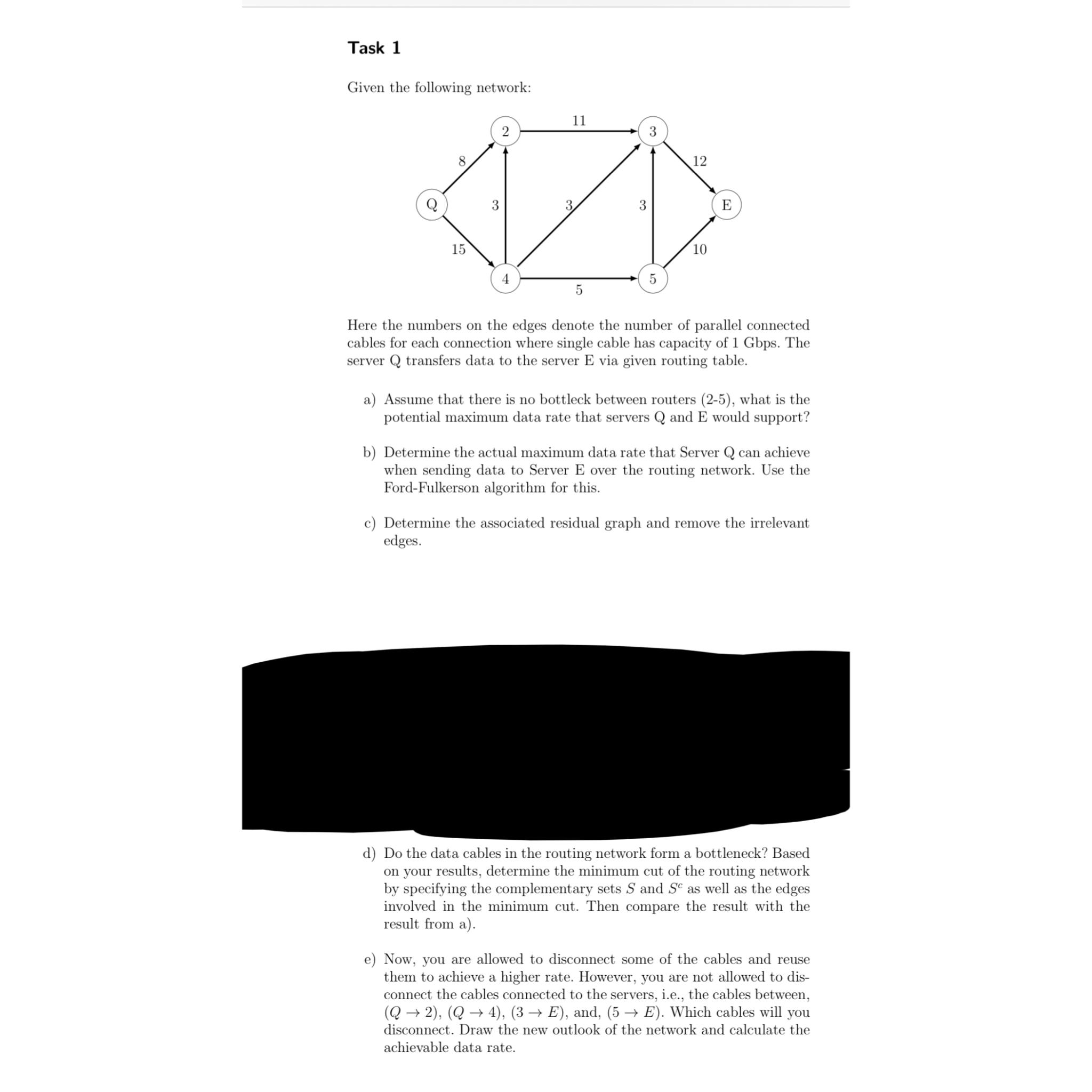
Question: Task 1 Given the following network: Here the numbers on the edges denote the number of parallel connected cables for each connection where single cable
Task
Given the following network:
Here the numbers on the edges denote the number of parallel connected cables for each connection where single cable has capacity of The server transfers data to the server via given routing table.
a Assume that there is no bottleck between routers what is the potential maximum data rate that servers and would support?
b Determine the actual maximum data rate that Server can achieve when sending data to Server E over the routing network. Use the FordFulkerson algorithm for this.
c Determine the associated residual graph and remove the irrelevant edges.
d Do the data cables in the routing network form a bottleneck? Based on your results, determine the minimum cut of the routing network by specifying the complementary sets and as well as the edges involved in the minimum cut. Then compare the result with the result from a
e Now, you are allowed to disconnect some of the cables and reuse them to achieve a higher rate. However, you are not allowed to disconnect the cables connected to the servers, ie the cables between, and, Which cables will you disconnect. Draw the new outlook of the network and calculate the achievable data rate.
Step by Step Solution
There are 3 Steps involved in it
1 Expert Approved Answer
Step: 1 Unlock

Question Has Been Solved by an Expert!
Get step-by-step solutions from verified subject matter experts
Step: 2 Unlock
Step: 3 Unlock
 Study Help