







Question: Task 1 : Kalman Filter Design You will need to design an integrated GPS / IMU / Air - data navigation system by constructing a
Task : Kalman Filter Design
You will need to design an integrated GPSIMUAirdata navigation system by constructing a navigation model with states position velocity, attitude and wind components inputs and measurements, and adapt your scalar extended Kalman filter EKF or iterated extended Kalman filter IEKF algorithm from the lab. The choice between EKF and IEKF is at your own discretion. If you are familiar with other estimation schemes, eg unscented Kalman filter, feel free to use them as well.
For this task you will work with dataTask mat which contains input measurements the outputs and the time variables and in seconds. and are matrices with rows the recordings of different time instances and the columns the variables are in the same ordering of and presented earlier.
You will realize that in comparison to your lab exercise, the expected value for the initial condition and the error covariance are not explicitly given. You could use engineering judgment to configure this.
For state variables that can be directly measured simply assume the initial value to be the same as the noisy measurements at the first time instance.
The airspeed body components we do not directly measure but we know the airspeed is measured and we know the airspeed will be mostly in the forward travelling direction. So it is reasonable to configure the initial guess of to be As for the wind speeds, we can simply guess them to be zero. The key point of making these engineering guesses is that you need to tell the scheme through that these guesses are far from being accurate, by making the variancestandard deviation suitably large.
Task : For the use of the Kalman filter, you will need to derive the Jacobian matrices for our nonlinear system. Obtain the expressions for your derived Jacobian matrices and with and from and from Present the expressions for the following elements in your report:
The th row, th column of the matrix,
The th row, th column of the matrix,
The th row, th column of the matrix,
The th row, th column of the matrix,
The th row, th column of the matrix,
The th row, th column of the matrix.
Hints: substitute IMU measurement equations into the kinematic equations, then group different terms appropriately into and Equations for the kinematic model and observation model can be found in usefulEquations.m and you can use Matlab's Symbolic Math Toolbox to help you compute the required matrices code developed in Lab B and may be helpful
Task : Complete the Kalman Filter design for the integrated navigation system code developed in Lab C may be helpful In clear figures, plot the trajectories of the estimated states and comment on your findings.
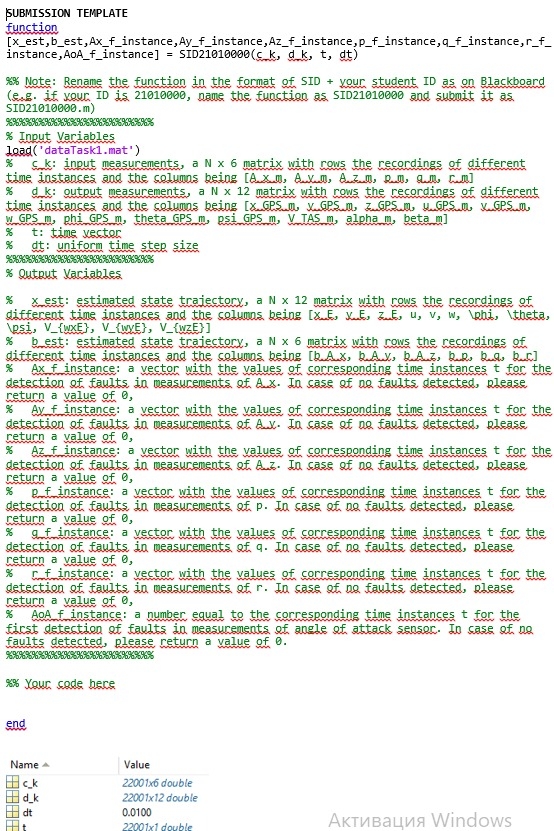
SUBMISSION TEMPLATE
function
instance, nstance
Note: Bename the function in the format of SID vour student ID as on Blackboard eg if xeur ID is name the function as SID and submit it as SIDm
$
Input Variables
loaddataTaskmat'
c k: input measurements, a N x matrix with rows the recordings of different
d k: output measurements, a N x matrix with rows the recordings of different W GPS m Phi GPS m theta GPS m RSi GPS m V TAS m alpha m beta m
t: time vecter
dt: uniform time step size
qutput Vaciables
x est: estimated state trajectory, a N x matrix with rows the recordings of psi, :
best: estimated state trajectory, a N x matrix with rows the recordings of
Ax
Step by Step Solution
There are 3 Steps involved in it
1 Expert Approved Answer
Step: 1 Unlock

Question Has Been Solved by an Expert!
Get step-by-step solutions from verified subject matter experts
Step: 2 Unlock
Step: 3 Unlock
 Study Help