







Question: Task 1 ----------------------------- - Read the attachment Driving Safely Assignment and finish all the 5 paper - YOU MUST GET ALL THE ANSWERS RIGHT -
Task 1
-----------------------------
- Read the attachment "Driving Safely Assignment" and finish all the 5 paper
- YOU MUST GET ALL THE ANSWERS RIGHT
- Also, provide steps too.
- Please help me with this task
- Please take your time, even more than 1 or 2 hours, but make sure ALL answers are correct, triple check all answers
ALL ANSWERS MUST BE CORRECT
Driving Safely Assignment
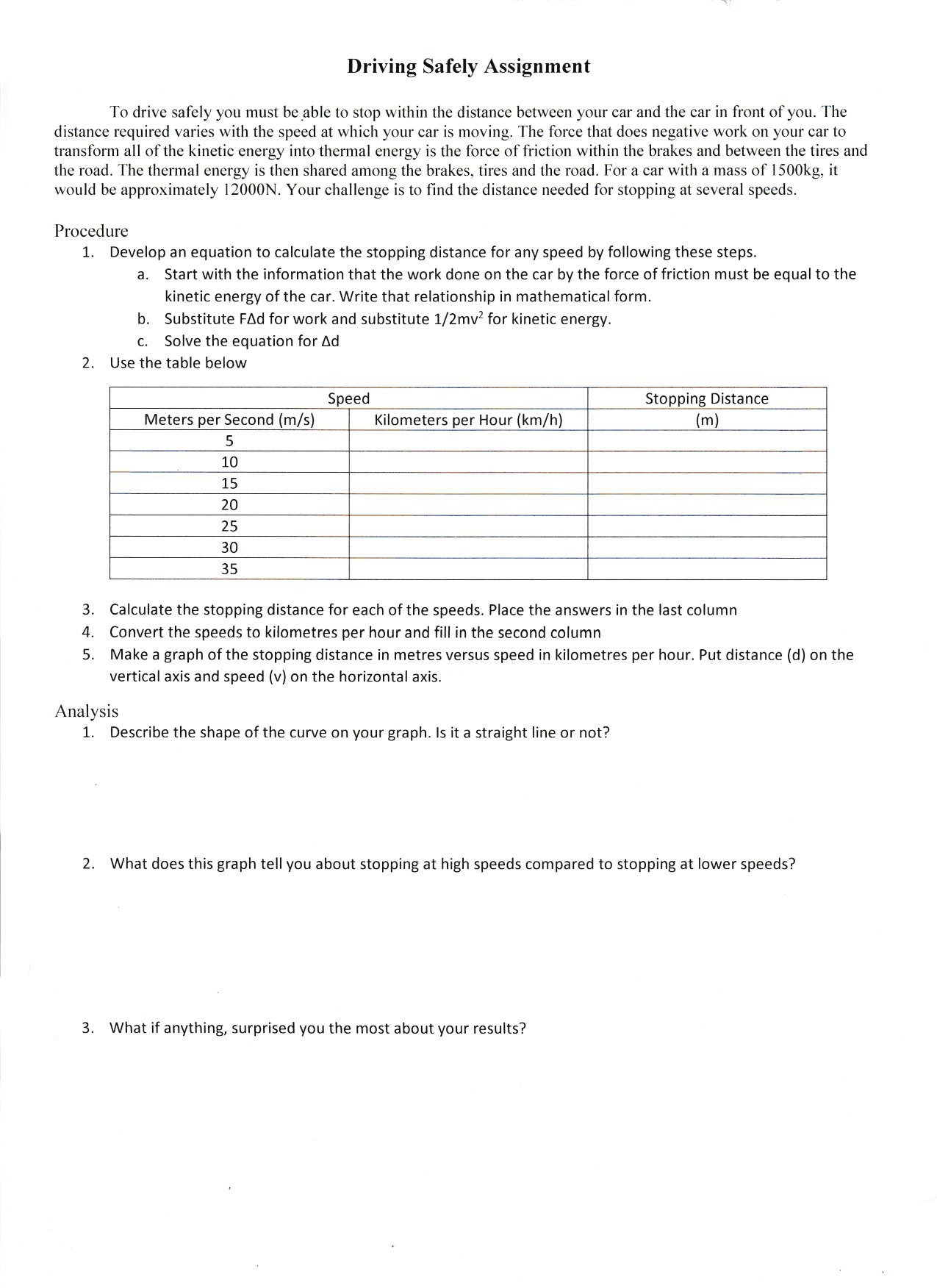

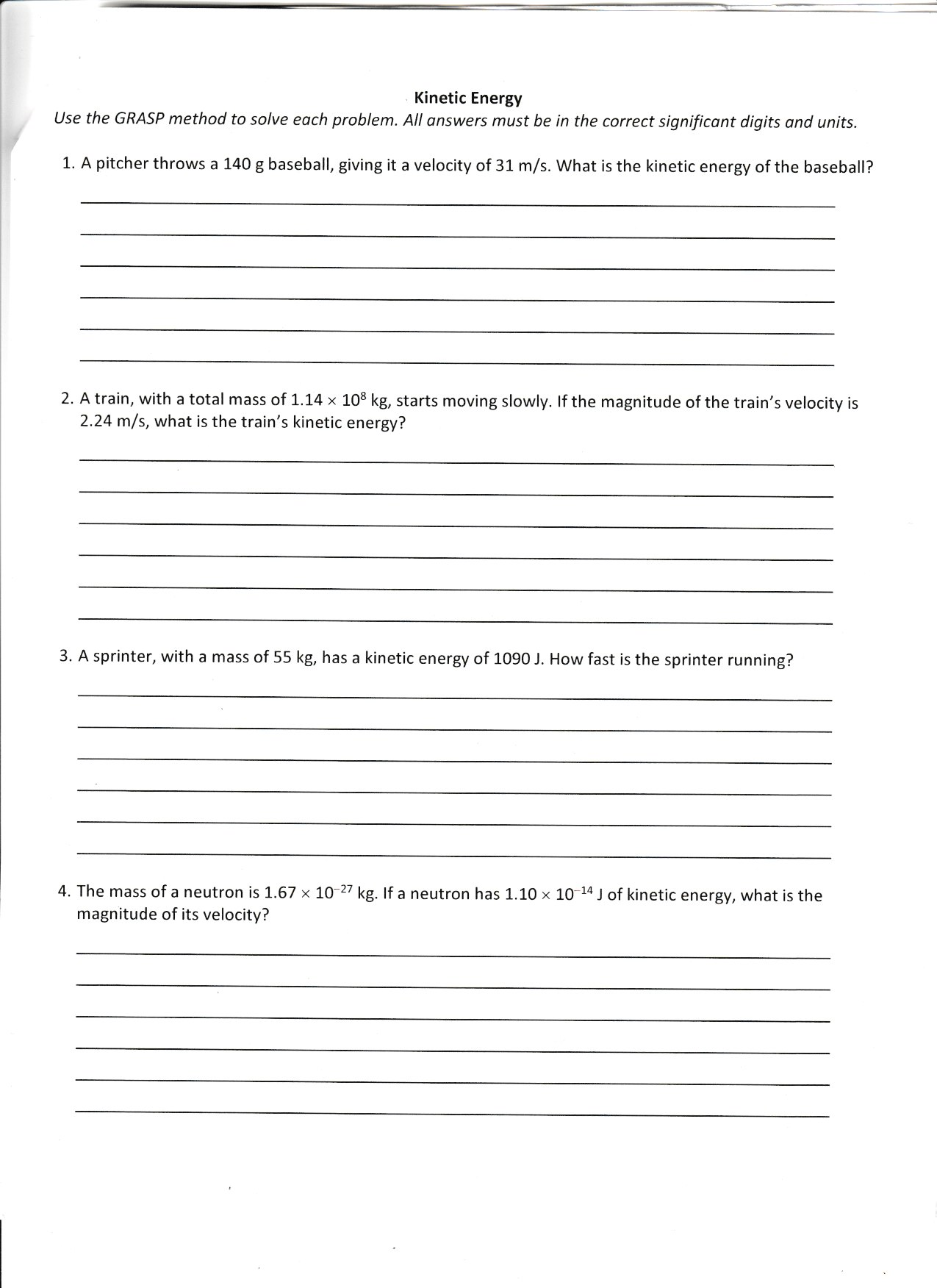
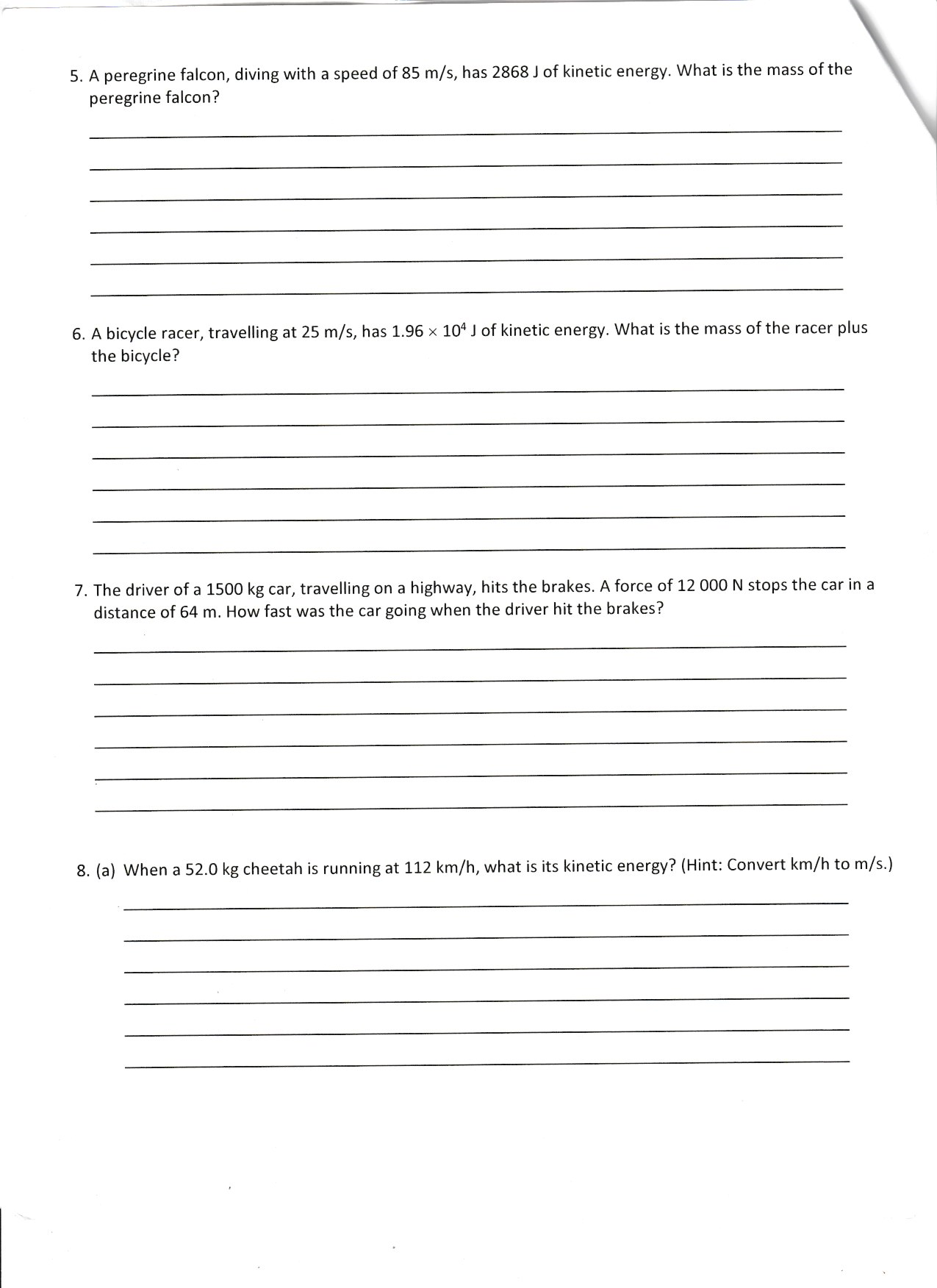
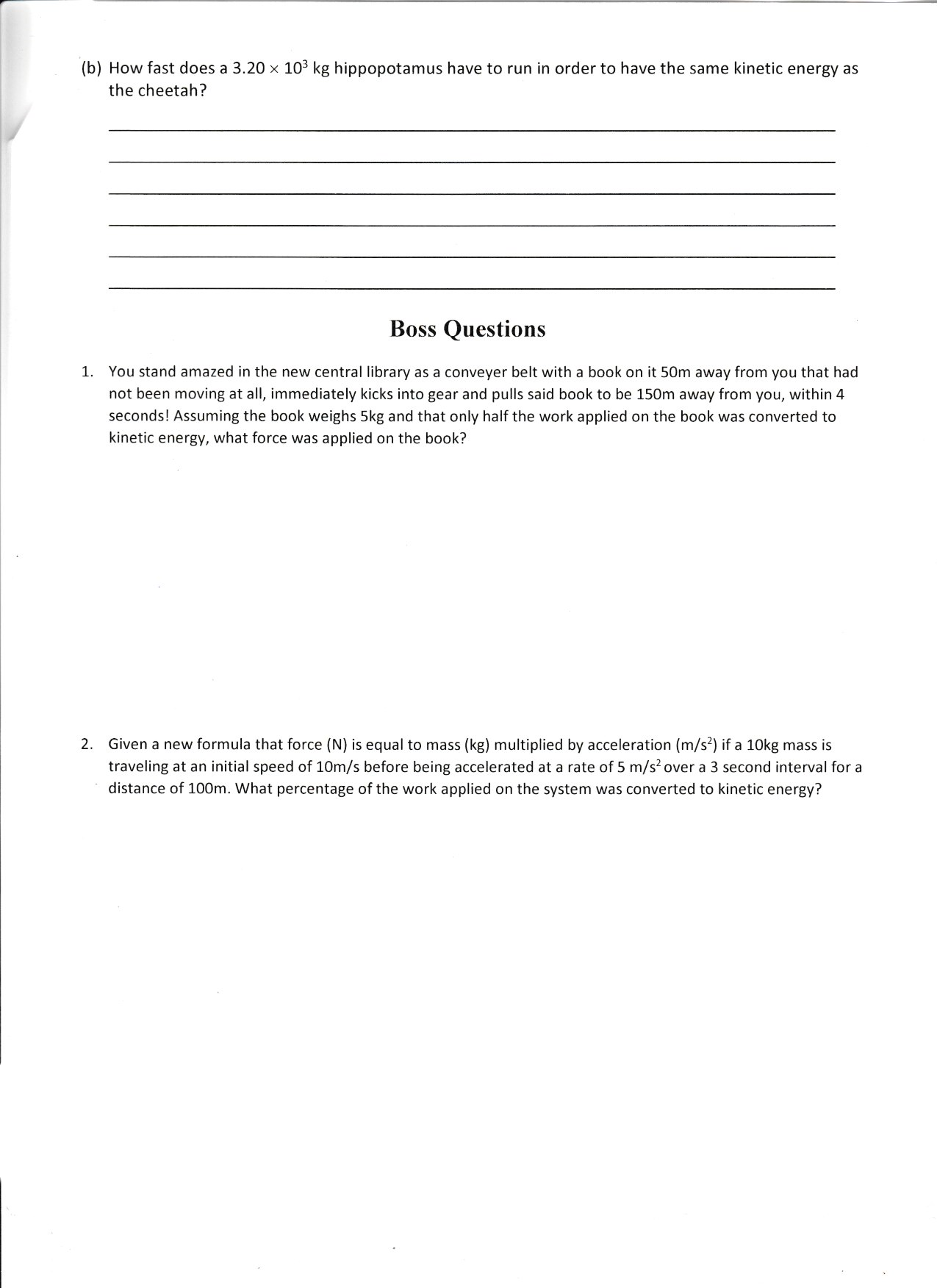
Driving Safely Assignment To drive safely you must be able to stop within the distance between your car and the car in front of you. The distance required varies with the speed at which your car is moving. The force that does negative work on your car to transform all of the kinetic energy into thermal energy is the force of friction within the brakes and between the tires and the road. The thermal energy is then shared among the brakes, tires and the road. For a car with a mass of 1500kg, it would be approximately 12000N. Your challenge is to find the distance needed for stopping at several speeds. Procedure 1. Develop an equation to calculate the stopping distance for any speed by following these steps. a. Start with the information that the work done on the car by the force of friction must be equal to the kinetic energy of the car. Write that relationship in mathematical form. b. Substitute FAd for work and substitute 1/2mv for kinetic energy. c. Solve the equation for Ad 2. Use the table below Speed Stopping Distance Meters per Second (m/s) Kilometers per Hour (km/h) (m) 5 10 15 20 25 30 35 3. Calculate the stopping distance for each of the speeds. Place the answers in the last column 4. Convert the speeds to kilometres per hour and fill in the second column 5. Make a graph of the stopping distance in metres versus speed in kilometres per hour. Put distance (d) on the vertical axis and speed (v) on the horizontal axis. Analysis 1. Describe the shape of the curve on your graph. Is it a straight line or not? 2. What does this graph tell you about stopping at high speeds compared to stopping at lower speeds? 3. What if anything, surprised you the most about your results?\fKinetic Energy Use the GRASP method to solve each problem. All answers must be in the correct significant digits and units. 1. A pitcher throws a 140 g baseball, giving it a velocity of 31 m/s. What is the kinetic energy of the baseball? 2. A train, with a total mass of 1.14 x 10⁸ kg, starts moving slowly. If the magnitude of the train's velocity is 2.24 m/s, what is the train's kinetic energy? 3. A sprinter, with a mass of 55 kg, has a kinetic energy of 1090 J. How fast is the sprinter running? 4. The mass of a neutron is 1.67 x 10⁻²⁷ kg. If a neutron has 1.10 x 10 14 J of kinetic energy, what is the magnitude of its velocity?\\ 5. A peregrine falcon, diving with a speed of 85 m/s, has 2858 l of kinetic energy. What is the mass of the peregrine falcon? ___,_.____.._- _--~-\"'' __.___._.._v- 6. A bicycle racer, travelling at 25 m/s, has 1.96 x 1043 of kinetic energy. What is the mass ofthe racer plus the bicycle? H ______- _~----\"''_ __________.__...-- __"_'_'___,__._.- 7. The driver of a 1500 kg car, travelling on a highway, hits the brakes. A force of 12 000 N stops the car in a distance of 64 m. How fast was the car going when the driver hit the brakes? __',_____._---' __________.w-- 8. (a) When a 52.0 kg cheetah is running at 112 km/h, what is its kinetic energy? (Hint: Convert km/h to m/s.) (b) How fast does a 3.20 x 10³ kg hippopotamus have to run in order to have the same kinetic energy as the cheetah? Boss Questions You stand amazed in the new central library as a conveyer belt with a book on it 50m away from you that had not been moving at all, immediately kicks into gear and pulls said book to be 150m away from you, within 4 seconds'' Assuming the book weighs 5kg and that only half the work applied on the book was converted to kinetic energy, what force was applied on the book? 2' Given a new formula that force [N] is equal to mass (kg) multiplied by acceleration [m/SZ) if a 10kg mass is traveling at an initial speed of 10m/s before being accelerated at a rate of 5 m/slover a 3 second interval for a ' distance of 100m. What percentage ofthe work applied on the system was converted to kinetic energy
Step by Step Solution
There are 3 Steps involved in it

Get step-by-step solutions from verified subject matter experts
 Study Help