







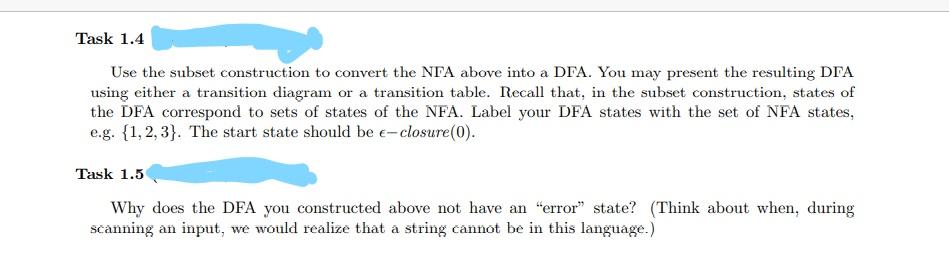
Question: Task 1.4 Use the subset construction to convert the NFA above into a DFA. You may present the resulting DFA using either a transition diagram
Task 1.4
Use the subset construction to convert the NFA above into a DFA. You may present the resulting DFA using either a transition diagram or a transition table. Recall that, in the subset construction, states of the DFA correspond to sets of states of the NFA. Label your DFA states with the set of NFA states, e.g. {1, 2, 3}. The start state should be closure(0).
Task 1.5 . Why does the DFA you constructed above not have an error state? (Think about when, during scanning an input, we would realize that a string cannot be in this language)
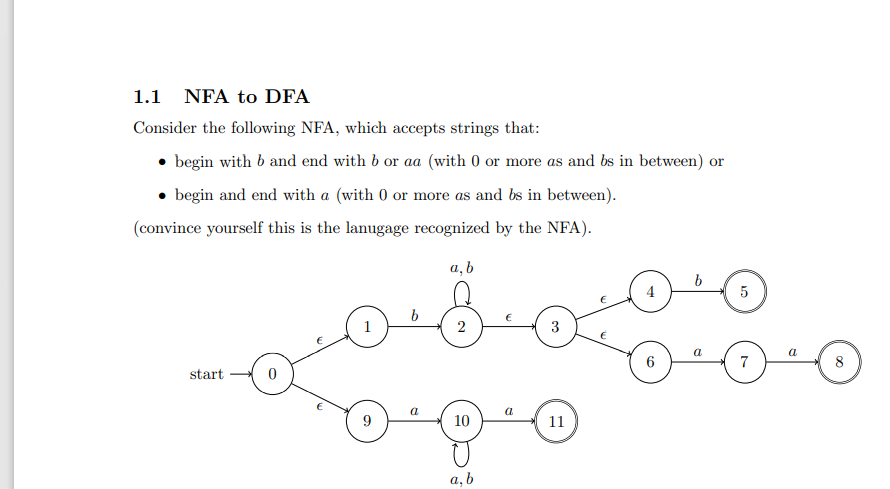
NFA -
 Best answer(B.A.) will get a like. Also, send other correctly answered questions by B.A. to my email id : smiths.1999420 at the rate g mail dot com. I will give them a like. Please answer the question correctly.
1.1 NFA to DFA Consider the following NFA, which accepts strings that: begin with b and end with b or aa (with 0 or more as and bs in between) or begin and end with a (with 0 or more as and bs in between). (convince yourself this is the lanugage recognized by the NFA). a,b b 5 b 1 2 3 a a 6 7 8 start a,b Task 1.4 Use the subset construction to convert the NFA above into a DFA. You may present the resulting DFA using either a transition diagram or a transition table. Recall that, in the subset construction, states of the DFA correspond to sets of states of the NFA. Label your DFA states with the set of NFA states, e.g. {1, 2, 3). The start state should be e-closure(0). Task 1.5 Why does the DFA you constructed above not have an "error" state? (Think about when, during scanning an input, we would realize that a string cannot be in this language.)
Step by Step Solution
There are 3 Steps involved in it

Get step-by-step solutions from verified subject matter experts
 Study Help