





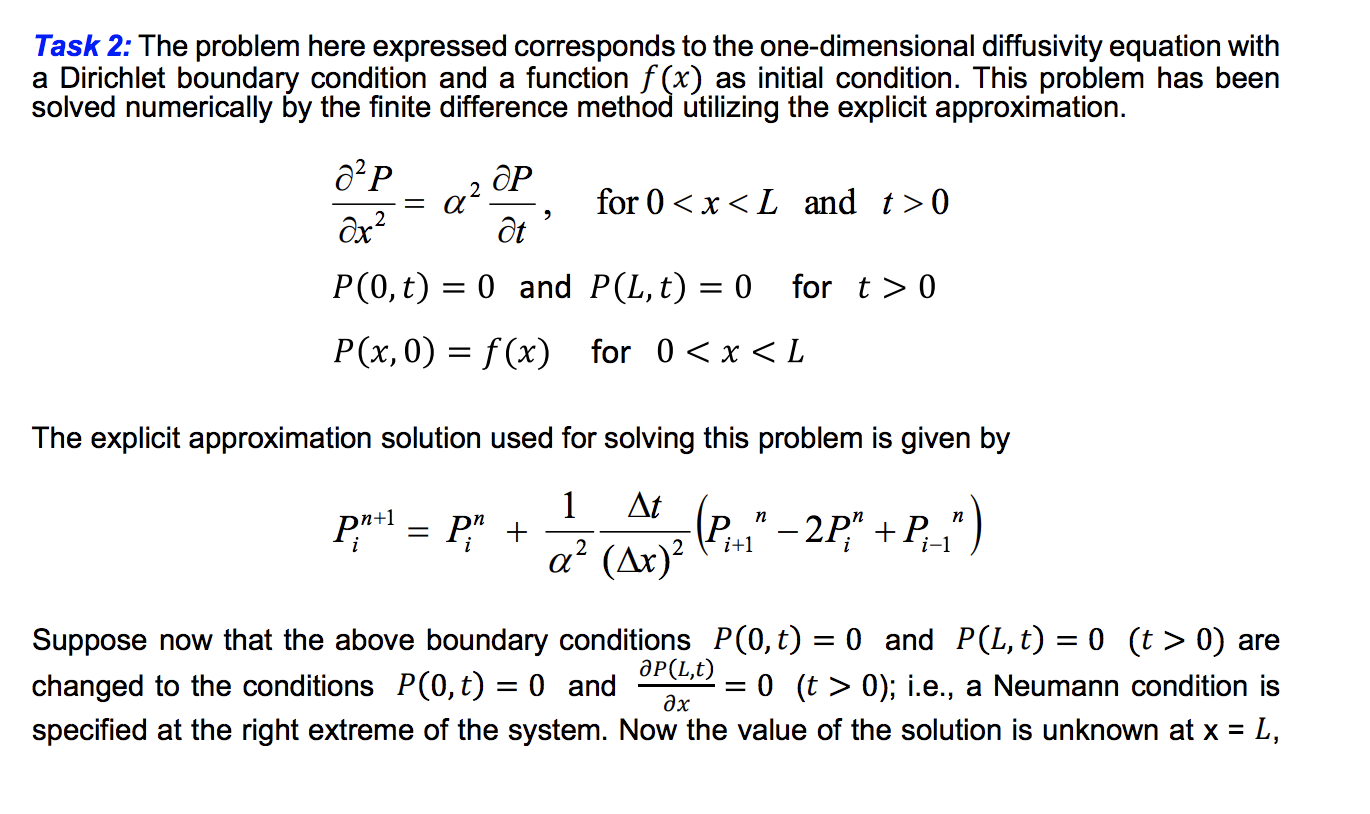
Question: Task 2: The problem here expressed corresponds to the one-dimensional diffusivity equation with a Dirichlet boundary condition and a function f (x) as initial condition.
Task 2: The problem here expressed corresponds toTask 2: The problem here expressed corresponds to
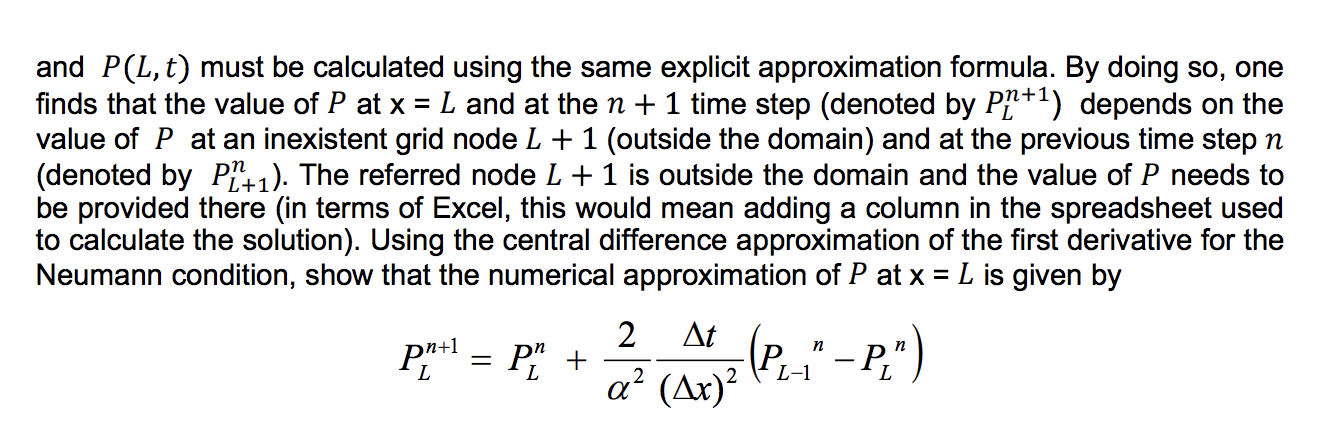
Task 2: The problem here expressed corresponds to the one-dimensional diffusivity equation with a Dirichlet boundary condition and a function f (x) as initial condition. This problem has been solved numerically by the finite difference method utilizing the explicit approximation. 2 2 P 42 OP for 0 0 Ox 2 at P(O, t) = 0 and P(L, t) = 0 for t > 0 P ( x, 0) = f ( x) for 0 0) are changed to the conditions P(0, t) = 0 and OP (L,t) ax -= 0 (t > 0); i.e., a Neumann condition is specified at the right extreme of the system. Now the value of the solution is unknown at x = L,and P(L, it) must be calculated using the same explicit approximation formula. By doing so, one nds that the value of P at x = L and at the n + 1 time step (denoted by P3\") depends on the value of P at an inexistent grid node L + 1 (outside the domain) and at the previous time step 11 (denoted by P3\"). The referred node L + 1 is outside the domain and the value of P needs to be provided there (in terms of Excel, this would mean adding a column in the spreadsheet used to calculate the solution). Using the central difference approximation of the rst derivative for the Neumann condition, show that the numerical approximation of P at x = L is given by 2 At ( 1):\": I); + ?(Ax)2 I11nB'n)

Step by Step Solution

There are 3 Steps involved in it

1 Expert Approved Answer
Step: 1 Unlock blur-text-image

Question Has Been Solved by an Expert!

Get step-by-step solutions from verified subject matter experts

Step: 2 Unlock
Step: 3 Unlock

Students Have Also Explored These Related Mathematics Questions!