







Question: Task 4 . 2 : Collision - Free Property Collision - free property ( also known as strong collision resistant ) is that it is
Task : CollisionFree Property
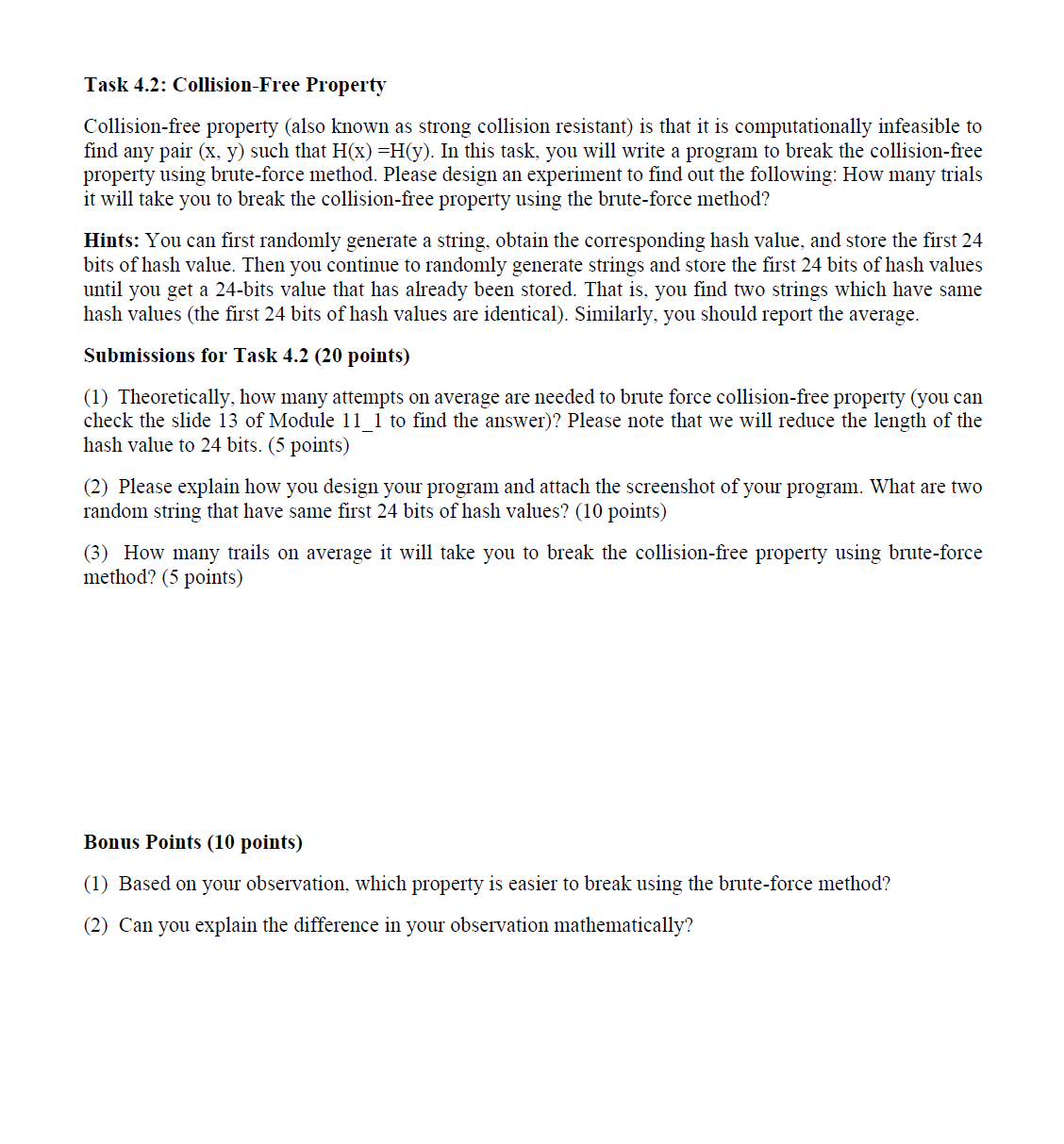
Collisionfree property also known as strong collision resistant is that it is computationally infeasible to find any pair mathrmxmathrmy such that mathrmHmathrmxmathrmHmathrmy In this task, you will write a program to break the collisionfree property using bruteforce method. Please design an experiment to find out the following: How many trials it will take you to break the collisionfree property using the bruteforce method?
Hints: You can first randomly generate a string, obtain the corresponding hash value, and store the first bits of hash value. Then you continue to randomly generate strings and store the first bits of hash values until you get a bits value that has already been stored. That is you find two strings which have same hash values the first bits of hash values are identical Similarly, you should report the average.
Submissions for Task points
Theoretically, how many attempts on average are needed to brute force collisionfree property you can check the slide of Module to find the answer Please note that we will reduce the length of the hash value to bits. points
Please explain how you design your program and attach the screenshot of your program. What are two random string that have same first bits of hash values? points
How many trails on average it will take you to break the collisionfree property using bruteforce method? points
Bonus Points points
Based on your observation, which property is easier to break using the bruteforce method?
Can you explain the difference in your observation mathematically?
Step by Step Solution
There are 3 Steps involved in it
1 Expert Approved Answer
Step: 1 Unlock

Question Has Been Solved by an Expert!
Get step-by-step solutions from verified subject matter experts
Step: 2 Unlock
Step: 3 Unlock
 Study Help