



Question: Task 4: Harmonics Lets continue with the idea of signal superpreation to show that complex signals can be constructed in this fashion. When a particular
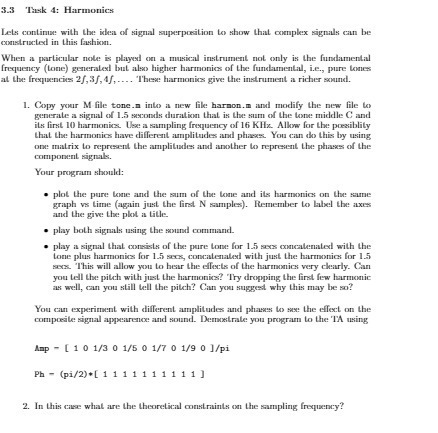
"Task 4: Harmonics Lets continue with the idea of signal superpreation to show that complex signals can be constructed in this fashion. When a particular note is played on a musical instrument not only is the fundamental frequency (lone) generated but also higher harmonies of the fundamental, i.e., pure bones at the frequencies 2/,3/, 4/,.... These harmonics give the indrument a richer sound. 1. Copy your M file tone.a into a new like harmon.m and modify the new file to generate a signal of 1.5 seconds duration that is the sum of the tone middle C and its first 10 harmonics. Use a sampling frequency of 16 KHx. Alloww for the preziblity that the harmonics have different amplitudes and phases. You can do this by using one matrix to represent the amplitudes and another to represent the phases of the component signals. Your program should: . plot the pure lone and the sum of the tone and its harmonics on the same graph vs Lime (again just the first N samples). Remember to label the axes and the give the plot a title. . play both signals using the sound command. . play a signal that consists of the pure tone for 1.5 ass concatenated with the Lone plus harmonies for 1.5 sees, concatenated with just the harmonica for 1.5 see. This will allow you to hear the effects of the harmonics very clearly. Can you tell the pitch with just the harmonics?' Try dropping the lind few harmonic as well, can you still tell the pitch? Can you suggest why this may be s? You can experiment with different amplitudes and phases to see the effect on the composite signal appearence and sound. Denverle you program to the TA using Amp - [ 1 0 1/3 0 1/5 0 1/7 0 1/9 0 ]/pi Ph - (pi/2)+ [ 1 1 1 1 1 1 1 1 1 1] 2. In this case what are the theoretical constraints on the sampling frequency
Step by Step Solution
There are 3 Steps involved in it

Get step-by-step solutions from verified subject matter experts