







Question: Task 5 Task 5: Circular Motion on the Go! Instruction: 1. Construct a set-up as shown in the figure below; {M _. 1m String/thin rope
Task 5
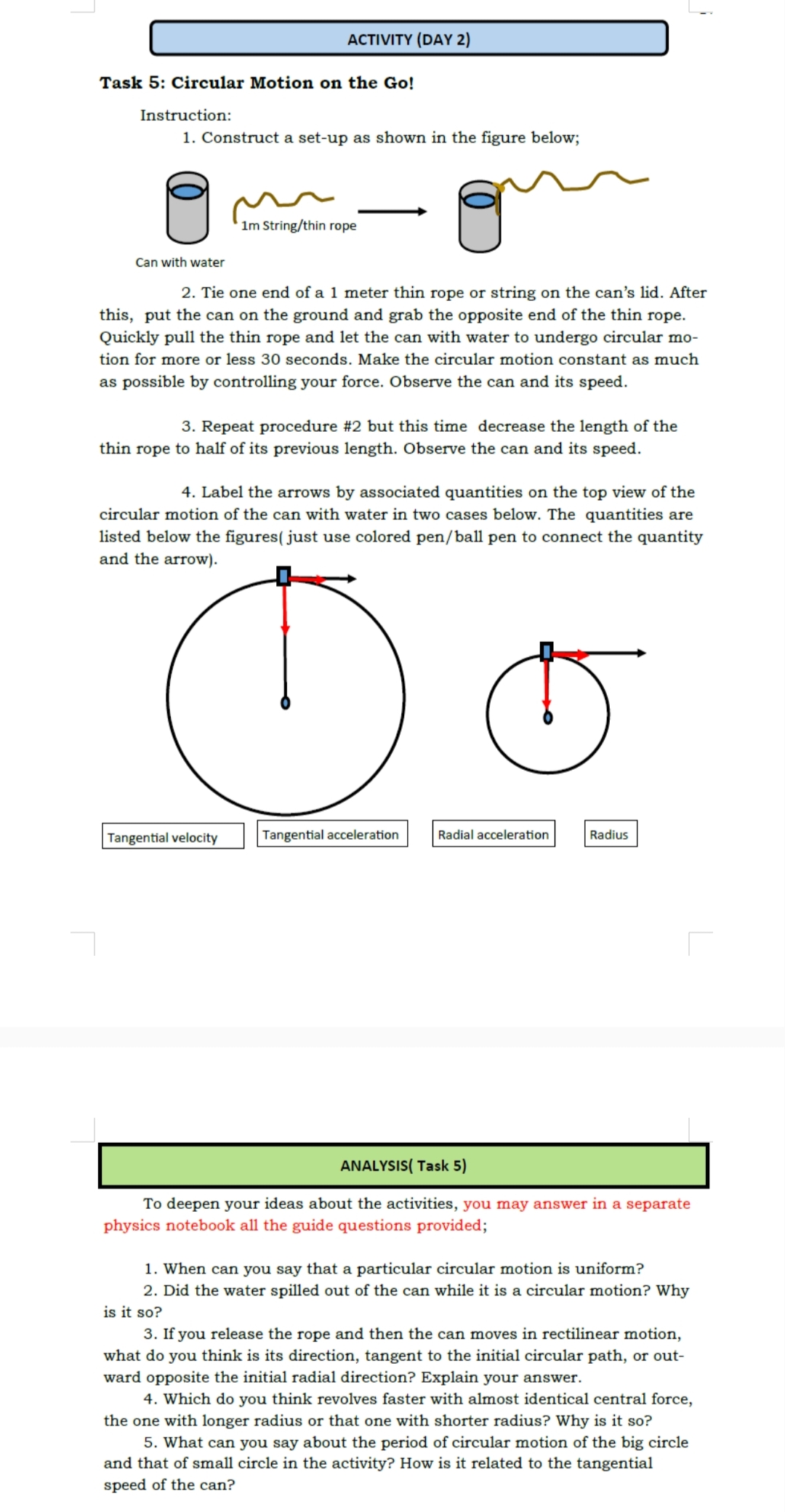
Task 5: Circular Motion on the Go! Instruction: 1. Construct a set-up as shown in the figure below; {\\M _. 1m String/thin rope Can with water 2. Tie one end of a 1 meter thin rope or string on the can's lid. After this, put the can on the ground and grab the opposite end of the thin rope. Quickly pull the thin rope and let the can with water to undergo circular mo- tion for more or less 30 seconds. Make the circular motion constant as much as possible by controlling your force. Observe the can and its speed. 3. Repeat procedure #2 but this time decrease the length of the thin rope to half of its previous length. Observe the can and its speed. 4. Label the arrows by associated quantities on the top view of the circular motion of the can with water in two cases below. The quantities are listed below the gures[ just use colored pen/ ball pen to connect the quantity and the arrow). Tangential velocity Tangential acceleration Radial acceleration w To deepen your ideas about the activities, you may answer in a separate physics notebook all the guide questions provided; 1. When can you say that a particular circular motion is uniform? 2. Did the water spilled out of the can While it is a circular motion? Why is it so? 3. If you release the rope and then the can moves in rectilinear motion, what do you think is its direction, tangent to the initial circular path, or out- ward opposite the initial radial direction? Explain your answer. 4. Which do you think revolves faster with almost identical central force, the one with longer radius or that one with shorter radius? Why is it so? 5. What can you say about the period of circular motion of the big circle and that of small circle in the activity? How is it related to the tangential speed of the can
Step by Step Solution
There are 3 Steps involved in it

Get step-by-step solutions from verified subject matter experts
 Study Help