







Question: Task description: PCA ( Principle Component Analysis) is = dimensionality reduction technique that projects the data into a lower dimensional space. It can be used
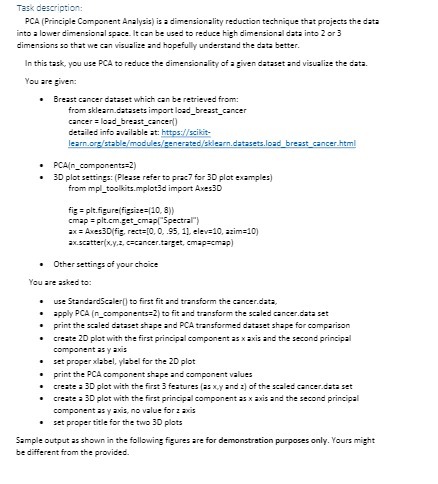
Task description: PCA ( Principle Component Analysis) is = dimensionality reduction technique that projects the data into a lower dimensional space. It can be used to reduce high dimensional data into 2 or 3 dimensions so that we can visualize and hopefully understand the data better. In this task, you use PCA to reduce the dimensionality of a given dateset and visualize the data. You are given: Breast cancer dataset which can be retrieved from: from sklearn.datasets import load_breast_ cancer cancer = load_breast_cancer() detailed info available at: https://scikit- learn.org/stable/modules/generated/sklearn. datasets.load_breast_cancer.html PCA(n_components=2) 30 plot settings: (Please refer to prac7 for 30 plot examples) from mpl_toolkits.mplotid import Axe:3D fig = plt.figure(figsize=[10, 8)] cmap = pit.cm.get_cmap["Spectral") ax = Axes3D(fig, rect=[0, 0, .85, 1), elev=10, azim=10) Ex.scatter(x,y,z, c=cancer.target, cmap=cmap) Other settings of your choice You are asked to: use StandardScaler() to first fit and transform the cancer.data, apply PCA (n_components=2) to fit and transform the scaled cancer. data set print the scaled dataset shape and PCA transformed dataset shape for comparison create 20 plot with the first principal component as x axis and the second principal component as y axis set proper xlabel, ylabel for the 20 plot print the PCA component shape and component values create = 30 plot with the first 3 features (as xy and =] of the scalled cancer.data set create = 30 plot with the first principal component as x axis and the second principal component as y axis, no value for z axis set proper title for the two 30 plots Sample output as shown in the following figures are for demonstration purposes only. Yours might be different from the provided
Step by Step Solution
There are 3 Steps involved in it

Get step-by-step solutions from verified subject matter experts
 Study Help