







Question: Task Summary The task is to write a critical essay analysing one media item, and drawing on three scholarly readings from the cements subject, in

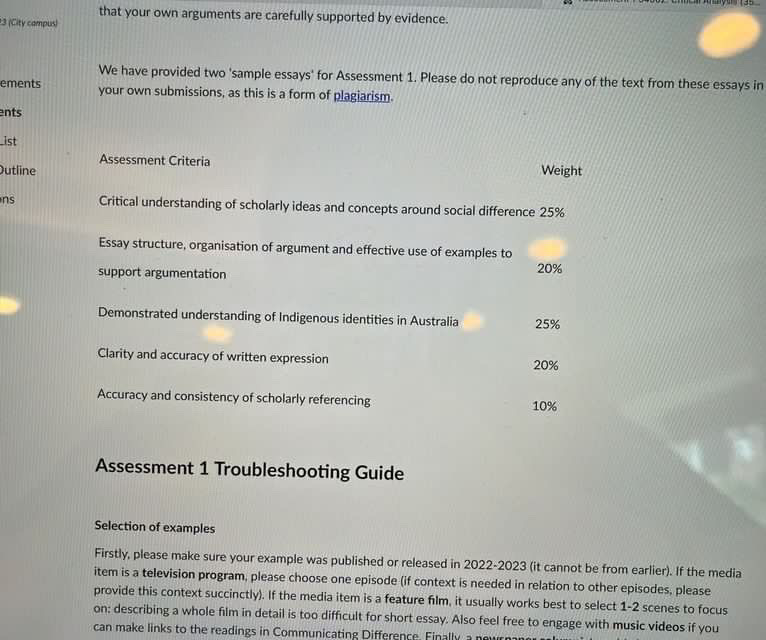

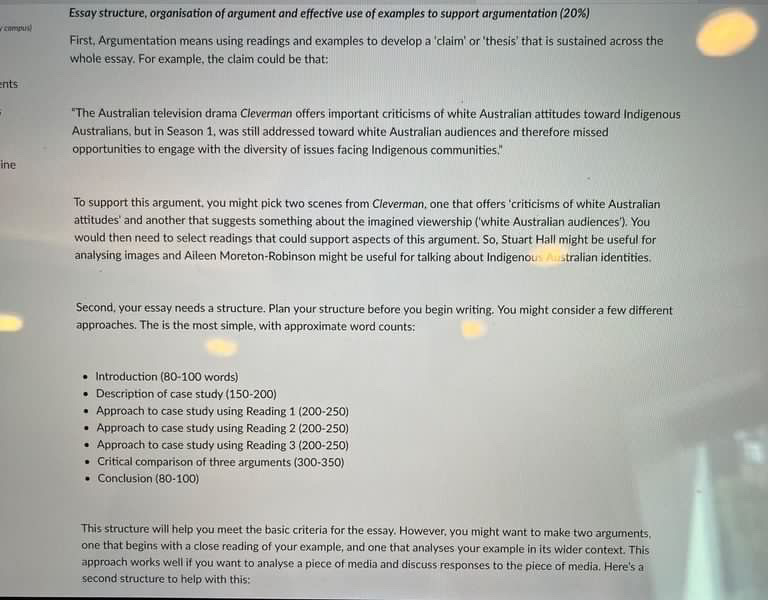


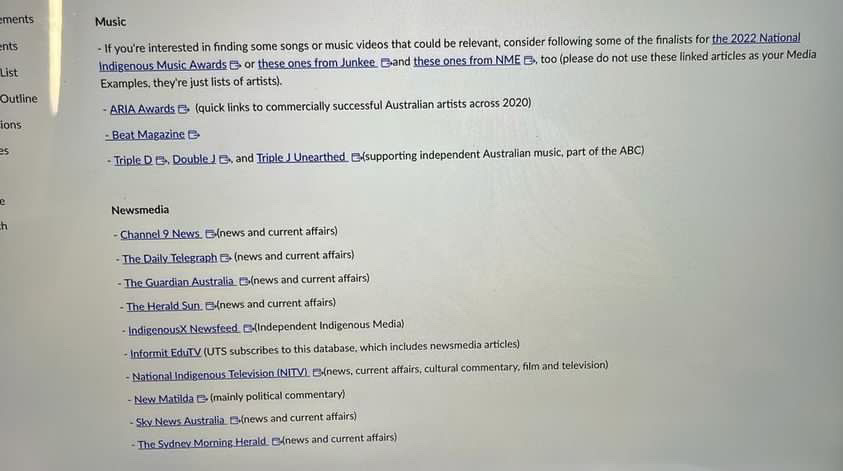
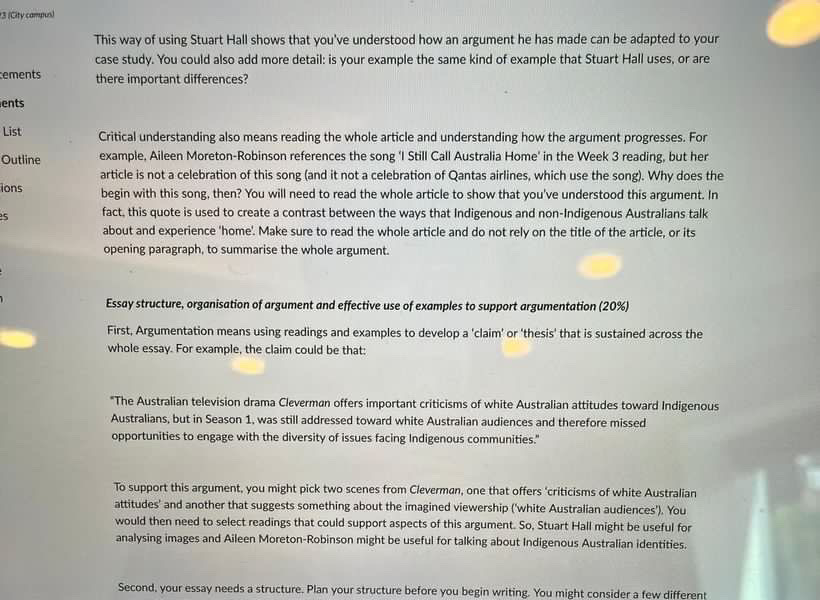


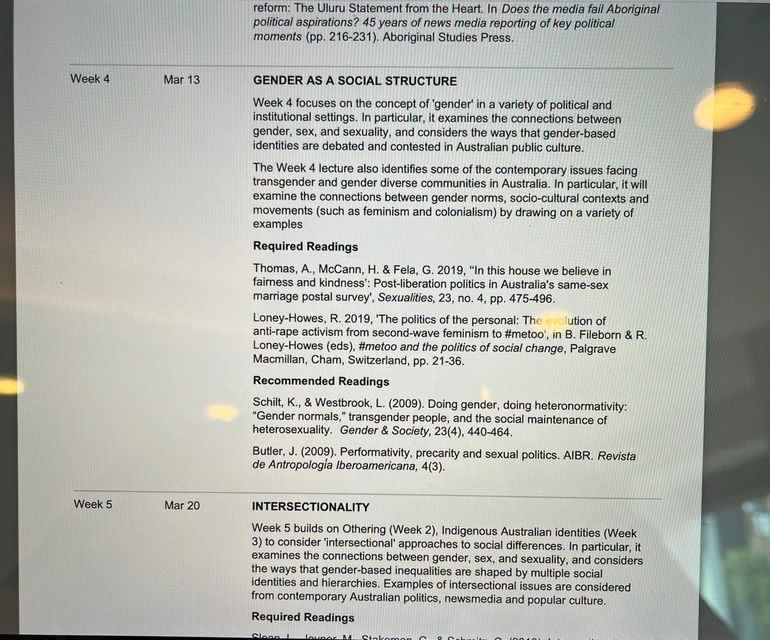
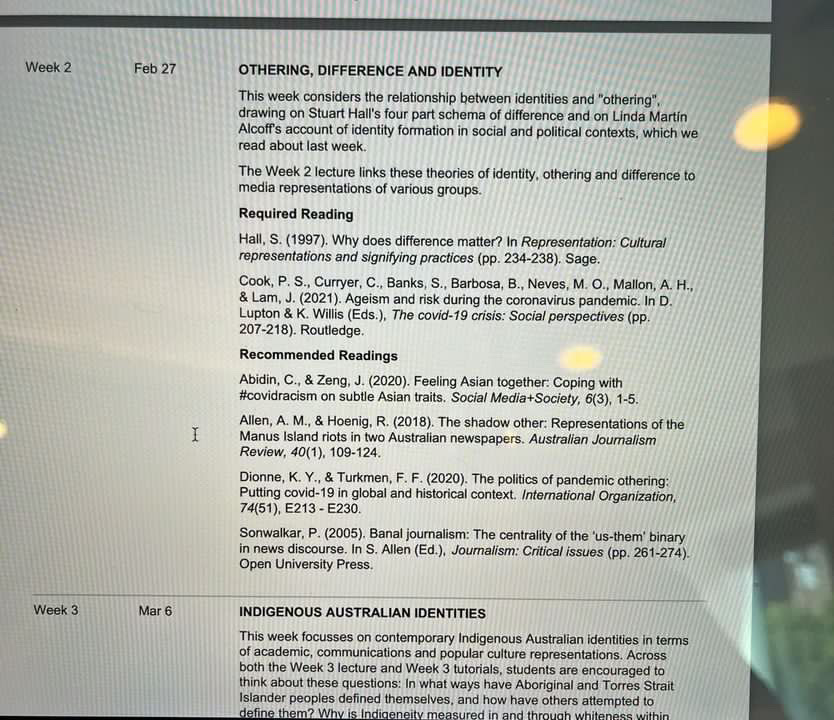
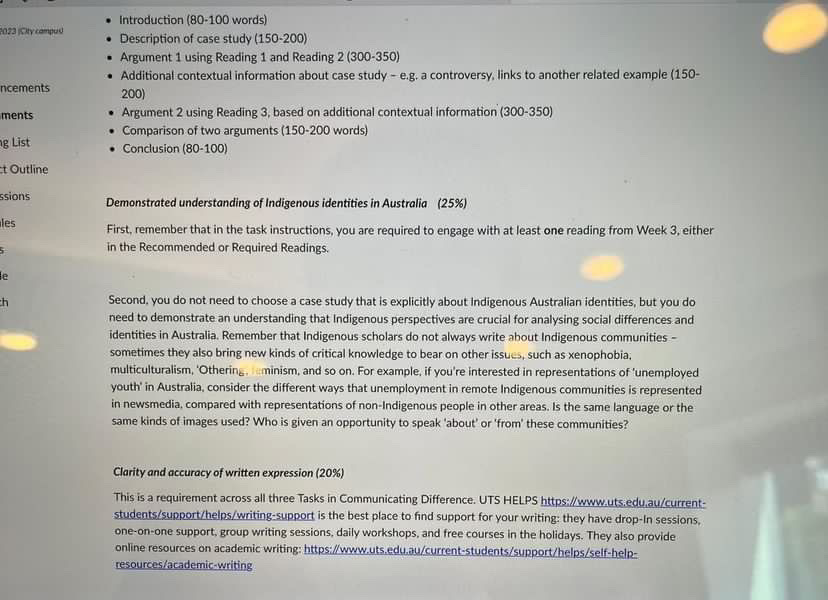

Task Summary The task is to write a critical essay analysing one media item, and drawing on three scholarly readings from the cements subject, in order to demonstrate an understanding of core concepts in Communicating Difference and to develop skills in academic reading and writing. lents List Task Instructions Outline First, choose one Australian media item published in 2022 or 2023. Eligible media items include films, television ions episodes, popular songs, and news media items. among others, See this list of Links and Resources to help you find an example. Please consult with your tutor if unsure about the case study. Second, choose three scholarly readings from any week in the Communicating Difference Subject Outline, and this must include at least one reading from Week 3 Indigenous Australian Identities. Scholarly readings can be drawn from both Required and Recommended Readings. Finally, critically discuss the ways that social identities and differences contribute to the social meanings of your chosen media item, drawing on the three chosen scholarly readings. For this discussion to be 'critical, you need to demonstrate an understanding of the key arguments in each reading, and to identify importance points of similarity and/or difference between the readings. You are welcome to disagree with or criticise the scholarly readings, provided that your own arguments are carefully supported by evidence. We have provided two 'sample essays' for Assessment 1. Please do not reproduce any of the text from these essays in your own submissions, as this is a form of plagiarism. Assessment Criteria Weight Critical understanding of scholarly ideas and concepts around social difference 25%\fWeek 5 Mar 20 INTERSECTIONALITY Week 5 builds on Othering (Week 2), Indigenous Australian identities (Week 3) to consider 'intersectional' approaches to social differences. In particular, it examines the connections between gender, sex, and sexuality, and considers the ways that gender-based inequalities are shaped by multiple social identities and hierarchies. Examples of intersectional issues are considered from contemporary Australian politics, newsmedia and popular culture. Required Readings Sloan, L., Joyner, M., Stakeman, C., & Schmitz, C. (2018). Intersectionality: Positioning privilege and marginalization. In Critical multiculturalism and 07/02/2023 (Autumn 2023) @ University of Technology Sydney Page 4 of 12 intersectionality in a complex world (Second ed., pp. 97-113). Oxford University Press. Meekosha, H. (2006). What the hell are you? An intercategorical analysis of race, ethnicity, gender and disability in the australian body politic. Scandinavian journal of disability research, 8(2-3), 161-176. Recommended Readings Bao, H. (2013). A queer 'comrade' in Sydney: Chineseness, queer desire and homonationalism. Interventions, 15(1), 127-140. Churchill, B., Baltra-Ulloa, J., & Moore, R. (2014). Difficult conversations: Race, class and gender in white Australia In S. A. Jackson (Ed.), Routledge international handbook of race, class, and gender (pp. 21-28). Routledge Clare, E. (2001). Stolen bodies, reclaimed bodies: Disability and queerness. Public Culture, 13(3), 359-365. Gleeson, J. (2017). Only for white, middle-class feminists? Issues of Intersectionality within the worlds of contemporary digital feminist campaigns. Platform: Journal of Media & Communication, 8(2). Kean, J. (2019), Coming to terms: Race, class and intimacy in Australian public culture. Sexualities, 22(7-8), 1182-1196. Notes: Census date is March 22nd\f\f\fments Music ints . If you're interested in finding some songs or music videos that could be relevant, consider following some of the finalists for the 2022 National List Indigenous Music Awards E or these ones from Junkee Grand these ones from NME E, too (please do not use these linked articles as your Media Examples, they're just lists of artists). Outline - ARIA Awards @. (quick links to commercially successful Australian artists across 2020) ions Beat Magazine B- - Triple D (, Double J E., and Triple J Unearthed E (supporting independent Australian music, part of the ABC) Newsmedia -Channel 9 News ((news and current affairs) .The Daily Telegraph @ (news and current affairs) - The Guardian Australia ((news and current affairs) - The Herald Sun. @ (news and current affairs) - IndigenousX Newsfeed @-(Independent Indigenous Media) . Informit EduTV (UTS subscribes to this database. which includes newsmedia articles) National Indigenous Television (NITVL B(news, current affairs, cultural commentary, film and television) - New Matilda . (mainly political commentary) - Sky News Australia [ (news and current affairs) -The Sydney Morning Herald Ednews and current affairs)\fAccuracy and consistency of scholarly referencing (10%) its The UTS Referencing Guide is here: In-text Referencing he Always add page numbers when providing direct quotes and add the year of publication when referring to an author's work. Please use this referencing guide to understand how to properly cite your sources. Below are some examples to show how this looks in practice. In-text citations: (McGrath & Viney 1997) or McGrath & Viney (1997) In a sentence: 'the film was . full of racist caricatures' (McGrath & Viney 1997, p. 137). McGrath and Viney (1997. p. 37) criticised racism in the film, citing a number of 'caricatures'.. If you have more than two authors - e.g. Alysen, Fattah and Smith - then write: (Alysen et al. 2003) or Alysen et al. (2003) In a sentence: Alysen, Fattah and Smith argue that newsmedia representations of unemployment are affected by negative stereotypes around location and ethnicity (Alysen et al, 2003).\freform: The Uluru Statement from the Heart In Does the media fail Aboriginal political aspirations? 45 years of news media reporting of key political moments (pp. 216-231). Aboriginal Studies Press, Week 4 Mar 13 GENDER AS A SOCIAL STRUCTURE Week 4 focuses on the concept of 'gender' in a variety of political and institutional settings. In particular, it examines the connections between gender, sex, and sexuality, and considers the ways that gender-based identities are debated and contested in Australian public culture. The Week 4 lecture also identifies some of the contemporary issues facing transgender and gender diverse communities in Australia. In particular, it will examine the connections between gender norms, socio-cultural contexts and movements (such as feminism and colonialism) by drawing on a variety of examples Required Readings Thomas, A., Mccann, H. & Fela, G. 2019, "In this house we believe in fairness and kindness': Post-liberation politics in Australia's same-sex marriage postal survey', Sexualities, 23, no. 4, pp. 475-496 Loney-Howes. R. 2019, 'The politics of the personal: The ution of anti-rape activism from second-wave feminism to #metoo', in B. Fileborn & R. Loney-Howes (eds), #motoo and the politics of social change, Palgrave Macmillan, Cham, Switzerland, pp. 21-36. Recommended Readings Schilt, K., & Westbrook, L. (2009). Doing gender, doing heteronormativity: "Gender normals," transgender people, and the social maintenance of heterosexuality. Gender & Society, 23(4), 440-464. Butler, J. (2009). Performativity, precarity and sexual politics. AIBR. Revista de Antropologia Iberoamericana, 4(3). Week 5 Mar 20 INTERSECTIONALITY Week 5 builds on Othering (Week 2), Indigenous Australian identities (Week 3) to consider 'intersectional' approaches to social differences. In particular, it examines the connections between gender, sex, and sexuality. and considers the ways that gender-based inequalities are shaped by multiple social identities and hierarchies. Examples of intersectional issues are considered from contemporary Australian politics, newsmedia and popular culture. Required Readings\f\fSelection of examples ements Firstly, please make sure your example was published or released in 2022-2023 (it cannot be from earlier). If the media item is a television program, please choose one episode (if context is needed in relation to other episodes, please ents provide this context succinctly). If the media item is a feature film, it usually works best to select 1-2 scenes to focus List on: describing a whole film in detail is too difficult for short essay. Also feel free to engage with music videos if you can make links to the readings in Communicating Difference. Finally, a newspaper columnist could also be an object of Outline study, if the same author has written many similar articles on the same theme (e.g. Andrew Bolt). ons Meeting the Assessment Criteria Critical understanding of scholarly ideas and concepts around social difference (25%) "Critical understanding' refers to your understanding of the arguments made in the scholarly readings. This requires demonstrating that you've read closely and carefully, and explaining the content of the reading you've chosen, Do not simply summarise the topic or title of the readings you have cited. Consider these examples: 'Newsmedia is an important part of contemporary society (Hall 1997) 'Asylum seekers are Others in Australian society (Hall 1997)' From these two sentences, your tutor still won't know whether you've read or understood Stuart Hall's 'Spectacle of the Other. However, you could write that: 'Australian newsmedia presents asylum seekers as "Others" in relation to an imagined national identity. frequently invoking an opposition between Us (peaceful, familiar, law-abiding) and Them (violent, unfamiliar, law-breaking), a distinction made by Stuart Hall in his discussion of nationalism and identity-making in Britain (Hall 1997. p. 229)'
Step by Step Solution
There are 3 Steps involved in it

Get step-by-step solutions from verified subject matter experts
 Study Help