



Question: Tasks Open the following link and click the lab option: https://phet.colorado.edu/sims/html/masses-and-springs/latest/masses-and-springs_en.html er 1. Check the 'Displacement' and 'Movable Line' options in the box to the
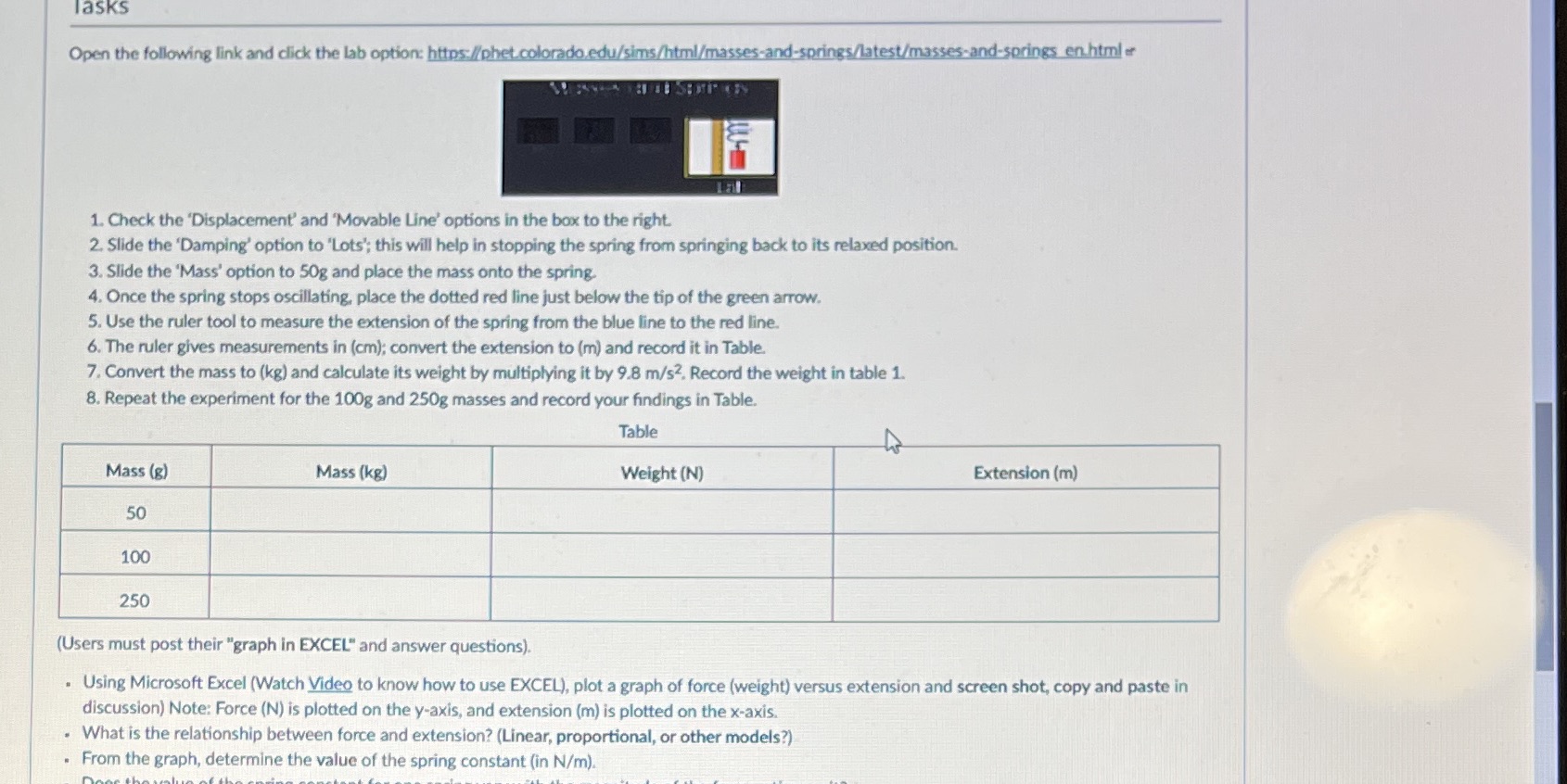
Tasks Open the following link and click the lab option: https://phet.colorado.edu/sims/html/masses-and-springs/latest/masses-and-springs_en.html er 1. Check the 'Displacement' and 'Movable Line' options in the box to the right. 2. Slide the 'Damping' option to 'Lots'; this will help in stopping the spring from springing back to its relaxed position. 3. Slide the 'Mass' option to 50g and place the mass onto the spring. 4. Once the spring stops oscillating, place the dotted red line just below the tip of the green arrow. 5. Use the ruler tool to measure the extension of the spring from the blue line to the red line. 6. The ruler gives measurements in (cm); convert the extension to (m) and record it in Table. 7. Convert the mass to (kg) and calculate its weight by multiplying it by 9.8 m/s2. Record the weight in table 1. 8. Repeat the experiment for the 100g and 250g masses and record your findings in Table. Table Mass (g) Mass (kg) Weight (N) Extension (m) 50 100 250 (Users must post their "graph in EXCEL" and answer questions). . Using Microsoft Excel (Watch Video to know how to use EXCEL), plot a graph of force (weight) versus extension and screen shot, copy and paste in discussion) Note: Force (N) is plotted on the y-axis, and extension (m) is plotted on the x-axis. . What is the relationship between force and extension? (Linear, proportional, or other models?) From the graph, determine the value of the spring constant (in N/m)
Step by Step Solution
There are 3 Steps involved in it

Get step-by-step solutions from verified subject matter experts