Question: Taxi, Uber, or Do You Need a Lyft? Before 2009, if you wanted to get somewhere within the city and didn't have a car, you
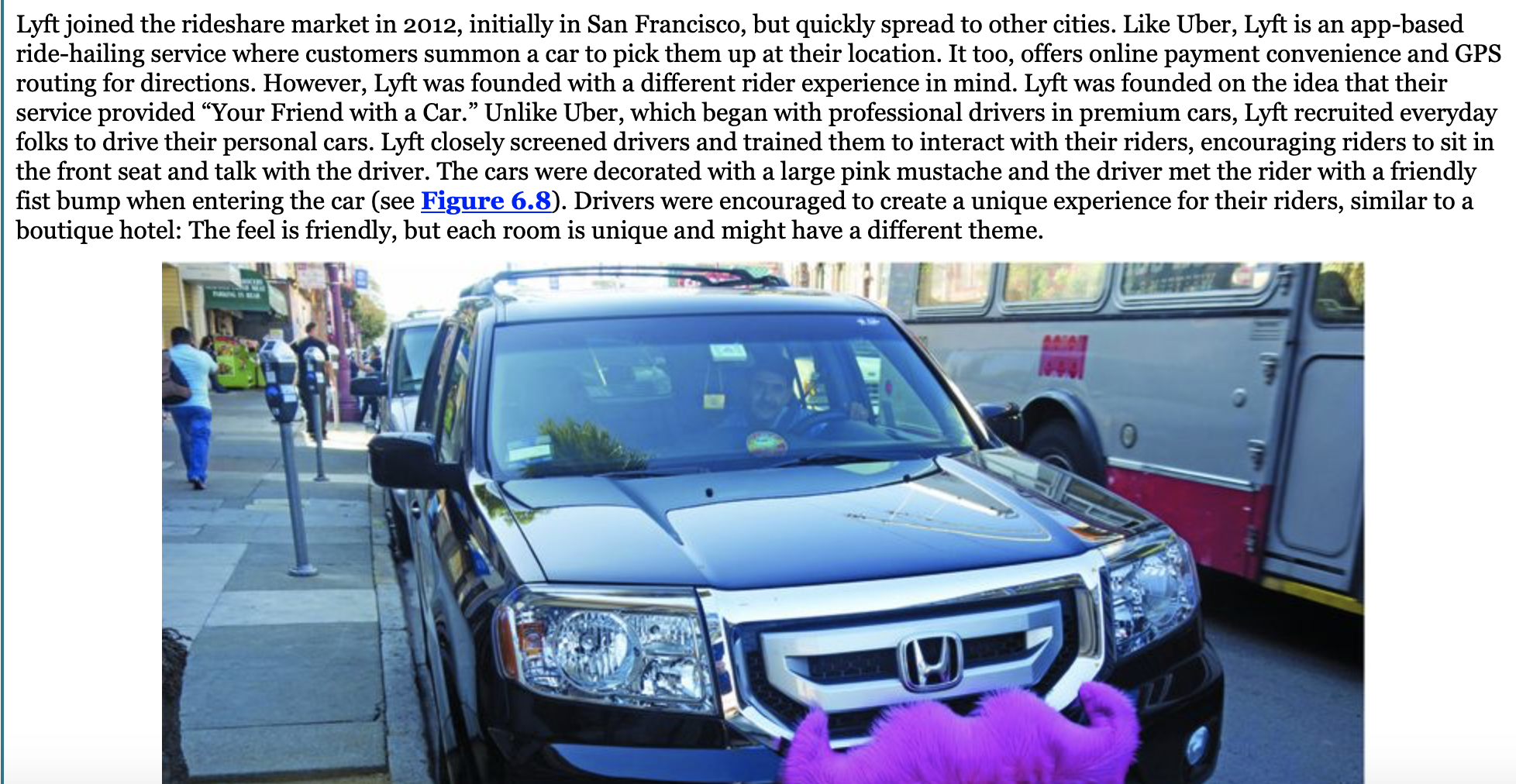
Taxi, Uber, or Do You Need a Lyft? Before 2009, if you wanted to get somewhere within the city and didn't have a car, you had to either use public transportation, walk, or hail a taxi. If you had to go any distance, had anything to carry, or the weather was too hot, too cold, or rainy, then walking wasn't much of any option. Public transportation is great in some cities, but in many others you can't go when and exactly where you want. So for those wanting convenient, point-to-point transportation, ready when you want to go, that left taxis. And taxis have been around for decades, driving customers from their hotel to the airport, or from business meeting to the hotel, or to dinner from the hotel, and even for simple errands for those without a car. But that all changed in 2009 with the advent of ridesharing companies. Ridesharing companies offer app-based rides that can be hailed at any time and are shared to reduce costs. Riders download the app on a smartphone, put in their credit card information, and then can summon drivers to their locations to take them somewhere else. Using these services is simple, quick, and typically less expensive than using a taxi. Because the service uses smartphone location capabilities, a rider can summon a driver to places taxis would not typically frequent. In addition, the mapping feature means the rider does not have to worry about giving directions. The rider simply types in or pinpoints the destination on the app map, and the driver knows where to go automatically. The other convenience feature is that payment is handled with the card on file, so there is no need for the rider or driver to worry about cash, running a credit card while in the car, or tipping. It is all handled electronically. For many customers this combination of benefits proved to be very attractive, and rideshare services are fundamentally transforming personal transportation in many markets. Several taxi companies in major cities have filed for bankruptcy. In San Francisco there were roughly 1,800 taxis as of 2016, but that same year, there were about 40,000 rideshare drivers in the city, and the number is still increasing. This trend is being repeated in most metropolitan areas and even in smaller towns and doesn't show signs of stopping soon. The two biggest players in the growing industry are Uber and Lyft. Uber was first to market in 2009. The company began as an app-based service for requesting premium black cars in a few metropolitan markets. Though it began as a service primarily aimed at business travelers, and still offers UberBLACK-with luxury cars driven by experienced drivers who dress the part, Uber has expanded to include a range of service options. UberX, UberXL, and UberSELECT are considered their economy options, while UberBLACK, UberSUV, and UberLUX offer more premium services. Given their origin with premium service options for business people, Uber is considered the private driver" for riders. Riders sit in the back, and can check email, read, or message while they get from point A to point B. The main choice when selecting Uber is which level vehicle you want to get you to your destination. Uber is most closely associated with its Uber Black service, since this is where the company began and is still favored by business people. Rapid expansion and growth have not been without controversy, as taxi associations, local governments, and other organizations have taken issue with Uber and how it does business. In spite of the negative publicity and some internal management issues, Uber has continued to grow, and now has drivers in over 630 cities. The growth has drawn competitors into th We've updated our read aloud feature! competitor for Uber is Lyft. Give it a try here Lyft joined the rideshare market in 2012, initially in San Francisco, but quickly spread to other cities. Like Uber, Lyft is an app-based ride-hailing service where customers summon a car to pick them up at their location. It too, offers online payment convenience and GPS routing for directions. However, Lyft was founded with a different rider experience in mind. Lyft was founded on the idea that their service provided Your Friend with a Car. Unlike Uber, which began with professional drivers in premium cars, Lyft recruited everyday folks to drive their personal cars. Lyft closely screened drivers and trained them to interact with their riders, encouraging riders to sit in the front seat and talk with the driver. The cars were decorated with a large pink mustache and the driver met the rider with a friendly fist bump when entering the car (see Figure 6.8). Drivers were encouraged to create a unique experience for their riders, similar to a boutique hotel: The feel is friendly, but each room is unique and might have a different theme. 2 Randy Duchaine/Alamy Stock Photo FIGURE 6.8 Wouldn't You Want to Be Friends With This Car/Driver? Lyft was successful in its first few years recruiting drivers and riders, recently passing the million unique riders per week mark, according to one of its cofounders, Mark Zimmer. The growth of Lyft has increased the competition in the rideshare market as both Lyft and Uber try to gain more of the increasing market. Both companies have intensified their efforts to recruit both drivers and riders, and in fact, many drivers actually drive for both services. Riders too, use both services, often choosing one over the other based on how close a driver is to the pick-up location or how much the ride might cost, as the two have different fees in different locations. In this growing market, it remains to be seen how the competition between the two will eventually play out, but both services have suggested they are working hard to incorporate driverless technology into their service soon, which could change this market yet again. How will you get somewhere in 2020 or 2030? Questions 1. Is there still a place for taxis in the current market? If so, who would be the ideal customers? 2. Identify the primary target market for Uber and Lyft? 3. Do you think Lyft will become more like Uber in the future or retain its original personality? 4. What are the primary concerns with ridesharing as an industry? Are these issues riders care about or not? 5. What issues do you foresee for the industry if or when driverless technology is viable









 Study Help