







Question: Taylor, age 18, is claimed as a dependent by her parents. For 2024, she has the following income: $6,250 wages from a summer job,
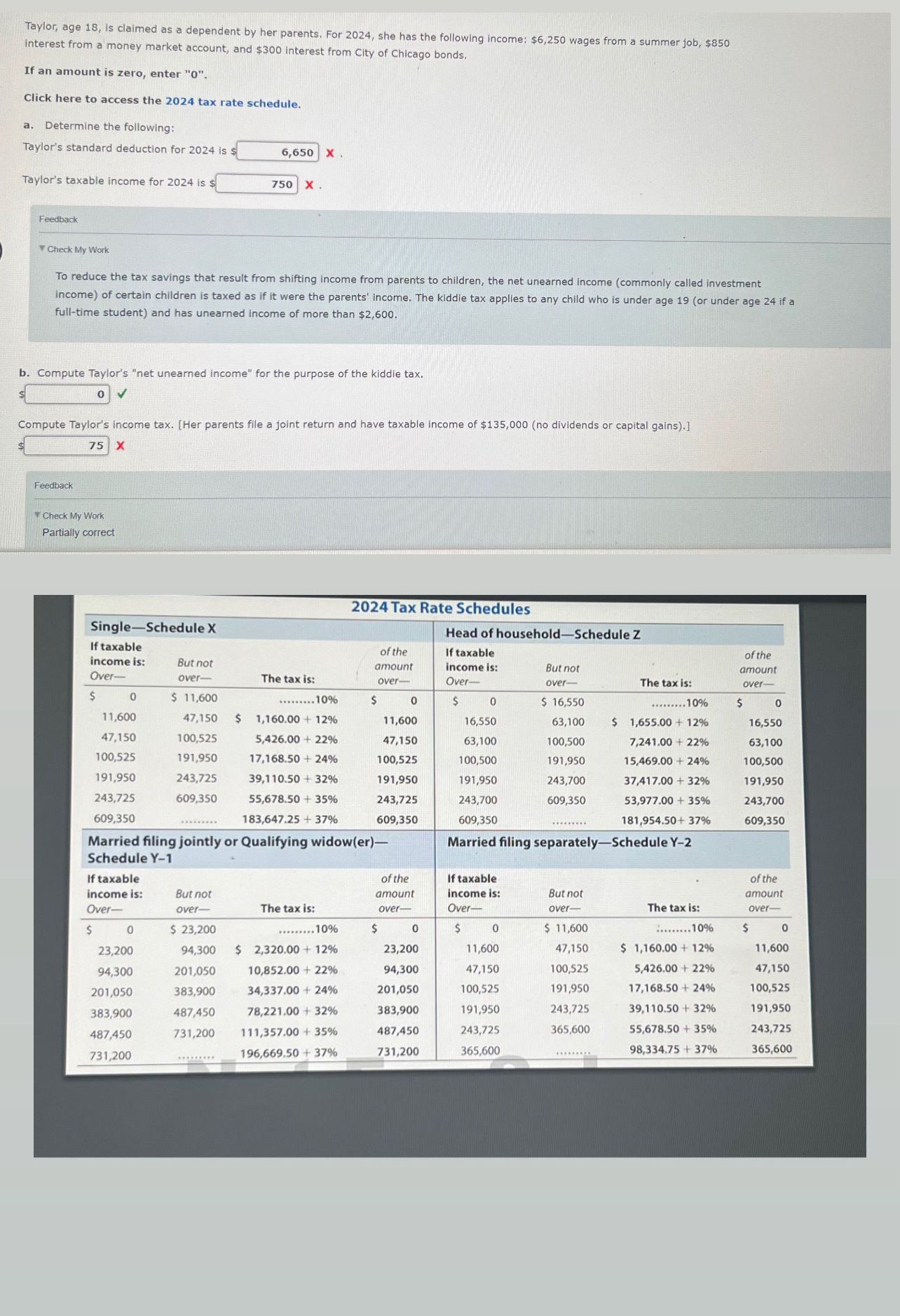
Taylor, age 18, is claimed as a dependent by her parents. For 2024, she has the following income: $6,250 wages from a summer job, $850 interest from a money market account, and $300 interest from City of Chicago bonds. If an amount is zero, enter "0". Click here to access the 2024 tax rate schedule. a. Determine the following: Taylor's standard deduction for 2024 is $ 6,650 X. Taylor's taxable income for 2024 is $ 750 X Feedback Check My Work To reduce the tax savings that result from shifting income from parents to children, the net unearned income (commonly called investment income) of certain children is taxed as if it were the parents' income. The kiddie tax applies to any child who is under age 19 (or under age 24 if a full-time student) and has unearned income of more than $2,600. b. Compute Taylor's "net unearned income" for the purpose of the kiddie tax. 0 Compute Taylor's income tax. [Her parents file a joint return and have taxable income of $135,000 (no dividends or capital gains).] 75 X $ Feedback Check My Work Partially correct 2024 Tax Rate Schedules Single-Schedule X Head of household-Schedule Z If taxable income is: Over- $ 0 But not over- $ 11,600 The tax is: of the amount over- If taxable income is: Over- But not over- The tax is: of the amount over- .........10% $ 0 $ 0 $ 16,550 .........10% $ 0 11,600 47,150 $ 1,160.00+12% 11,600 16,550 63,100 $ 1,655.00 + 12% 16,550 47,150 100,525 5,426.00 +22% 47,150 63,100 100,500 7,241.00 +22% 63,100 100,525 191,950 17,168.50 + 24% 100,525 100,500 191,950 15,469.00+24% 100,500 191,950 243,725 39,110.50+32% 191,950 191,950 243,700 37,417.00+32% 191,950 243,725 609,350 55,678.50+35% 243,725 243,700 609,350 53,977.00+35% 243,700 609,350 183,647.25 + 37% 609,350 609,350 181,954.50+ 37% 609,350 Married filing jointly or Qualifying widow(er) Schedule Y-1 Married filing separately-Schedule Y-2 If taxable income is: Over- $ 0 But not over- $ 23,200 The tax is: of the amount over- If taxable income is: Over- But not over- The tax is: of the amount over- .........10% $ 0 $ 0 $ 11,600 .........10% $ 0 23,200 94,300 $ 2,320.00+12% 23,200 11,600 47,150 $ 1,160.00+12% 11,600 94,300 201,050 10,852.00 +22% 94,300 47,150 100,525 5,426.00+22% 47,150 201,050 383,900 34,337.00 +24% 201,050 100,525 191,950 17,168.50+24% 100,525 383,900 487,450 78,221.00+32% 383,900 191,950 243,725 487,450 731,200 111,357.00+ 35% 487,450 243,725 365,600 39,110.50+32% 55,678.50+35% 191,950 243,725 731,200 196,669.50+ 37% 731,200 365,600 98,334.75+37% 365,600
Step by Step Solution
There are 3 Steps involved in it
To solve this problem we need to calculate several components Taylors standard deduction taxable inc... View full answer

Get step-by-step solutions from verified subject matter experts
 Study Help