







Question: TechFusion Inc. is a dynamic, forward - thinking company that specializes in developing innovative products that integrate both hardware and software solutions. Established with a
TechFusion Inc. is a dynamic, forwardthinking company that specializes in developing innovative products that integrate both hardware and software solutions. Established with a vision to bridge the gap between cuttingedge technology and usercentric design, TechFusion delivers a wide range of products tailored to meet the diverse needs of businesses and consumers alike. The company is now preparing a plan for a product development project comprising activities. Due to the nature of this type of project, the activities are subject to risks that could impact their time and cost.
The execution of this project begins with the Basic Design Activity H which serves as a foundational step. This phase is crucial, as it involves establishing a clear framework and detailed specifications that will guide all subsequent activities. By defining clear objectives and requirements, the basic design ensures that all team members are aligned with the project's goals.Following the basic design, Hardware Design for A Activity I and Hardware Design for B Activity J focus on the specific hardware components required for the project. Activity I involves designing the hardware for one aspect, while Activity J addresses the requirements for another. Both activities depend on the completion of the basic design, ensuring alignment with overall project goals. Once the hardware designs are complete, the next steps involve Drawings for B Activity K and Drawings for A Activity O Activity K requires creating detailed technical drawings for the hardware designed for component B while Activity O involves preparing similar documentation for component A These drawings are essential for guiding the manufacturing and installation processes. The Software Specifications Activity L outline the necessary software requirements for the project. This includes defining the features, functions, and performance criteria for the software that will be integrated, ensuring it meets all design specifications. Next, Parts Purchase for B Activity M and Parts Purchase for A Activity N focus on acquiring the necessary components for both hardware designs. Timely procurement is crucial for maintaining the project schedule, as it directly impacts subsequent activities. After securing the parts, the project moves into the Installation Drawings Activity P phase, where diagrams are created to assist in the installation process. These drawings are vital for ensuring that all components are assembled correctly according to the design specifications. Software Purchases Activity Q involves acquiring the software required for the project. This step is critical, as it ensures that all necessary tools and applications are available for later development and testing. Following procurement, Delivery of Parts for A Activity R and Delivery of Parts for B Activity S focus on the logistics of bringing the purchased components to the project site. Timely delivery is essential to avoid delays in assembly. Next, Software Delivery Activity T involves providing the acquired software to the team. This activity is crucial for enabling integration with the hardware components. With all parts and software ready, the project progresses to Assembly of A Activity U and Assembly of B Activity V These activities focus on assembling the components for A and B respectively, preparing the project for the testing phase. After assembly, the project enters testing with Test A Activity W and Test B Activity X Activity W involves testing the functionality and performance of component A while Activity X evaluates component B Successful completion of these tests is necessary to ensure that the components meet specified standards. Finally, the project culminates with Final Installation Activity Y and Final System Test Activity Z Activity Y involves the comprehensive installation of all components within the designated environment, while Activity Z entails conducting a final system test to verify that all project elements work together seamlessly and function as intended.
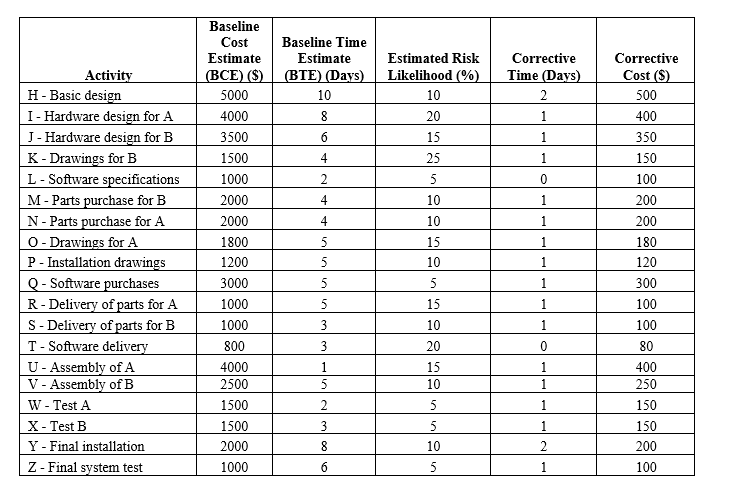
The following table presents the baseline cost and time estimates BCE and BTE along with the estimated costs and time required to address potential failures and the likelihood of failure for each activity: picture
You are required to work in teams of up to three students. Each team should work independently to submit a report that addresses the following questions:
a Construct the Gantt Chart
b Construct the critical path diagram
c Identify the critical path
d Calculate the total slack and free slack for each activity
e Determine the expected time in days to complete the project
f Determine the expected project completion date
g Calculate the expected project cost
h Determine the risk time and risk cost for the project
I need the table of predessesor
Step by Step Solution
There are 3 Steps involved in it
1 Expert Approved Answer
Step: 1 Unlock

Question Has Been Solved by an Expert!
Get step-by-step solutions from verified subject matter experts
Step: 2 Unlock
Step: 3 Unlock
 Study Help