Question: Telecommunications engineers consider a continuous time Markov chain with three states, so the state space is S = {0,1,2} The process is at state 0
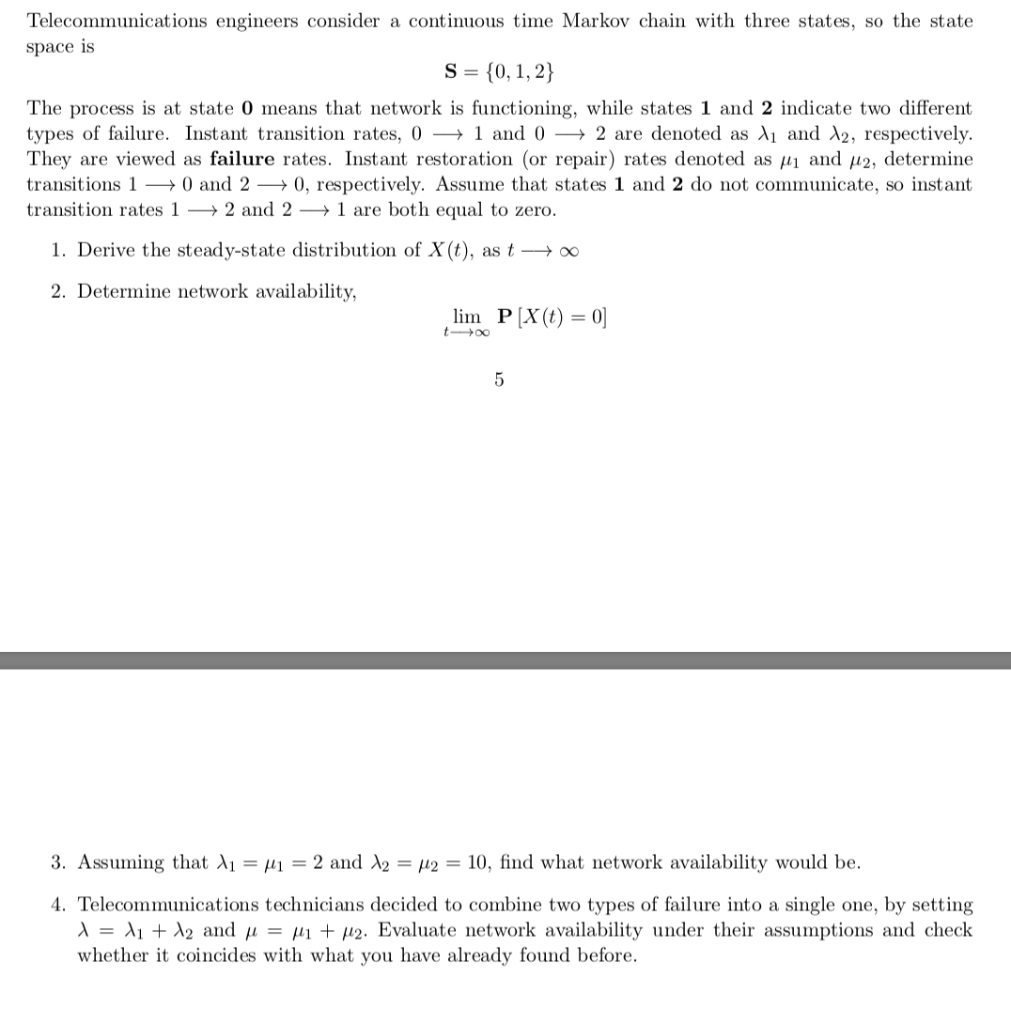
Telecommunications engineers consider a continuous time Markov chain with three states, so the state space is
S = {0,1,2}
The process is at state 0 means that network is functioning, while states 1 and 2 indicate two different types of failure. Instant transition rates, 0 1 and 0 2 are denoted as 1 and 2, respectively. They are viewed as failure rates. Instant restoration (or repair) rates denoted as 1 and 2, determine transitions 1 0 and 2 0, respectively. Assume that states 1 and 2 do not communicate, so instant transition rates 1 2 and 2 1 are both equal to zero.
1. Derive the steady-state distribution of X(t), as t
2. Determine network availability, lim t P[X(t)=0]
3. Assuming that 1 = 1 = 2 and 2 = 2 = 10, find what network availability would be.
4. Telecommunications technicians decided to combine two types of failure into a single one, by setting = 1 + 2 and = 1 + 2. Evaluate network availability under their assumptions and check whether it coincides with what you have already found before.
Telecommunications engineers consider a continuous time Markov chain with three states, so the state space is S = {0, 1, 2} The process is at state O means that network is functioning, while states 1 and 2 indicate two different types of failure. Instant transition rates, 0 = 1 and 0 2 are denoted as 11 and 12, respectively. They are viewed as failure rates. Instant restoration (or repair) rates denoted as Mi and M2, determine transitions 1 +0 and 2 + 0, respectively. Assume that states 1 and 2 do not communicate, so instant transition rates 1 + 2 and 2 1 are both equal to zero. 1. Derive the steady-state distribution of X(t), as t o 2. Determine network availability, lim P (X(t) = 0) 3. Assuming that 11 = M1 = 2 and 12 = M2 = 10, find what network availability would be. 4. Telecommunications technicians decided to combine two types of failure into a single one, by setting 1 = 11 + 12 and u = Mi + M2. Evaluate network availability under their assumptions and check whether it coincides with what you have already found before. Telecommunications engineers consider a continuous time Markov chain with three states, so the state space is S = {0, 1, 2} The process is at state O means that network is functioning, while states 1 and 2 indicate two different types of failure. Instant transition rates, 0 = 1 and 0 2 are denoted as 11 and 12, respectively. They are viewed as failure rates. Instant restoration (or repair) rates denoted as Mi and M2, determine transitions 1 +0 and 2 + 0, respectively. Assume that states 1 and 2 do not communicate, so instant transition rates 1 + 2 and 2 1 are both equal to zero. 1. Derive the steady-state distribution of X(t), as t o 2. Determine network availability, lim P (X(t) = 0) 3. Assuming that 11 = M1 = 2 and 12 = M2 = 10, find what network availability would be. 4. Telecommunications technicians decided to combine two types of failure into a single one, by setting 1 = 11 + 12 and u = Mi + M2. Evaluate network availability under their assumptions and check whether it coincides with what you have already found before









 Study Help