







Question: Term Answer Description A. The general term that describes the portion of an asset's total expected Risk return that is greater than the return earned
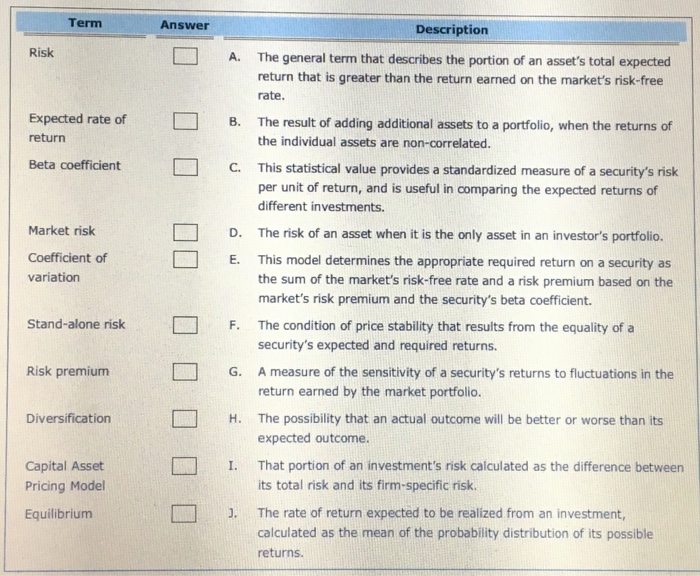
Term Answer Description A. The general term that describes the portion of an asset's total expected Risk return that is greater than the return earned on the market's risk-free rate. Expected rate of B. The result of adding additional assets to a portfolio, when the returns of return the individual assets are non-correlated. Beta coefficient C. This statistical value provides a standardized measure of a security's risk per unit of return, and is useful in comparing the expected returns of different investments. Market risk D. The risk of an asset when it is the only asset in an investor's portfolio. coefficient of E. This model determines the appropriate required return on a security as variation the sum of the market's risk-free rate and a risk premium based on the market's risk premium and the security's beta coefficient. Stand-alone risk F. The condition of price stability that results from the equality of a security's expected and required returns. G. A measure of the sensitivity of a security's returns to fluctuations in the Risk premium return earned by the market portfolio. H. The possibility that an actual outcome will be better or worse than its Diversification expected outcome. Capital Asset L I. That portion of an investment's risk calculated as the difference between its total risk and its firm specific risk. Pricing Model J. The rate of return expected to be realized from an investment, Equilibrium calculated as the mean of the probability distribution of its possible returns
Step by Step Solution
There are 3 Steps involved in it

Get step-by-step solutions from verified subject matter experts
 Study Help