







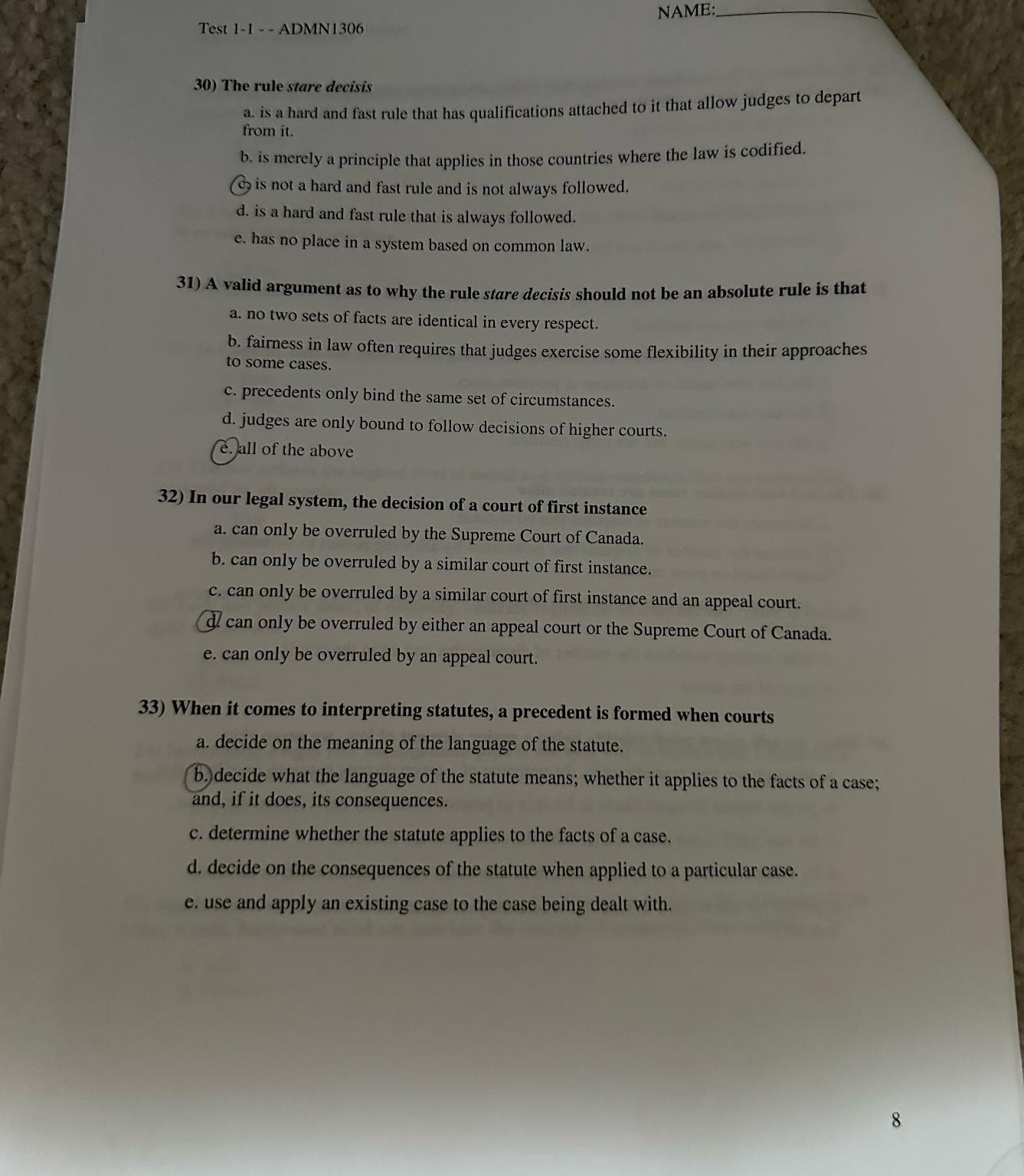
Question: Test 1 - 1 - ADMN 1 3 0 6 NAME: The rule stare decisis a . is a hard and fast rule that has
Test ADMN
NAME:
The rule stare decisis
a is a hard and fast rule that has qualifications attached to it that allow judges to depart from it
b is merely a principle that applies in those countries where the law is codified.
C is not a hard and fast rule and is not always followed.
d is a hard and fast rule that is always followed.
e has no place in a system based on common law.
A valid argument as to why the rule stare decisis should not be an absolute rule is that
a no two sets of facts are identical in every respect.
b fairness in law often requires that judges exercise some flexibility in their approaches to some cases.
c precedents only bind the same set of circumstances.
d judges are only bound to follow decisions of higher courts.
e all of the above
In our legal system, the decision of a court of first instance
a can only be overruled by the Supreme Court of Canada.
b can only be overruled by a similar court of first instance.
c can only be overruled by a similar court of first instance and an appeal court.
d can only be overruled by either an appeal court or the Supreme Court of Canada.
e can only be overruled by an appeal court.
When it comes to interpreting statutes, a precedent is formed when courts
a decide on the meaning of the language of the statute.
b decide what the language of the statute means; whether it applies to the facts of a case; and, if it does, its consequences.
c determine whether the statute applies to the facts of a case.
d decide on the consequences of the statute when applied to a particular case.
e use and apply an existing case to the case being dealt with.
Step by Step Solution
There are 3 Steps involved in it
1 Expert Approved Answer
Step: 1 Unlock

Question Has Been Solved by an Expert!
Get step-by-step solutions from verified subject matter experts
Step: 2 Unlock
Step: 3 Unlock
 Study Help